Interview (Part 2): Michael R. Perry
Michael R. Perry has had a long and productive career in Hollywood writing and producing 1-hour TV including such series as Millennium, Law & Order: Special Victims Unit, The Guardian, Stephen King’s Dead Zone, and The River. He has also written movies including Paranormal Activity 2 and his latest The Voices, based on his 2009 Black List script. The movie rolls out in theaters and on VOD beginning Friday, February 6.
Today in Part 2, Michael discusses what he learned from working with the likes of Chris Carter, David Kelley, and David Milch, and what the inspiration was for his new movie The Voices:
Michael: David Kelley taught me that no matter what you’ve written, it’s what winds up on film that carries the day. He watched dailies like no one else I’ve ever seen, observing the chemistry between actors and reacting to it. If a guest character was fantastically charismatic on day one of shooting, the next rewrite might expand the role. He also had a slightly mystical, intuitive writing process. On Season One of The Practice, I asked him, “what’s Bobby’s house like, we’re writing a scene that’s set there.” He said, “I don’t know, I haven’t written it yet, write it the way you think it should be and we’ll go from there.” He wrote voraciously; one time he went away for a weekend vacation and come back with a new script, because he’d had an idea on the plane and wanted to put it on paper.
Chris Carter taught me that all the heavy lifting is in breaking the story. We would often spend far longer breaking a story on “Millennium” than it took to shoot and edit the episode! We used index cards on a cork board, one card per scene. Vince Gilligan carried that tradition forward onto “Breaking Bad.”
Chris also taught me how to produce. He sends writers to the production office (in my case, in beautiful Vancouver!) and has them troubleshoot and make decisions about how to realize the episode at casting sessions, in the production meeting, at the tech scout, during the shoot, in the editing room and on the scoring stage. At some point I called him during some mini-crisis during a shoot, and I explained the situation to him. He could have said “do this,” which would have been crippling. Instead, he said “you will be able to figure it out.” Nothing has been more terrifying or more liberating. He threw me in over my head, knowing I would be able to swim.
Learning to produce made me a much better writer, because I know how a script is read by an actor, a director, a cinematographer, a location scout, etc. They are the first audience, and they want to take the ride! If your script engages them emotionally and intellectually, they can translate those feelings into film.
David Milch taught me to read everything aloud. Dialogue that looks great on the page can sound terrible aloud and vise-versa. Say it. Say it again. This includes the descriptive passages!
Scott: Since you broke into the business in 1991, there has been a sea change in the TV landscape, specifically a 1000% increase in the number of scripted cable TV series since 1999. In your view, what’s behind that and what does the future hold?
Michael: 1994, I start in one-hour television just as agencies, studios and networks declare “one hour television is dead.” Because syndication values were much higher for half-hour sitcoms, a belief circulated that those were the last days of one-hours, that within a couple years there would be only half-hour shows on television. I thought: I better make the best of it.
Cut to, six years later. In 2000, Robert Palm, exec producer of “Law & Order: Special Victims Unit” pointed to a story in Variety that said ABC would show “Who Wants to be A Millionaire” five nights a week. “We’re dinosaurs, Michael,” he said, and suggested there might only be a couple years left for one-hour drama, that we’d be looking for some other line of work.
Cut to, 2015: I never believe anyone’s prediction any more. I stick to the writing, with the belief that, if it’s good, it will find a home. I met with Lindsay Sloane last fall and she said there are 52 outlets for one-hour drama. If you write it, they will come.
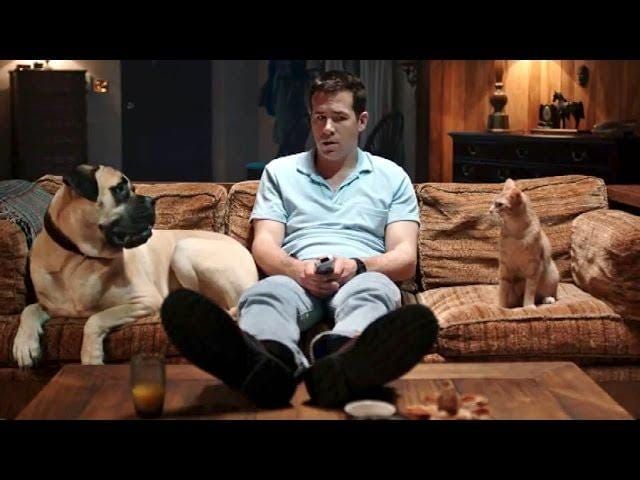
Scott: Let’s talk about your new movie The Voices, starring Ryan Reynolds, Gemma Arterton, and Anna Kendrick, directed by Marjane Satrapi. Here is a plot summary:
“A mentally ill factory worker stumbles innocently into the role of a killer, guided along the way by his evil talking cat and benevolent talking dog.”
That brings to mind David Berkowitz, a k a Son of Sam who shot and killed six people in 1977, claiming a demon who had possessed a neighbor’s dog had commanded him to commit the crimes. Did that have anything to do with your inspiration for The Voices? If not, what was the origin of this story idea?
Michael: Who hears Voices? Practically everyone. We’re all writers here, we can admit it, right?
Let’s put this right up front: who has voices running through his head, all day long, muttering them aloud, arguing with them, poking them to see if they’re believable, interesting or funny, pitting them against each other? A writer of fiction, whether of TV, movies or novels. It’s the job to have your psyche on a lend-lease program with people who don’t really exist.
There is a little Berkowitz in Jerry, perhaps, but I don’t really believe Sam the dog was talking to him, and even if he were, Berkowitz is still culpable for the murders! (Some reports said that Berkowitz was feigning hearing voices, in order to cop an insanity plea.)
There’s a bit of Ed Kemper, too: a court-appointed psychiatrist pronounced him mentally sound and free to go without supervision — while outside, in the trunk of his car, were two severed heads. I always wondered how a guy could appear so friendly to a professional when right outside the door was proof he was dangerous.
There’s some Dennis Nilsen, too: he kept dead bodies around his house because he said they made him feel less lonely. That seemed so sad and strange, I wanted to know if it were possible to convey that sentiment on film, the way he experienced it.
Scott: The Protagonist of The Voices is Jerry, played by Ryan Reynolds. How would you describe Jerry in terms of what’s going on with him psychologically?
Michael: I love movies, television shows & books about mental illness, always have, everything from Sybil (book and TV movie, teleplay by Stewart Stern) to Olive Kitteridge (brilliant Jane Anderson script!) But I feel it’s unfair to tell the story of someone whose perception is so different from our own from a neutral, third-person position of privilege. I want the viewer to walk the walk with Jerry.
Jerry hears voices. As his psychiatrist tells him, “lots of people hear voices,” and that’s absolutely true. I never used any clinical term to describe Jerry’s condition because I feel that it would pollute the perception of him as a fully-fledged member of the human race. Some reviewers misuse the term “schizophrenic” which is archaic; that diagnosis is not even in the DSM-V. Jerry’s just a guy, and I want to be able to identify with him without labels, to ask the question, “what would that be like?” with empathy and understanding, rather than condescension.
What’s going on with him psychologically is that he hears voices that are so real to him, they seem to be coming from outside his body: from his cat, his dog, etc. His mother had the same worldview and paid heavily for revealing it to authorities. So, Jerry struggles the best he can to navigate the world in this condition.
I feel that many other stories about mental illness end with someone being saved by the love of a good woman (or man, or sensitive doctor) which rings false. The choices available to a guy like Jerry are limited, and I wanted to start out with the celebration of his success: he’s proud to have a job, to have an apartment, to have been asked to help on a picnic, to have a crush on a girl. For Jerry, it’s a joyous achievement. But it’s on fragile footing … and that’s where the tragedy begins.
Tomorrow in Part 3, Michael digs more deeply into the creative choices he made in writing The Voices.
For Part 1, go here.
Michael is repped by UTA and Kaplan / Perrone Entertainment.
The Voices opens in theaters and on VOD on February 6.