Interview (Part 3): Michael R. Perry
Michael R. Perry has had a long and productive career in Hollywood writing and producing 1-hour TV including such series as Millennium, Law & Order: Special Victims Unit, The Guardian, Stephen King’s Dead Zone, and The River. He has also written movies including Paranormal Activity 2 and his latest The Voices, based on his 2009 Black List script. The movie rolls out in theaters and on VOD beginning Friday, February 6.
Today in Part 3, Michael digs more deeply into the creative choices he made in writing The Voices:
Scott: Ryan Reynolds is quoted as saying one of the reasons he was attracted to the role of Jerry is the character’s dual natures: angel and devil on his shoulders, voiced by Mr. Whiskers and Bosco. How did those characters evolve into being?
Michael: Mr. Whiskers is a melange of the real things a cat might think as he goes through his day (where’s my food? I love killing birds, etc.) and the vicious voice of a condemning parent in Jerry’s mind, that voice that speaks quietly or loudly in many people, that says “you’re going to fail, you’re not good enough,” etc. As I write this answer, perhaps part of my brain says “who the hell wants to hear your half-assed psychological observations? It’s a stupid talking cat movie, people want to laugh, get over yourself,” — but I ignore it. Jerry can’t ignore that voice; it’s real, and it’s coming from outside him, and in his case, it seems to come from his cat: the voice of fear, resentment, failure, and taboo ideas.
Bosco is a mash-up of things a dog “thinks” (“let’s go for a walk, I love you, man!”) and the instinct for self-love within Jerry, the sense that he matters, that his life has meaning, that he’s valuable. It comes in quieter moments, when he’s happy, when fear and uncertainty have abated somewhat; it can also come on the defensive, in response to the vicious things Mr. Whiskers says.
Scott: You not only have talking cats and dogs, there are talking heads, and I mean that quite literally. Do you remember how that aspect of the story emerged?
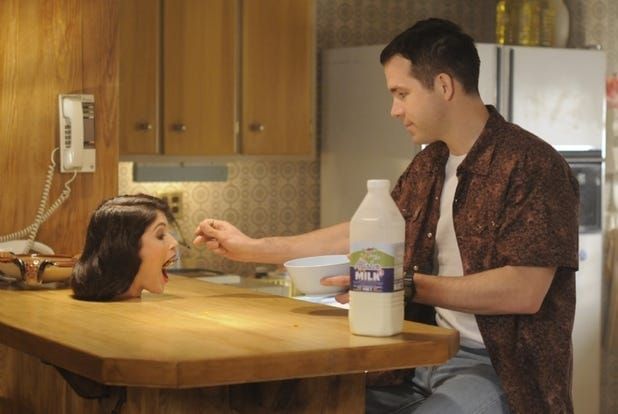
Michael: Before I wrote the first word I wanted to fully commit to seeing the world through Jerry’s eyes. I even wrote it the way Jerry would have written a screenplay: on a 99-cent store notebook with a four-pack of 99-cent store pencils. When I imagined Jerry feeling remorse and guilt about what he’d done, I realized nowhere would that sense be stronger than when he was looking at Fiona’s head.
She became an important voice in the choir of his conscience (although everything she says, after she dies, is really Jerry. Her “Britishness” post-mortem consists of the most ridiculous and corny British-sounding phrases that Jerry might know. The brilliant Gemma Arterton nailed that aspect of the performance, too!)
Scott: As the story plays out, it’s like there are two worlds: There is the real world outside Jerry’s house and the fantasy world of Jerry’s imagination inside his house. Can you walk us through your thought process on how you landed on those ‘rules’ relating to Jerry’s interface with the world?
Michael: It was 100% intuitive. I knew that from frame one I wanted to see the world through Jerry’s eyes; my working title was “Jerry’s World.” Wondering about Nilsen and Kemper and others of their ilk, who seemed to be happy enough while living in horrific circumstances, suggested that he sees something other than what’s there. I just started writing it down.
All too often, insanity in a movie is portrayed by lots of jumping up and down and tearing of hair and shouting and muttering. But, it’s also insane to be in appalling circumstances and not see it at all. Watch Hoarders, and they all seem like perfectly lovely people, often with good jobs and haircuts … until you step into their lair, and while everyone else is fighting off vomit, the hoarder-of-the-week is making small talk and offering to brew a pot of tea.
The rules were: Jerry’s world is perfect but slightly off-center; when he’s on his meds it’s a grim, sad, horrific place. Marjane Satrapi, Maxime Alexandre and Udo Kramer spent three months of pre-production and the entire shoot translating that idea into specific, expressive visuals that never leave the viewer wondering where they are at any moment.
Scott: For a movie with dark humor, such as The Voices, getting the tone just right is critical. Did you find that tone early or was it trial and error type thing during the drafting process?
Michael: I knew the tone from the first page, but polishing and honing it so that it was instantly recognizable to a reader took some time.
Scott: How many drafts of the script did you write before it went out to buyers and over how long a period of time?
Michael: Three, over about a year. (It was interrupted by a job!)
Scott: You shot the movie in Berlin. What was that like?
Michael: Incredible. Fantastisch! Our aesthetic great-grandfather is probably The Cabinet of Dr. Caligari (which spell check inanely wants to retitle “Dr. Calgary”) and “The Voices” was produced on the same lot — Studio Babelsberg. It was a dream come true, to see Jerry’s altered vision of the world built by great German artists under Marjane Satrapi’s brilliant leadership. Because 99% of the movie is subjective POV, world-through-Jerry’s-eyes, it had to be built, and everyone on the crew understood this and helped to make his delusion a filmable reality.
Scott: The script for The Voices made the 2009 Black List. Did making the Black List give the project a boost in terms of moving it forward to production?
Michael: Of course it helped! Roy Lee was on-board before the Black List, and that was a critical bit of good fortune, because he wanted to produce it, knew it would be difficult, and wasn’t going to let anything stand in his way. But: being on the Black List allowed people to admit that they liked it! I think there was a subset of people who read it, who thought, “oh, my God, I like this, what is wrong with me?” and when they found out many people liked it, they could come out of the closet. It gave the script a much broader readership, and helped artists like Marjane Satrapi and Ryan Reynolds get the support they needed to make the movie.
Scott: The movie opens on February 6th in select theaters and VOD. Looking back on the entire process, what are some of your thoughts as the movie is finally going to reach a viewing audience?
Michael: THRILLED! My thoughts are: go see it! Get it on V.O.D.! Post about it! I recommend seeing it with an audience if you possibly can, because it’s quite a ride.
Tomorrow in Part 4, Michael answers some writing craft questions.
For Part 1, go here.
Part 2, here.
Michael is repped by UTA and Kaplan / Perrone Entertainment.
The Voices opens in theaters and on VOD on February 6.