Interview (Part 4): Aaron Guzikowski (“Prisoners”)
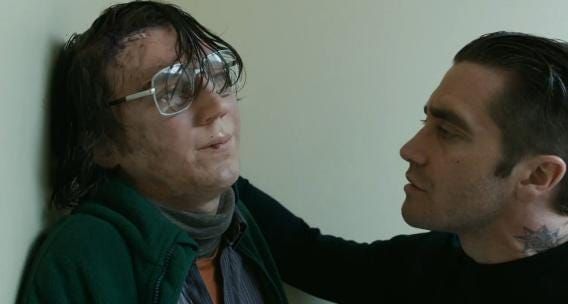
One of the best movies of 2013 was Prisoners, written by Aaron Guzikowski, directed by Denis Villeneuve, and starring Hugh Jackman and Jake Gyllenhaal. So I was thrilled to have the opportunity to have an hour-long conversation with Aaron about his background as a writer, his work on Prisoners, his involvement in the new Sundance Channel TV series “The Red Road” and his thoughts on the craft of screenwriting.
Today in Part 4, Aaron digs into the mindsets of the two lead characters, Keller and Loki:
Scott: One of the stellar things about the movie is the layers you provide to the characters in terms of their motivation. For example, Keller, in the first line in the movie as he’s talking to his son about his father, says, “The most important thing your grandfather taught me is to be ready.”
Aaron: Right.
Scott: Then his daughter gets kidnapped essentially right from under his nose. I was thinking about that character and what he would feel, a sense of shame. Then I was reading in the script where there is this accusation by his wife, “You said you could protect us from anything.” Then, in the scene description, you literally have, “He looks sickened with shame.” Could you talk about that as a motivating dynamic for his character?
Aaron: Yeah. It’s basically what you said. You have this guy whose whole philosophy is built on this idea of being able to protect his family, being able to provide for them and to be ready for whatever the world might throw at them. Then to have this happen in addition to just the pain of not knowing where his daughter is, there’s this added layer of failure and shame.
He is this guy who, on the surface, seems so completely capable and unshakable. Yet, his daughter is gone and his wife is falling apart. All of these preparations he’s made have all been for not. That works really well to just drive him to these extreme places in order to try and get back to where he believes he needs to be.
Scott: Arguably the most central motif of the movie is torture, how far a parent will go to try and save their child. What about that theme interested you?
Aaron: I think any pressure that actually causes people to change and behave in ways that are totally different than how they would normally. It’s always interesting inside of a movie like this or any movie. I think this is such an extreme form of that, the way that it infuses everything with this added layer of electricity, tension, and anxiety. I think that’s what attracted it to me, all things that make a great thriller.
Which was my goal, try and write something that was at the end of the day, just really visceral. A thriller that’s about something, but definitely at the end of the day it’s a movie that just chugs along. It’s a machine in terms of making people feel uneasy. Then taking them on a ride and having that good old fashion thriller experience.
Scott: One of the key turning points is after Keller has taken Alex, and then he’s brought the other father, Franklin, and shown him what he’s done. Keller says this about Alex: “He lost his right to be considered a human when he took our children.”
It reminded me ‑ you mentioned Silence of the Lambs — how Buffalo Bill dehumanizes his kidnap victim Catherine Martin. We see that when he refers to her not as “you,” but “it.” “It puts the lotion on its skin,” right? A similar dynamic here where essentially Keller has said this character, Alex, has lost his humanity, right?
Aaron: Yeah. I think certain characters are able to do that. They have this control over their own mind and perception, that they can just make a decision to see something a certain way. They can just go with it.
Keller has that extreme force of will that allows him then to stop. He has this cold logic and it makes perfect sense to any parent. After having done this, this person has forfeited their right to be a human being. That’s always a hell of a thing. [laughs]
Scott: There’s a Pandora’s Box dynamic. First, it’s Keller and Alex, then Keller, Franklin, and Alex, and then Nancy, Keller, Franklin, and Alex. There is this tension of basically how much this scenario will grow, how many people will find out what’s happened. Do you remember how that dynamic evolved as you developed the story?
Aaron: It was pretty organic. I always thought of it like this plague, what Keller is doing. This form of violence and darkness just keeps spreading. That anyone who touches it is infected by it. There was never any plan in terms of how that all was going to work. I think the characters, after having figured out who these people were, that informed what decisions they would make. That dictated how things would evolve in terms of the story.
Scott: Pivoting a bit and looking at the story from Loki’s perspective, at some point, he begins to suspect that Keller has done something wrong and they get into an adversarial relationship. Do you remember, early on in the process, what the inspiration was in that shift in the narrative and how that happened?
Aaron: It was very early on. Even when it wasn’t a two‑hander and Loki was just a minor character. Not a minor character, but certainly not as big a character as he is now. There was always this thing where the father for some reason, was just rubbed the wrong way by this guy, and in no way had any faith that he was going to find his daughter.
Loki was always this strange presence in terms of his social interaction with other people. He has a hard time in terms of relating to people and he’s very internal in a weird way. Then there’s just something about him that makes people uneasy. That combination of facts just caused these guys to instantly not get on very well.
Scott: One thing you did that was quite interesting in Prisoners is you’ve got these series of what would ostensibly be red herrings. There’s the priest, there’s Alex, there’s Bob Taylor, and there’s a corpse in the priest’s basement.
What you did was great. You tied all of them together. It’s not like any of them is just a fabricated dead end, they’re all tied to this one central event. I’m curious how important was it for you to bring all of that together into this one narrative?
Aaron: I always knew that I needed to have Mr. X. I didn’t want to have a cheap type Mr. X. As you said, I wanted everything to be part of the same fabric. I always had the basic landscape of this whole world sort of figured out, and then it was just a matter of figuring out which pieces of it to employ to create these dead ends, but dead ends that actually are important in their own way once you get to see them in a certain light.
I don’t know. It’s hard to look back and figure out what the order of figuring that stuff out was, but I think a lot of it was you figure out the larger story, and then you just go over it with a microscope, and you find these little pieces of the story that, when taken out of context, become these dramatic misdirects.
Scott: You have an interesting beat with Loki where at some point he does his own little mini‑version of torture when he assaults Bob Taylor.
Aaron: Yes, it’s interesting, because in a lot of ways Keller and Loki are somewhat alike, and they both have this pent‑up violent side. Loki, like Keller, is also playing into the reason these children are being taken, which is, as the Holly Jones character states at the end, to turn the people who are searching for them into demons, to make people lose their faith and start behaving like monsters.
Tomorrow in Part 5, Aaron shares his feelings about the critical and box office success of Prisoners and his new TV series “The Red Road.”
For Part 1, go here.
Part 2, go here.
Part 3, go here.
Aaron is repped by Verve and Madhouse Entertainment.