Interview (Part 4): Eric Heisserer (2012, 2014 Black List)
This weekend, the horror movie Lights Out rolls out in movie theaters across North America. Starring Teresa Palmer and Maria Bello, directed by David F. Sandberg, the screenplay was written by Eric Heisserer. I thought it was a good opportunity to reprise a 2013 interview I did with Eric and reach out to him with some questions about Lights Out.
Today in Part 4, Eric talks about the challenges of directing his first movie and the script he wrote “Story Of Your Life” which made the 2012 Black List:
Scott: Let’s talk about directing the film. You mentioned the three big no-no’s of production: No kids, no animals, no water. With Hours, you have all three. How challenging was it for you as a first directing effort?
Eric: Because I survived it I feel like I could go back and do it again. If it had broken me then obviously I’d be singing a different song. What saved me the most was not knowing how difficult those elements would be. I had no stigma attached to some of these situations like dealing with infants or dogs or flooding. Because I was unaware of the magnitude of the difficulty or what a hassle it could be I sort of plowed ahead and said, “No, we can do this.” I was the voice of optimism right up until the time it dawned on me exactly why everyone was nervous. By then it was too late. One of my producers on set said to me was, “Eric, what’s great about you is you don’t know what you don’t know.”
I think that’s what really what saved the whole movie is we kept shooting and we kept plowing through. That statement was kind of a compliment.
Scott: Apart from the difficulty of working with animals, babies, water, what did you learn as a writer from your directing experiences?
Eric: I learned that directors have it a lot harder than we think they do. I learned how vitally important it is to write a script to be shot. That is to make sure that whatever it is that you’re writing is a cinematic experience, designed as a transitory document to get to the final product of the movie. Then you’re going to find things after you’ve shot it that you need to move around or change in order to tell the ultimate version of the story.
I’ve written scripts before that I would say could be perceived as good reads. You know, they pop off the page, they’re a literary experience. But having directed now and gone back and looked at those older scripts I can tell you that they really were not written to be shot. That’s my new mantra, my new mission is that whatever I write, I’m writing something that, in reading, the director knows exactly what kind of movie it is.
Scott: You’re heading out to South by Southwest for the debut of the movie?
Eric: Yeah, in a week and a half.
Scott: What’s it feel like to be approaching the premiere of the first movie you wrote and directed?
Eric: It’s pretty exciting. I’m just thrilled to show off Paul Walker’s performance. I’m really proud of him and I’m excited for what this might do for his career.
Scott: OK. I’d like to move to another story you are writing, another great script, Story of Your Life, an adaptation of a short story by Ted Chiang. Logline provided by IMDB:
“A linguist is recruited by the military to assist in translating alien communications.” How did you get involved in that project?
Eric: I’ve been a fan of Ted Chiang’s for years now and I carried around with me his anthology book like it was a Bible for a long while. One of the questions you get from producers on the “bottled water tour” of general meetings is, “Do you have any material you’re passionate about, maybe we can turn it into a movie?” People are always looking for that. I’d trumpeted Ted Chang and “Story of Your Life” as something I’d been excited about adapting for a long while.
But it’s science fiction and intellectual, so it’s a hard sell. I find the word “intellectual” scares off a lot of people in this town. It took years for me to find producers who actually read the story and understood some of the big revelations in it, and emotionally responded to it. I found it with the two Dans at 21 Laps, Dan Cohen and Dan Levine.
We teamed up and began the arduous journey of getting this movie made. It began with getting the rights of the story from Ted who was understandably wary. Because Hollywood loves alien invasion movies with lots of explosions and humanity as the scrappy underdog. This story was definitely not that.
Once we convinced Ted we were seeking a faithful adaptation, I then began to work the script on spec and wrote that for about a year before it was ready to go out. Thankfully we found a studio who believed in the project as passionately as we do.
Scott: You mention science fiction and intelligence and that made people nervous. It’s also got a female lead. Maybe you can talk about that. Have you ever worked with a female protagonist before in your writing?
Eric: I’ve written unproduced scripts like that before and some could say Nancy from Nightmare in Elm Street is the female protagonist. It’s one of the reasons I was so attracted to the story in the first place. I was hungry to do a movie with a female lead. I feel that there are not enough of those stories. Certainly there are actresses out there now fully capable of playing those roles. But yeah, there were plenty of studios that were discouraged by that. We got notes from a couple of studios that said, “If you’d change this to a male lead we’d be more interested.” But thankfully we stuck to our guns and we’re pretty proud of what we have.
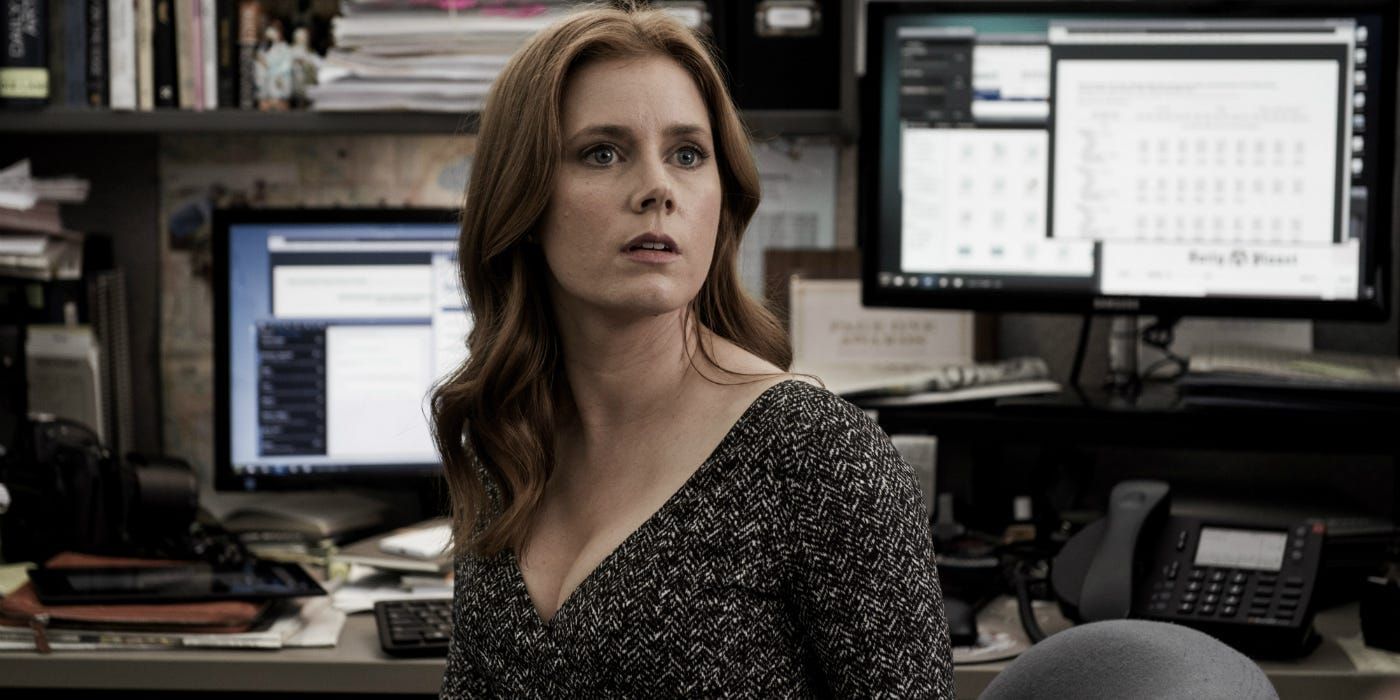
Amy Adams in Arrival a k a “Story of Your Life”
Scott: A key narrative element is humans and aliens learning each other’s languages. As a writer, someone who works with words every day, I imagine you may have had a special affinity for this aspect of the story.
Eric: Very much, yeah. It’s easy to become hyper‑critical and hyper aware of your own writing so that was a dangerous rabbit hole for me.
Scott: Oftentimes I’ve noticed with movies involving aliens, they either (A) somehow already know a language, (B) they got some sort of translator device or © they get exposed to something like TV into a rapid downloadable language like E.T.. But Story of Your Life has a realism to it and learning a language is a very slow methodical step by step process. How much of a challenge was that for you to make that process as entertaining as you did in the script?
Eric: I think that was one of the things that came rather easily. Some of that was just lifted right from Ted’s gorgeous source material. Some if it was based on anecdotes that I’d heard from my father who was professor of ancient history at OU for 30 years. He had lots of little anecdotes that I’d collected over the years. Some of those worked their way into the script. I was more worried about how to make the movie escalate properly and realistically while still adhering to a natural three-act structure that movies need.
Scott: Story of Your Life made the 2012 Black List. What were the circumstances by which you found out you made it?
Eric: I imagine there were people out there who thought that had to have been a typo. “How could the guy who wrote Nightmare in Elm Street be on the Black List?” I grew up in a time when the same guy who wrote Carpenter’s “The Thing” also wrote “The Bad News Bears.” I came from a time where people weren’t monogamous to one genre. I hope the public at large will be curious and respecting of these different ventures. I guess I’m about to find out with South by Southwest in a few weeks.
Scott: Has being on the Black List benefited you either personally or professionally, or giving your projects more momentum?
Eric: It’s been beneficial to me in that it has reframed…what am I looking for? It’s broken me out of whatever box that I was put in before. I’m no longer seen as just a horror writer. I can compete for other writing jobs I’m passionate about that I wouldn’t otherwise have a chance with. So I’m grateful for that. What I’m most thrilled with is getting to meet other Black List writers and just talking about the craft and the business with them. There’s some extraordinary talent out there that I’m excited to be able to socialize with, to network with. Like Ryan Condall, and Scott Frazier, and Young Kim, these guys are cool. I’m thrilled to see the kind of voice that they bring to their writing and ultimately to the movies.
Here is my another question to Eric about Lights Out and his response:
Scott: James Wan has written, directed, and/or produced a slew of horror-thriller movies including Saw, Annabelle, Insidious, and The Conjuring, and he is a producer on Lights Out. What was it like to work with him? How did your collaborative process help shape the story of Lights Out?
Eric: James had his hands full with post-production on Furious 7, and yet he continued to carve out time early on for us. What I love most about James is how readily he shares all his lessons learned working in horror, his tips and his caveats. It was James who showed me how you craft scares in a chain, linking three or more together in a sequence the way you do a seduction scene in a romance, or a dance number in a musical. He was our wise Jedi mentor.
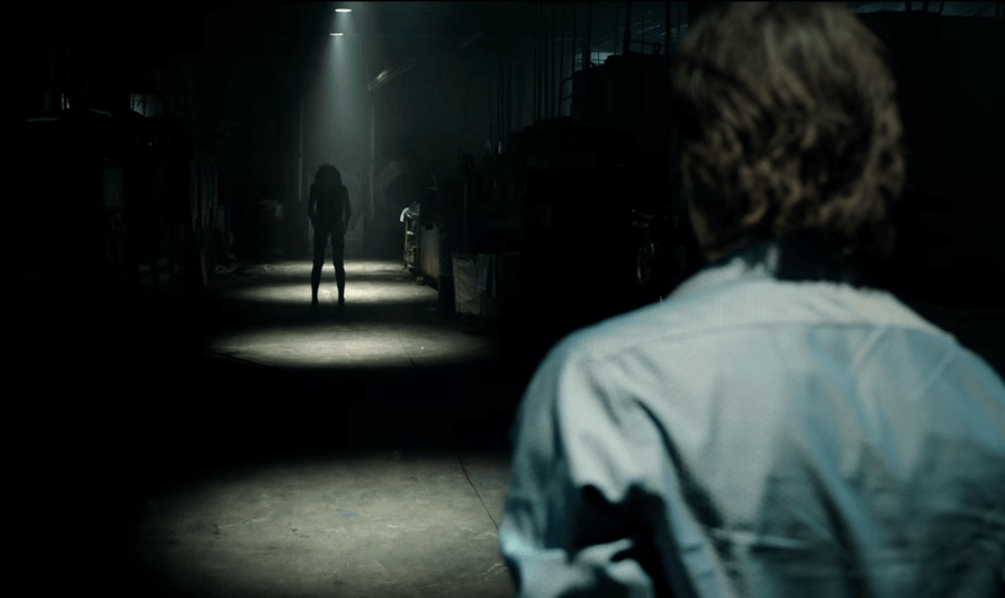
A shot from Lights Out
Tomorrow in Part 5, Eric reveals some of his keys to the craft of screenwriting.
For Part 1 of the interview, go here.
Part 2, here.
Part 3, here.
Eric is repped by UTA and Art/Work Entertainment.
Twitter: @HIGHzurrer.