Interview (Written): Adam McKay and Charles Randolph (“The Big Short”)
A WGA interview with The Big Short director and co-writer Adam McKay and co-writer Charles Randolph. This week, the pair got nominated for a Best Adapted Screenplay Oscar for the movie’s script.
On the surface, McKay and Randolph are as alike as calculus and fruit punch. The former is a fleet-footed, quick-witted Philly native who dropped out of Penn State one semester shy of his B.A., moved to Chicago to do stand-up comedy (often pelted by bottle caps chucked by drunken audience members), then co-founded the legendary Upright Citizens Brigade. (You might have already heard about his work on Saturday Night Live, where he wrote or co-wrote some of the show’s greatest sketches, not to mention the run of box office hits he’s made with buddy Ferrell). Randolph, on the other hand, is an erudite, book-smart Nashville baby who marched earnestly into the world of academia with a penchant for philosophy and pop culture, who might still be pricing corduroy blazers and biographies of Emmanuel Kant at the campus bookstore were it not for a serendipitous collision with the Farrelly Brothers on the USC campus in the early 1990s. Which gentleman is chocolate and which is peanut butter is anyone’s guess, even to them.
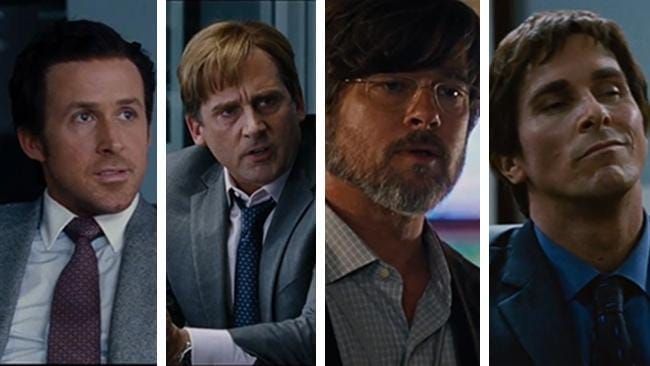
Ryan Gosling, Steve Carell, Brad Pitt, Christian Bale, stars of The Big Short
Centuries ago, Sir Philip Sidney said that the purpose of art is to instruct and delight. Adam, you’ve been delighting film audiences for decades, but with The Big Short, you’ve come around to instructing them as well.
Adam McKay: Well, this is a true story about a horrible, horrible part of our country’s recent history, so it kind of inherently has to be instructive — but that doesn’t mean it has to choke audiences or put them to sleep. We started with Michael Lewis’ book, which already has a real cinematic quality to it (which is one of the things that makes Lewis so great), and then Charles did the first adaptation, which was also amazing, and then I was brought on and that began what was a very odd collaboration between Charles and me. We had a number of chocolate-and-peanut-butter moments, working together. The end result has a lot of energy and these really amazing characters. I hope the “instruct” part doesn’t feel too instructive to audiences; we worked really hard to serve the information to audiences as the main characters were receiving it themselves. And to me, one of the funny things about these characters is that they are in the middle of doing horrible things, but they kind of don’t know it at the time. Some of them at least.
Charles, you were the first hire to write the film. Tell me about that.
Charles Randolph: I bought Michael’s book when it first came out, and I loved it. I’ve loved all of his books, and what I loved in The Big Short, as always in his books, is Lewis’ ability to explain this incredibly complicated world and have these extraordinary characters somehow always say, “Dammit, we can do this ourselves,” whatever “this” might be. That was really exciting to me — as a reader first, but as a writer. So the early drafts were working very loyally with the basic framework Lewis had laid out in the book. Everybody was happy with it, except nobody really could figure out how to justify making it. So then Adam came in and he brought with him this utterly fantastic authorial voice. The interstitial sequences in the film, the breaking of the fourth wall, these are sweet spots in Adam McKay’s creative register, and it really gave the script tremendous energy.
Adam McKay: The wall, basically, that Charles’ draft had hit was, through no fault of his own, it was really a wonderful draft, and there are so many great things Charles wrote, but the studio wasn’t sure about the characters: “Are these guys heroes? Are they villains? Is it going to be hard watching these guys making money from this scam?” I, personally, was never bothered by that ambiguity, and I don’t think Charles was either. We like that ambiguity. It’s the thing writers are always fighting to keep in their scripts. But the draft I did, basically, I sort of scraped off the “movie” skin of it and turned the thing into more of a conversation with the audience. It softened things just a little bit, and the studio wasn’t quite as concerned after that. It also helped when we got Christian Bale and Ryan Gosling!
Charles Randolph: That’s probably true! What Adam added is an authorial voice to the characters, a voice that we could trust. He added this level of consciousness and conscience to the film, and we identify with that consciousness as much as we do the characters themselves. That just feels secure for audiences, even when the characters behave badly. That kind of authority in a writer’s voice, it invites audiences to come along to whatever places we want to take them, and they trust they will not be tricked or treated, emotionally or story-wise. It comes from his background in stand-up comedy and improvisation, in his ability to feel where an audience is at any given moment. In some weird way, that energy really became the driving voice of the film, the driving center of the narrative, and it really solved the problems that we were having getting the script made. What Adam did made all the difference in the world.
If you haven’t seen The Big Short, you absolutely should. McKay and Randolph manage to put a human face on a complex subject while making it both entertaining and informative.
For the rest of the interview, go here.