Interview (Written): Drew Goddard (“The Martian”)
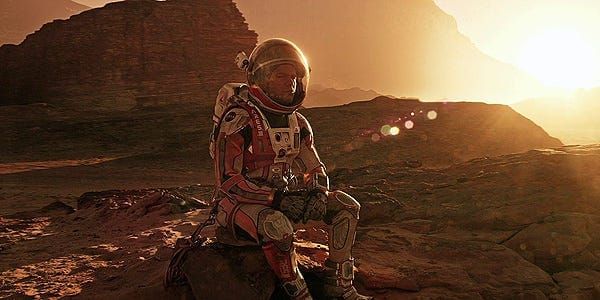
A Creative Screenwriting interview with Drew Goddard, nominated for a 2016 Academy Award for Best Adapted screenplay for The Martian:
The first act of The Martian is dominated by scenes featuring Watney on his own, and you had to balance periods of silence and Watney’s narration. Obviously there are limits to what a character can say in narration before it comes off as too wordy or too technical, especially in this movie. What was the biggest challenge with writing that act?
I think it’s exactly what you’re saying. You want to make sure there’s a reason for any time he’s talking to the camera and that’s challenging. But that was the rules we set out for ourselves. We didn’t want it to just be “Here I am to explain the movie to the audience,” which is a trap you can fall into with narration. It was much more about the scientific experiments that is the Ares mission and Mark Watney’s decision to say “You know, even though I’m stuck here I’m going to continue my work.” In that case his work was documenting how he’s trying to survive so that once they found him they would understand what happened. That’s what sets up the prism in which we’re viewing the whole movie. Once you do that, it allows you to open up outward and get more existential in the back half of the movie. That was the challenge — committing to our structure.
What sets The Martian apart from similar “survival” stories is Watney’s confident attitude. Although there are scenes where he doubts his ability to survive, his “I’m gonna have to science the shit out of this” attitude carries the film. How important was this attitude in making the audience connect with Watney?
It was certainly one of the things that attracted me to the book right away. The optimism in the face of despair felt special, like something I hadn’t quite seen before. The despair is there, but we’re just not overtly talking about it. The hope was always that the audience would start to see that his optimism is what’s keeping him alive because if he allowed fear and despair to creep in it would be overwhelming. It is a desperate situation and he’s using humor to save himself. Matt did a beautiful job of finding that balance and letting the quiet moments tell that side of the story.
I think you have to step back when you’re looking at a screenplay and ask, “Well, what is this really about?” The optimism in the face of despair is such a key part of the soul of the movie, not just for Watney but for everyone. Refusing to give in to despair becomes bigger than Matt Damon making jokes. It becomes the point of why we’re here.
For the rest of the interview, go here.
You may download the script for The Martian here.