Interview (Written): Paul Schrader
Screenwriter of noteworthy movies including Taxi Driver and Raging Bull.
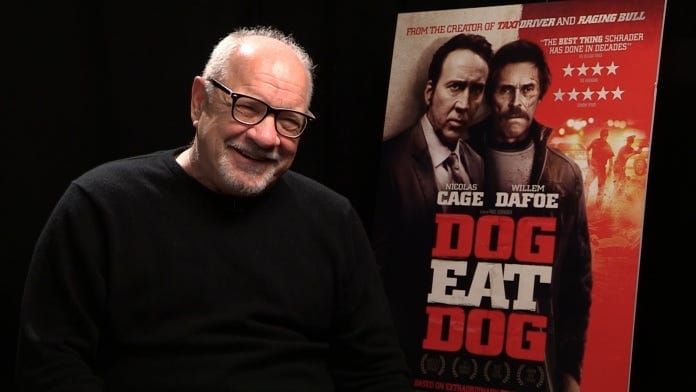
Screenwriter of noteworthy movies including Taxi Driver and Raging Bull.
A Little White Lies interview with Paul Schrader upon the release of his latest movie Dog Eat Dog.
Criticism was something of a movement back then, with internal movements of its own.
I was writing for the LA Free Press, which was a radical publication, alternative press of about 100,000 circulation. We were part of the movement, and film critics were a part of that movement too. It seems strange now. Through some odd serendipity or weird twist of fate, I got interested in intellectual movies when I was at college, in the seminary. I got interested in Bergman. I couldn’t see movies in Grand Rapids because they didn’t have theatres. So I went over the summer to Columbia University and took some courses, just so I could see films, and then by happenstance I was in a bar one night with someone and they knew Pauline Kael. We ended up having dinner with her and one thing led to another. I was a seminarian at the time, and she said to me, “You don’t wanna be a minister, you wanna be a film critic!” She got me into UCLA and got me the job at the Free Press.
Was she a big influence on your writing in the beginning?
She cast a long shadow. She had a number of acolytes — ‘Paulettes’ — but her style was pretty inimitable. Of course I was affected by it, though. One of the reasons she had power at that time was that she had these connections. I remember her calling up and saying that we have to get behind La Chinoise. So not only did she write a review, but seven or eight other reviews would get written. But then, Godard was the guy you went to the barricades for.
It’s hard to imagine a film like that getting made today.
People talk about the ‘Golden Age’ of Hollywood in the late ’60s and early ’70s. It wasn’t that the films were better or the filmmakers were better, it was the audiences that were better. It was a time of social stress and audiences turned to artists for answers. What do you think about women’s rights? What do you think about the war? The moment that a society turns to artists for answers, great art will emerge. It’s just that simple. It just happens. Back then, movies were at the centre of the cultural conversation. Bonnie and Clyde was smack in the centre, so was The Godfather. Now today, a great number of younger people, my children for example, do not think that movies are important. When audiences don’t think movies are important, it’s very hard to make important movies. That’s the difference.
For the rest of the interview, go here.