Licensing and screenwriting
The Hollywood Reporter reports that several entertainment companies continue to kick ass in a critical ‘ancillary’ revenue stream — licensing:
Entertainment companies and properties again dominated the top of the list of the 100 biggest licensing companies for 2008.
Disney Consumer Products retained the №1 spot and Warner Bros. Consumer Products stayed in third, while Marvel Entertainment and Nickelodeon/Viacom Consumer Products each gained a spot to finish fourth and fifth, respectively, according to License! Global magazine.
How much revenue are we talking?
Disney reached $30 billion in retail sales of licensed products in 2008, up from $26 billion in 2007 and $24 billion the year before, the publication said.
Evidently no recession here. To put these numbers in perspective, domestic box office for movies in 2009 is projected to break $10B for the first time. Disney alone did 3 times that much in “retail sales of licensed products” in 2008. And it’s not just Disney raking in the dough with licensed goods:
Warner Bros. and Marvel added superhero powers to the ranking. The former has stayed steady at $6 billion from 2006–08, and Marvel has grown from $4.8 billion in 2006 to $5.5 billion in 2007 and $5.7 billion last year, according to the data. Nick/Viacom repeated its $5.5 billion licensed-sales haul in 2008.
What does this mean for a screenwriter? Fact: Movies and TV drive sales of licensed goods. Disney thrives on Hannah Montana, High School Musical, the Jonas Brothers. So one direct impact, if a writer can conjure up a script as a potential starring vehicle for one of these acts, that can put the script at an advantage. Also as you try to generate great story concepts, stay cognizant of possible licensing elements. For example, there was a pitch that just sold with this premise:
An adult reminisces about his childhood and the group of stuffed animals that came to life at night.
Do you think that the “group of stuffed animals” translated into dollar bill signs in the minds of the buyers, i.e., “licensed goods?”
Those are some direct implications. Indirectly the fact that the amount of revenue for licensed goods dwarfs box office dollars influences the spec script market in this way: Whatever script you write that does not have a licensed goods element in it must be appreciably better than a script that does create licensing opportunities. Why? Because your movie has to rely on ‘traditional’ forms of revenue (e.g., domestic box office, international box office, DVD sales, cable, broadcast, etc) alone, no stuffed animals or action figures to jack up profit projections.
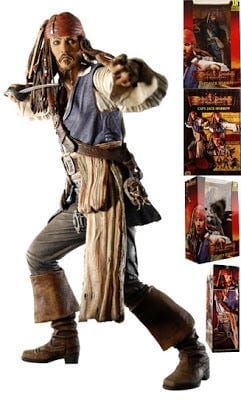
Is this yet another reason to get depressed over the state of screenwriting? No, it’s another reason for you to think creatively. There is absolutely no reason why a movie with characters who will make for licensed goods can’t be a great movie. Look at Pirates of the Caribbean. Great movie. Great characters. Great play action figures. Star Wars. Jurassic Park. Iron Man. The Dark Knight. All strong movies. All with built-in licensed goods opportunities.
So have you ever thought about your characters as potential licensed goods? Do you think that’s just too crass, too monetary? Or can a writer still be creative if they embrace how important this form of ‘ancillary’ revenue has become to movie studios?
Comment Archive