“Mad Max: Fury Road” and moments
Yesterday I posted A Story’s “Second Music”. In it, I featured a poem by Annie Lighthart, focusing on these words:
“Now I understand that there are two melodies playing, one below the other, one easier to hear, the other… lower, steady, perhaps more faithful for being less heard yet always present… I stop and stop again to hear the second music… I set my ear to it as I would to a heart.”
Off that, I wrote this:
In a screenplay, there are two melodies: The Plotline. The Themeline.
The former we see as Action and hear as Dialogue.
The latter we intuit as Intention and interpret as Subtext.
That first melody is visceral, playing to our eyes and ears.
The second melody is more… evocative… feeling… emotionally tactile.
When we write a screenplay, we give much thought and consideration to the Plotline, as we should. The events from scene to scene. Pace. Transitions. Major plot points.
That’s the first music.
We must also — and in equal fashion — pay close attention to the Themeline. The emotional life of the characters. The psychological ups and downs, ins and outs. The emergence of themes and motifs.
That’s the second music.
After I uploaded the post, I was reflecting on Mad Max: Fury Road in relation to this idea of first music and second music. The first music is… well… this:
I remember the pyrotechnics, of course, the movie’s amazing sights and sounds, the spectacle, its first music. But what impressed me, too, was its second music. There were moments. Key moments. Several of them located in precise spots throughout the story, brief breaks from the action or revelatory exchanges amidst the action, where we entered into the psychological journey of the characters.
One of the best analyses I’ve read about the movie is “This Is Our Furiosa.” Mad Max: Fury Road and the Moments In Between, by Bilge Ebiri, film critic for New York Magazine and Nerve.com. His observations speak to this point. An excerpt:
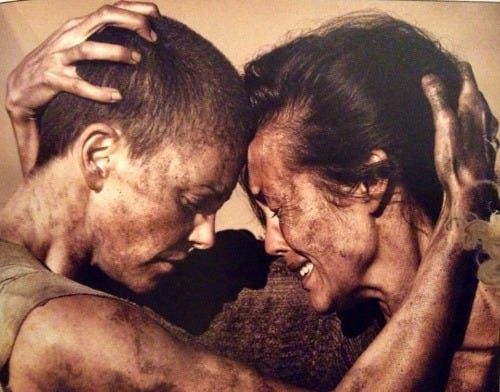
There’s a moment about two-thirds of the way through Mad Max: Fury Road that speaks to one reason why I love the film so much. It comes during one of the film’s rare quiet scenes. Max (Tom Hardy), Furiosa (Charlize Theron), and their small lot of refugees have arrived among the Vuvalini, the all-female warrior tribe from which Furiosa was stolen, along with her mother, many years ago. Most of the women remember Furiosa only dimly: She was taken, as she says, “7000 days” ago, “plus the ones I don’t remember.” They ask what happened to her mother. “She died, on the third day,” Furiosa replies. And then the Vuvalini reflexively perform a quiet, brief mourning gesture — holding a hand up, grabbing at the air, and bringing it to their chest. After seeing them, Furiosa herself slowly does the gesture as well.
This exchange lasts all of twelve seconds, and it’s probably easy to miss, or ignore, for some. But every time I see the film, it strikes me as a deceptively profound moment. Watch Theron’s performance here: As she grabs at the air, her haunted eyes watch her own hand, as if she were seeing it for the first time. Her face is that of someone remembering something that was once probably very much a part of her — not just her mother, but this whole Vuvalini ritual, and the sense of belonging it implies. She’s re-learning, in other words, the person she used to be.
We also realize that, as a captive young girl, Furiosa probably never properly got to mourn her mother. She probably couldn’t — or maybe she chose not to. At any rate, it’s clear that she put this part of herself away for a long, long time; she may not have even realized it was still there. Here, in this quiet gesture, is a world of backstory and development for those who want it. It fires the imagination — but it doesn’t insist on it. Like the best art, it empowers the viewer to drift and dream beyond the borders of the work.
This moment is an expression of the story’s second music — “I stop and stop again to hear the second music… I set my ear to it as I would to a heart” — and here the music is conveyed wordlessly and through gestures, speaking to the power of visual storytelling. More from Ebiri:
In movies like these, the absence of conventional dramatic development makes us lock in on the smallest of gestures and incidents — not out of poverty, mind you, but because great filmmakers teach us to see all over again. Their work transforms us, changes our inner rhythms and points us in all sorts of directions we may never have noticed.
Honestly, I felt more authentic human emotion in watching Mad Max: Fury Road than in all other Marvel movies combined, and that is directly due to the fact George Miller and his fellow filmmakers provide a set of key moments in which they quiet the first music of the bombastic plot and allow viewers to participate in the second music, created from the psychological experiences of central characters. Miller gives us an opportunity to identify and resonate with the feelings at work in the moment, attuning ourselves to their collective melody.
So many of the big comic book / superhero / franchise movies traffic either almost exclusively in the first music. Or if they dip into the second music, it comes across as simplistic, inauthentic, and manipulative.
Here’s to filmmakers like George Miller who with Mad Max: Fury Road has given us not only a movie that kicks ass… it also creates moments of human connection which makes the action that much more meaningful.
For the rest of Ebiri’s blog post, go here.
Comment Archive