“Money not easy for filmmakers”
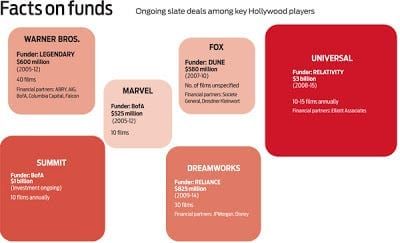
Informative article in THR yesterday about something Hwood studios are scrambling for amidst the current global economic slump — Money:
Despite a credit crunch that has wealthy investors hiding cash under their mattresses rather than risking it on films and Wall Street retreating from financing studio slates, Hollywood isn’t running out of money.
In short, a film-finance bubble that pumped billions into Hollywood during the first few years of the new millennium has popped, but the show is going on with new — and a few old — players.
Foreign investors and government entities, including U.S. states and foreign territories offering incentives, have taken up some of the slack. Plus, finance folks have hit up strategic investors including film distribution partners; rich individuals who might or might not have invested in films before; and relative newcomers to the field among financial investors, such as family foundations and pension funds.
In the 80s, Hwood milked the Japanese. In the 90s, it was the Germans. In the first decade of the new millennium, it was Wall Street:
From August 2004-August 2007, Wall Street channeled at least $11 billion into the production of about 600 films, the money coming from such famous names as Morgan Stanley, Merrill Lynch, Goldman Sachs, JPMorgan and Citibank.
“There is no way to replace all of that money,” Film Department CEO Mark Gill says. “The time of easy money is over.”
Okay, I’m not a math wizard, but $11B divided by 600 movies comes out to $183M per movie. In 2004, the average cost of producing and marketing a Hollywood movie was $102.9M. Where did the extra $80M per movie go?
I smell bailout money taking care of those deficits!
An interesting note at the end of the piece:
“We’re having to educate new investors,” says Laura Fazio, who has worked on slate deals for investment banks and now is managing director and global head of telecom, media and technology at Aladdin Capital Management. She has traveled to Asia and Europe lately because, “we all just have to go further afield.”
With battered housing and stock markets, she tries to sell film investments with the positive industry trends. “I have a great chart that shows worldwide boxoffice rising against all the major market indices,” Fazio says.
So, while things are much more sober in film financing these days compared with a few years ago, the sky isn’t falling.
Movies — still a growth industry.
What does any of this have to do with screenwriting? Plenty. Movies are a business. We need to remember that. If you want to maximize the chances of selling a spec script, you have to have some idea of the market forces at work.
Right now funding is tighter than it has been in decades. Hwood is having to go after new investors. They are more likely to play it safe. And right there you have the economic background why the studios are churning out remakes, sequels, and movies based on pre-branded products: They don’t have Goldman Sachs and Morgan Stanley around anymore to fling $183M per movie at the studios, so they’re going after what they perceive to be a ‘sure’ thing.
Given that economic atmosphere, I’d say now more than ever, it is critical to work on scripts that have a strong, marketable high concept. And since Hwood is playing it safe, look at the usual suspects in genres: Comedy, Action, Thriller.
Of course, you can go off and write whatever you want and still sell it — if it’s an absolutely head-turning great script. But in this climate, choosing to work on a strong high concept in one of Hwood’s most popular genres is probably a smart move.
Comment Archive