Movie Analysis: “Edge of Tomorrow”
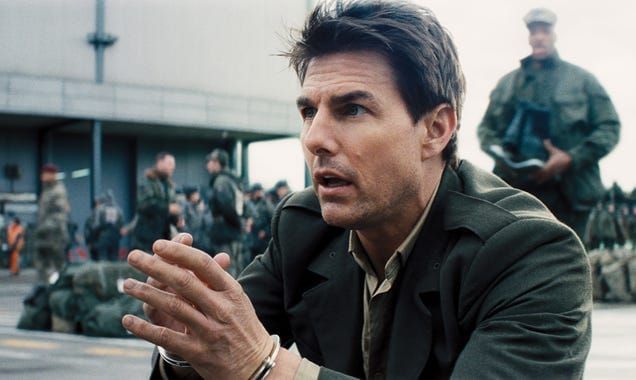
I wanted to knock out some thoughts on Edge of Tomorrow as quickly as possible because based on its so-so box office, I’m afraid the movie won’t be in theaters here in the States too much longer… which is a shame because it’s perhaps the best science fiction movie I’ve seen since The Matrix. If you’re a fan of the genre and want to experience an entertaining, intelligent, emotionally resonant, character-driven movie, you really should go check out Edge of Tomorrow.
For those of you who have seen the movie, I have some initial thoughts on it below. If you have not seen it, do not click on More because there are tons of spoilers.
It’s impossible to start any discussion of the movie without acknowledging Groundhog Day because both movies have essentially the same conceptual premise. Here is a Groundhog Day plot summary from IMDB:
A weatherman is reluctantly sent to cover a story about a weather forecasting “rat” (as he calls it). This is his fourth year on the story, and he makes no effort to hide his frustration. On waking the ‘following’ day, he discovers that it’s Groundhog Day again, and again, and again. First he uses this to his advantage, then comes to the realization he is doomed to spend the rest of eternity in the same place, seeing the same people do the same thing EVERY day.
Here is the official Warner Bros. summary of Edge of Tomorrow:
An alien race has hit the Earth in an unrelenting assault, unbeatable by any military unit in the world. Major William Cage (Cruise) is an officer who has never seen a day of combat when he is unceremoniously dropped into what amounts to a suicide mission. Killed within minutes, Cage now finds himself inexplicably thrown into a time loop-forcing him to live out the same brutal combat over and over, fighting and dying again…and again. But with each battle, Cage becomes able to engage the adversaries with increasing skill, alongside Special Forces warrior Rita Vrataski (Blunt). And, as Cage and Vrataski take the fight to the aliens, each repeated encounter gets them one step closer to defeating the enemy.
The similarity is not only the Protagonist being forced to relive the same day, but also that over time, he gets better and better at living it. Furthermore even though the movies are entirely different genres and their goals are radically different, they share the same fate in that both Protagonists are trapped and cannot escape unless they perfect a pattern within the context of their endless day to achieve their respective aims.
I suppose it’s no wonder the Attractor character in Edge of Tomorrow is named Rita (Emily Blunt), I’m guessing a nod to Andie MacDowell’s character in Groundhog Day who is also named Rita.
And yet, Edge of Tomorrow stands very well on its own two feet, taking this shared conceit and running with it in some compelling and complex ways, giving new meaning to Hollywood’s business model: Similar But Different. [See also: Source Code].
Speaking of characters, Edge of Tomorrow slots right into my theory that most movies have five primary archetypes. My take on the lineup:
Protagonist: Cage (Tom Cruise in an excellent performance). Appropriately named because he’s stuck in a ‘cage’ of time, an endless loop. That’s one critical way the credited screenwriters — Christopher McQuarrie and Jez Butterworth & John-Henry Butterworth — create a sense of connection with the story’s Protagonist. On top of this, they also use the Fish Out Of Water dynamic, thrusting Cage into a harrowing combat situation when he has zero military training.
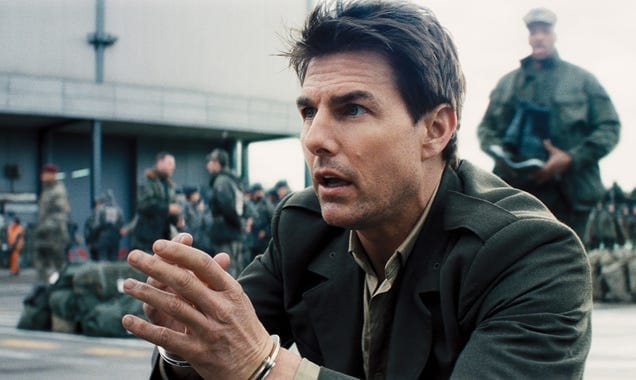
Then they add this: Since Cage has been the charming media spokesperson for the global defense initiative, he has blood on his hands in the form of thousands of men and women who have enlisted in the cause inspired by Cage’s words. Given everything else that goes on in a tight, taut first act, this is a small detail, but one which makes Cage personally culpable and demonstrates how committed the writers are to create central characters well beyond the depth of what we normally see in these type of movies.
Nemesis: The Aliens. While they are cut from the standard science fiction jib — creatures whose sole motivation is to take over other worlds — they are a few notches more intriguing than normal Alien Baddies in large part because they are smart. In fact, they pretty much pull the strings, the opening gargantuan assault by humans turning out to be one big clusterfuck orchestrated by the aliens themselves so they could wipe out humanity’s last shot. In addition, the fact there are three levels of Aliens — Mimics, Alphas, and Omega — provides a bit more intrigue to their aggregate presence. although it does feel like this tripartite setup reflects more on the story’s similarity to a video game (i.e., minions and bosses).
[I have a hard time imagining a movie connecting more with a gamer’s experience than Edge of Tomorrow. The very idea of Cage and eventually Rita learning what they can before dying, over and over, advancing from Starting Point A to Ending Point Z, even to the degree of memorizing actual patterns of enemy activities and steps they have to take to avoid getting whacked, echoes video game-playing. In addition to which, the ‘players’ (Cage and Rita) have to figure out ways to survive as well as the Nemesis’ weak point to win the ‘game’. By the way, I don’t think this is a weakness in the movie, in fact it actually creates a lot of the humor in the story, an asset I will discuss later.]
Attractor: Rita (Emily Blunt). I’ve seen Tom Cruise interviewed several times about this movie and on each occasion, he says the story is primarily Rita’s. That could just be Cruise being magnanimous as he is the story’s Protagonist and at the end of the day, he is The One to save the day. However Rita, whose character is the poster child for the human defense effort (“Full Metal Bitch”), is a powerful central character, in fact strong in so many ways: muscles, willpower, determination, resolute, a true and committed soldier, every bit an equal to her male counterpart.
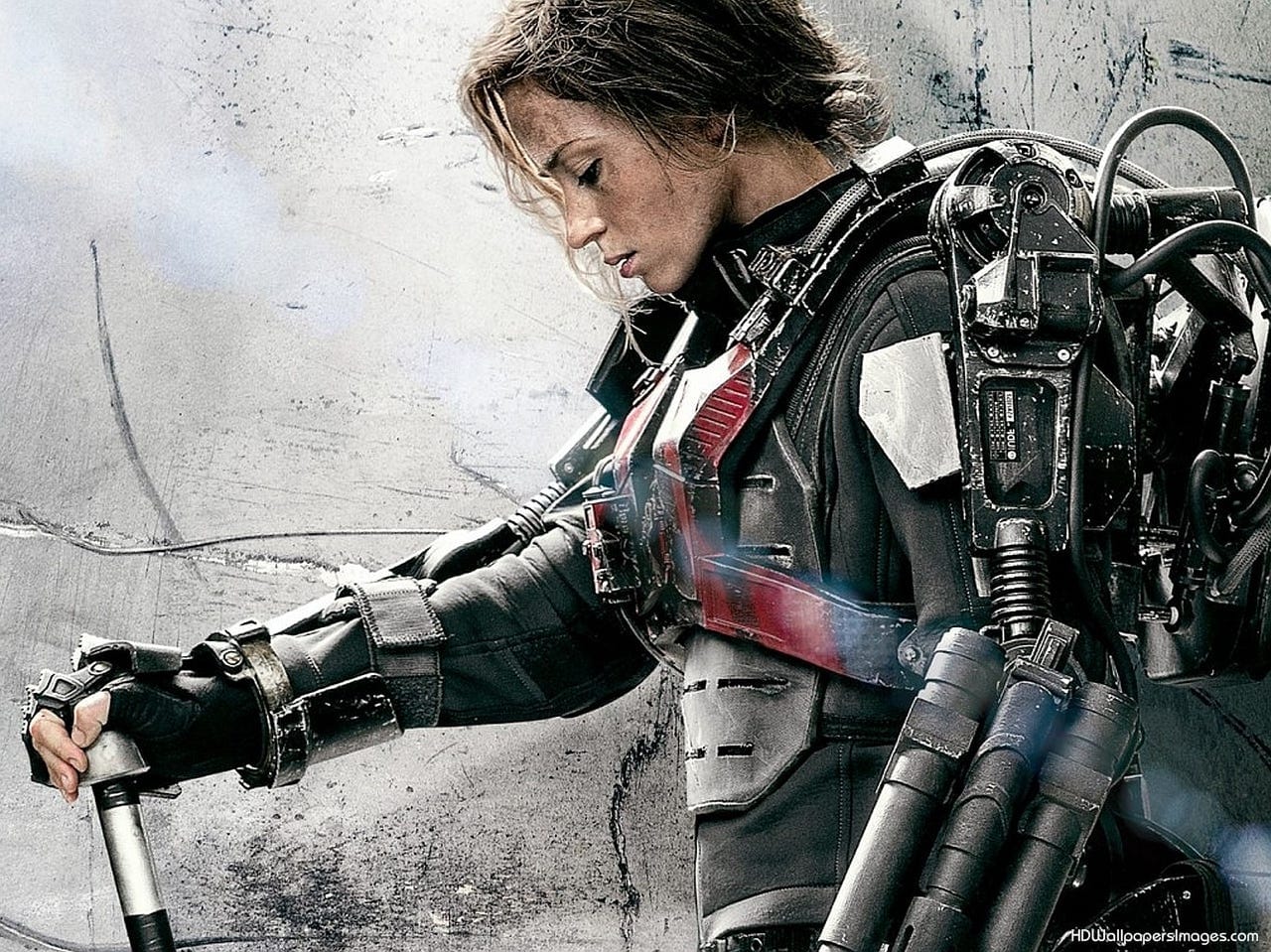
And yet, she has layers to her psyche as well, having had the same power to relive an Endless Day over and over that Cage has, only then losing it. As a result, she has seen death up close and personal hundreds of times, including someone named Hendrix she apparently loved, witnessing his demise multiple times. The way the writers handle the incrementally evolving Protagonist-Attractor relationship is one of the finest aspects of the movie in my opinion. Much of it happens via dialogue, of course, but a goodly amount occurs visually through the process of the pair being bound together in literal life-then-death, life-then-death circumstances. That this relationship is downright central to the story keeps us in touch with its emotional core throughout, not just window dressing as in other big event movies. And by the way, Blunt totally rocks this role.
Mentor: Dr. Carter (Noah Taylor). Of course, there needs to be a scientist who understands a lot of this stuff and that’s where Carter comes in. He’s pretty much a talking head, but even here we get some depth to his character: Although he was on the right track in terms of how to deal with the alien invasion, The Powers That Be perceived him to be crazy, and locked away his invention, then busted him down to working on weapons in an ad hoc factory. Fortunately there are all sorts of holograms and techno-maps to provide visuals when Carter is on the clock wading through the story’s necessary exposition.
Trickster: Lots of them. First, there is J-Squad, the group of soldiers into whose presence Cage is initially thrust. They don’t like Cage in the least, so even though allies in uniform, they are in effect enemies from the get-go. Eventually they do become comrades, joining up with Cage and Rita in the pivotal third act Final Struggle.
Then there is General Brigham (Brendan Gleeson) who turns on Cage when the Major tries to bribe his way out of combat service, leading to Cage being portrayed as a deserter, then stuck with J-Squad and that assault team. Eventually Brigham gives Cage and Rita the device Carter invented, their last hope at finding the location of the Omega alien.
Finally there is Time itself. It functions as an enemy in that Cage is trapped in an endless and violent loop. However because he can keep improving his understanding of the details of the Endless Day, it creates a possible way out. Then in a big assist, after Cage dies one last time, it goes even further back in time, the day before the Endless Day, which allows him to experience a Denouement in which he sees the aliens have been defeated (due to Cage’s sacrificial efforts) and more personally, an opportunity to be with Rita and — presumably — start a life together anew.
The beauty is all of these characters work together so well. For example, the Aliens act as a projection of Cage’s fear of death, something exposed quite early as he attempts to evade going to the front line. Beyond that, every death Cage suffers drives him deeper and deeper into what it means to be human, what it means to be truly alive, in essence compelling Cage to uncover what is really genuine and human within his own psyche. In that respect, Rita is precisely the character Cage needs to intersect with, not only in terms of plot machinations and training to be a warrior, but to lead him beyond a life lived on the surface to discover her humanity beneath that hardened exterior. Even the soldiers in J-Squad are part of Cage’s psychological metamorphosis in that by the end, he moves from lone wolf to team player, acknowledging the need to be part of a team.
Each of these characters plays a part in Cage’s narrative destiny, not only the plot, but his metamorphosis-journey. Put it this way: The Cage we meet in The Opening would never have a shot at connecting in an authentic way with Rita, nor by extension his own True Self. He has to go through every stage of psychological development, a compressed experience of ‘reincarnation’ and learning, to become the Cage he is meant to become by the end of the story.
More generally, I was impressed by the movie in a number of other ways:
* It is intelligent. Far too often when I watch big blockbuster science fiction, superhero or comic book inspired movies, there just isn’t much going on to engage my mind. Then if I don’t really care about the characters, which is often the case, I’m left to experience nothing but a bunch of explosions and noise, amounting to meaningless claptrap. But Edge of Tomorrow engaged my mind the entire time, tempting me to anticipate where the story would go and appreciating the plot twists, some of which I figured out in advance, others I didn’t, but all working really well individually and collectively.
* It has a nice pace. Now for many of these franchise movies, the filmmakers tend to think of pace as frenzy, more eye candy, more bombast in the soundtrack, keep ratcheting up the events, leaving the viewer — well, at least me — overwhelmed with little chance to absorb emotionally what might be going on. Of course, I think one of the reasons why those movies tend to frenzy is precisely because there is so little going on in the story’s psychological realm. But not in Edge of Tomorrow. As noted, the writers do an excellent job creating a pair of central characters we care about. And to the director’s credit (Doug Liman who does a terrific job), the plot actually slows down on key occasions to allow the characters to interact and us to process those feelings, which is to say…
* It has a rich psychological journey to go along with the physical journey. First, there is Cage going through a series of emotional passages related to the shocking conundrum in which he finds himself: denial, bargaining, futility, anger, proactivity. The writers have thought through Cage’s metamorphosis process relative to his changing psyche. But what is most impressive is how the story deals with the most central issue of life… which is death. Obviously this is tied to the story’s central conceit, but the narrative explores death from multiple perspectives and emotional places: shock, fear, humor, sadness, resignation, then at the end embracing that aspect all humans share, our will to survive.
To this last point, I am surprised the writers didn’t include one way of Cage dying: suicide. By my recollection, every time Cage dies, it’s either through an accident by some vehicle, killed by an alien, snuffed by Rita, in other words externally driven. Told by Rita he has to die in the field, not in a hospital, I would have thought that at a critical moment, Cage would be forced to kill himself. Would have been a dramatic moment, but not in the movie.
* It has a sense of humor. Look, I know everyone in Hollywood is way into ‘edge’ and ‘dark’ stories, but sometimes there is nothing more entertaining than an action movie with some humor to it, and Edge is a home run on this front. While some of it provides a nod to gamers, the experience we have getting whacked, hitting reset, then having another go at it, none of the humor is forced, it’s all character-based. I can’t help but think if the studio had made a point in marketing this aspect of the movie, it might have helped generate more positive buzz, but they missed that opportunity, which is a shame because there is a nice balance between the seriousness of the narrative and moments of levity which help give the story more of a human face. Like this:
There’s a lot more to discuss about the movie, but I’ve got to run. Before I close my comments, I want to address a critique floating around out there about the ending, for example this blog post from one of my favorite sites /Film: Three Reasons Why That “Edge of Tomorrow” Ending Is The Worst. Here are the three reasons:
1) It makes no damn sense.
2) It destroys all the stakes that the film expertly built up.
3) It strikes the wrong tone.
You can read the article to drill down into the rationale for each line of argumentation. Perhaps this is correct in terms of rational logic, but as I have said about movies, emotional logic trumps rational logic virtually every time.
In Hollywood, there is an age-old saying about movie endings: “Give them what they expect, then give them what they want” (I noted this in today’s Daily Dialogue post).
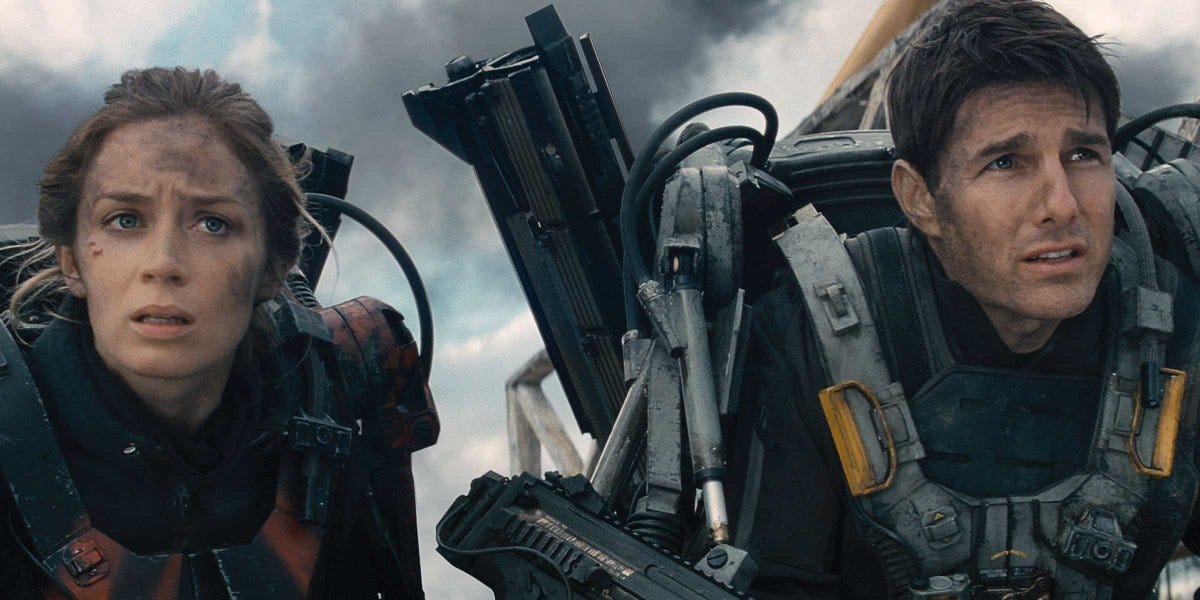
In Edge of Tomorrow, what we expect is that Cage and Rita are dead. Or at least Rita. But that’s not what we want. What we want is what the movie gives us: Cage and Rita together at last.
You know why? Because we care about the characters. Moreover they have gone to hell and back, multiple times, and they deserve to be together… and we deserve to see that reunion at the end… which by the way is played perfectly with Rita looking at Cage for the ‘first’ time with her tough gal “what do you want” line, then Cage just laughing out loud at the total absurdity of the situation, but with the glorious realization of what he and Rita have accomplished… and now they can be together. Again all of this because we genuinely care about this duo.
Okay, I’ve run out of time, but as you can tell, I thought the movie was great. I know there is controversy over the fact the writer of the original spec script (Dante Harper) received no writing credit whatsoever, but I can only speak to the final product on the screen… which in my view flat-out works.
How about you? What did you think about Edge of Tomorrow?
UPDATE: I was reminded during our discussion of EOT how much I loved Looper, so I would add that into the mix of favorite science fiction movies in recent years.
Comment Archive