Movie Analysis: “Jurassic World” — Plot
Another in our bi-weekly series in which we analyze movies currently in release. Why? To quote the writing mantra I coined over 5 years ago: Watch movies. Read scripts. Write pages. You will note which one comes first. Here are my reflections from that post about the importance of watching movies:
To be a good screenwriter, you need to have a broad exposure to the world of film. Every movie you see is a potential reference point for your writing, everything from story concepts you generate to characters you develop to scenes you construct. Moreover people who work in the movie business constantly reference existing movies when discussing stories you write; it’s a shorthand way of getting across what they mean or envision.
But most importantly, you need to watch movies in order to ‘get’ how movie stories work. If you immerse yourself in the world of film, it’s like a Gestalt experience where you begin to grasp intuitively scene composition, story structure, character functions, dialogue and subtext, transitions and pacing, and so on.
Let me add this: It’s important to see movies as they get released so that you stay on top of the business. Decisions get made in Hollywood in large part depending upon how movies perform, so watching movies as they come out puts you in the same head space as reps, producers, execs, and buyers.
This week’s movie: Jurassic World, screenplay by Rick Jaffa & Amanda Silver and Colin Trevorrow & Derek Connolly, story by Rick Jaffa & Amanda Silver, characters by Michael Crichton.
Our schedule for discussion this week:
Monday: General Comments
Tuesday: Plot
Wednesday: Characters
Thursday: Themes
Friday: Takeaways
For those of you who have not seen the movie, do not click MORE as we will be trafficking in major spoilers. If you have seen Jurassic World, I invite you to join me in breaking down and analyzing the movie.
The central conceit of Jurassic World echoes Jurassic Park quite closely: The ‘monster-in-a-box’ gets loose. The narrative then becomes an exercise in escape and survival — the guts of Act Two — then defeating the ‘monster’ — the focus of Act Three.
I noted in yesterday’s comments I thought the plot of Jurassic World was — generally speaking — one of the story’s strengths. Consider the cast of primary characters:
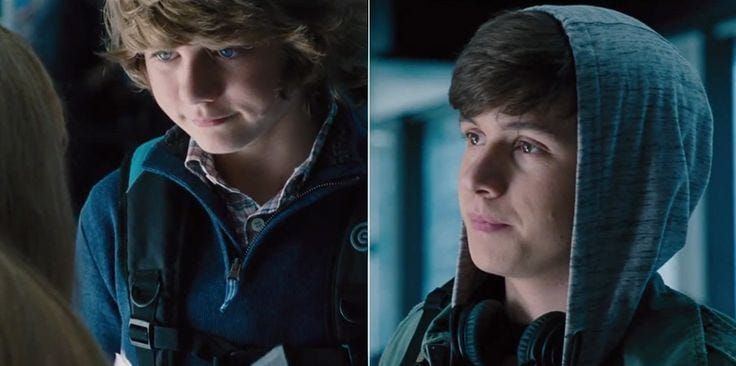
Gray (Ty Simpkins) and Zach (Nick Robinson)
Owen (Chris Pratt)
Claire (Bryce Dallas Howard)
Masrani (Irrfan Khan)
Hoskins (Vincent D’Onofrio)
Barry (Omar Sy)
Dr. Henry Wu (BD Wong)
Lowery (Jake Johnson) and Karen (Judy Greer)
There are other characters, but these are the main players in the action. Separating and intersecting these characters, one subplot crossing with another, represents a challenge, like a game of chess. Here are a few thoughts on how that played out:
* Gray and Zach need to lose their caretaker Zara, then take off on their own in order to get into trouble. Why? To create personal stakes. After all, they are the characters through whose perspective the trip to the park is told and with whom — in theory — the viewer will most identify.
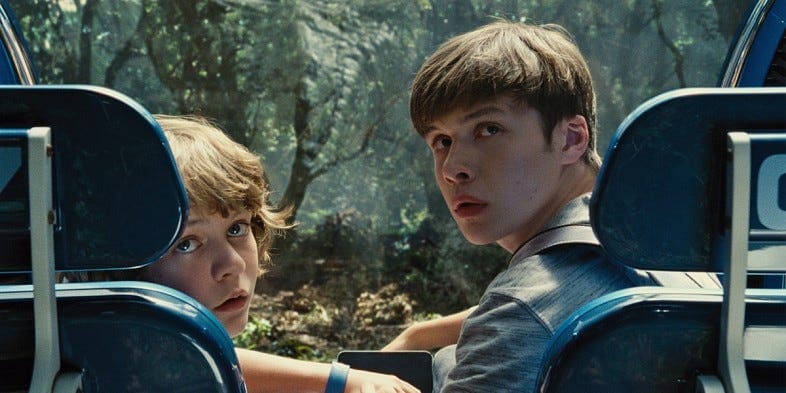
* The boys getting lost in the park while Indominus is on the loose precipitates Claire’s desperate need to find them. And that leads her to Owen for help, cementing together this oil-and-water pair of characters.
* While those two subplots play out — Gray and Zach / Claire and Owen — there is another narrative strand at work: The plan by Hoskins to use the raptors as weaponized warriors. This brings him into contact with Masrani, then Lowery and Karen, and finally the reveal about his involvement with Dr. Wu.
* When Claire and Owen intersect with Gray and Zach, bringing the four together, very soon thereafter Hoskins initiates his takeover (this requires Masrani’s death and Owen to return to HQ in order to facilitate with the release of the raptors). Thus once the direct threat to the boys’ lives and Claire and Owen’s goal of finding them is resolved, the plot shifts from escape to confronting the ‘monster’ menace.
Then there are the movements of Indominus. I must say I felt the beast’s constant intersections with key characters at key moments felt less than credible. It was like the creature had an almost supernatural ability to know where to be to service the plot best. In other words, some whiffs of writer’s convenience. But bottom line, that’s probably a case where emotional logic trumps rational logic because we want to see Indominus threatening key characters on a recurring basis, so like any ‘monster,’ it has a predilection to be in the right spot at the right time — or from the POV of the human characters, wrong spot, wrong time.
One plot element where I just could not get beyond my logic was when the boys made their way into the old Jurassic Park. Not only was this one of the most nostalgic sequences, which as I noted yesterday kept reminding me how great Spielberg’s touch was in the original movie, I just did not buy the whole Zach just happening to know how to fix a car based on a throwaway line of dialogue about his uncle or something, then actually getting the 22 year-old jeep to run simply by replacing the battery. I’m sure most viewers bought into it because — emotional logic — they wanted to see the two youngsters slaloming around in the jeep while trying to avoid getting devoured by Indominus. From a writing standpoint, it was a critical choice because that became the boys’ means to get back to HQ without having to run several miles. But still, that beat felt forced.
That said, as I noted yesterday, there are some nice plot twists deftly set up, then paid off such as the process by which Indominus gets whacked — by Mosasaurus in the lagoon. The Final Struggle at the end of Act Three is a big, bold climax that fundamentally works, and involves all of the major players who are left alive — Zach, Gray, Claire, Owen, Indominus, and some of the raptors, most noticeably Blue who has its own subplot arc in relation to Owen, ultimately coming off as an ally to the humans.
All in all, the plot services the spectacle pretty well, I’d say.
How about you? What were your impressions of the plot? Did it all work for you? Were there some rough patches? Just in general, what strikes you most about the plot?
Please join me in comments to further analyze Jurassic World.
Comment Archive