Movie Analysis (Part 2): “Gravity”
This week, I’m going through the script for the movie Gravity, excerpting every scene that touches on its primary ‘small’ story: Ryan Stone (Sandra Bullock) dealing with her grief related to the death of her young daughter. I laid out my rationale for this exercise in Part 1 of the series:
I’m not suggesting the small story in Gravity is wholly responsible for its ginormous box office success. What I am saying is this:
* At least some of the positive BWOM (By Word Of Mouth) about this movie derived from the audience’s emotional connection with a mother who has lost her child and is forced to cope with her grief under remarkable circumstances.
* If the filmmakers themselves looked at the movie as a metaphor for the Protagonist dealing with her personal issues, then it makes sense for us to think about the story that way as well.
* No spectacle movie can be considered to be great unless it has a compelling small story at work in it.
Here is what I propose: Over the next week, I’m going to go through the script for Gravity and strip out every single scene that references the movie’s small story. In that process, I am going to focus on three dynamics:
1. The overall arc of that subplot moving from Beginning to End.
2. How the metaphor of outer space services the psychological nature of this subplot.
3. Stone’s metamorphosis as she is forced to grapple with her grief.
More generally, I am hoping each of us will come away with an appreciation for the importance of the machinations of a story’s Internal World balanced against the entertainment value of all the action in its External World.
SPOILER ALERT: If you have not seen the movie and don’t wish to know what happens, do not click on More. If you do want to track the series, I’ll see you below the fold.
Plot Summary: A medical engineer and an astronaut work together to survive after a catastrophe destroys their shuttle and leaves them adrift in orbit.
Background: Dr. Ryan Stone is a biomedical engineer on her first Space Shuttle mission. She is accompanied by Matt Kowalsky (George Clooney) and Shariff (voiced by Phaldut Sharma).
Here are today’s excerpts:
Ryan is on a space walk, attempting to make a repair on the Hubble Space Telescope. Matt Kowalsky (George Clooney) approaches:
MATT: So, what do you like about being up here?
RYAN: The silence. I could get used to it.
This is the very first indication of Ryan’s inner conflict. Why does she like “the silence”? Why could she get used to it? Presumably there is some ‘noise’ in her life that is problematic. At this point, we only have this oblique reference, but it does set the subplot into motion by hinting at the mystery of what it might be about.
Then disaster strikes. From the IMDB plot summary:
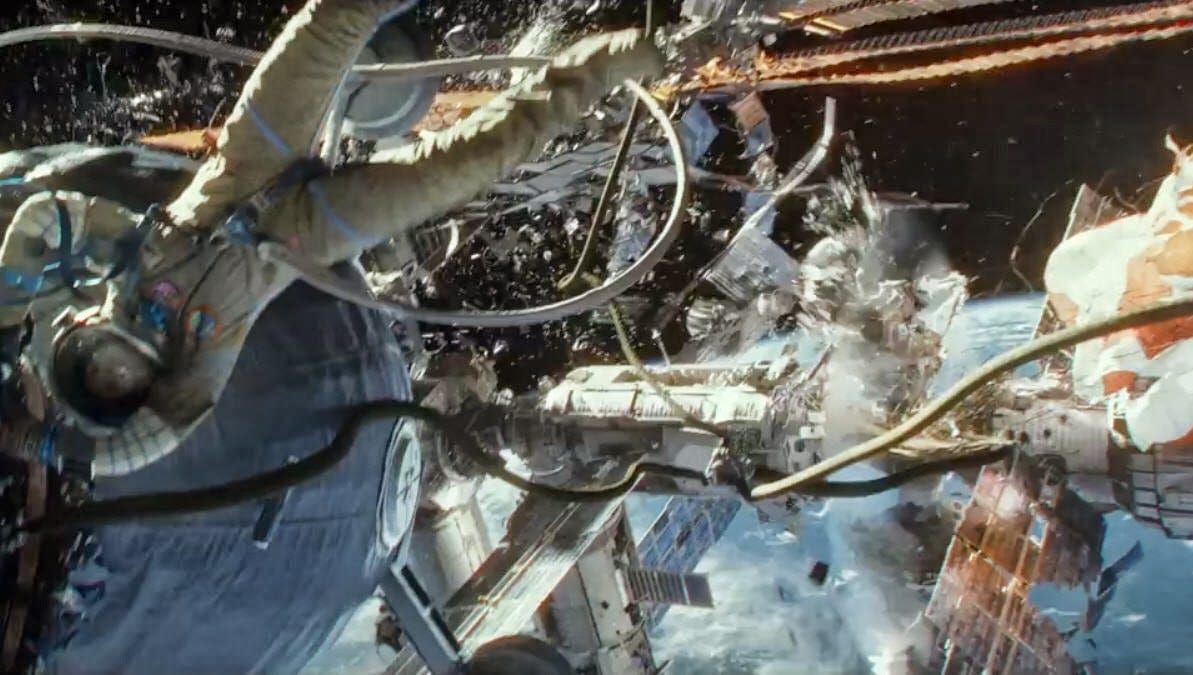
Houston tells them that debris from a Russian missile strike on a defunct satellite has caused a chain reaction, destroying other satellites… High-speed debris strike the STS, sending it spinning wildly, with Stone at the end of the boom arm. A piece of debris breaks the robot arm off from the STS, and Stone is forced to release the tether holding her to the robot arm.
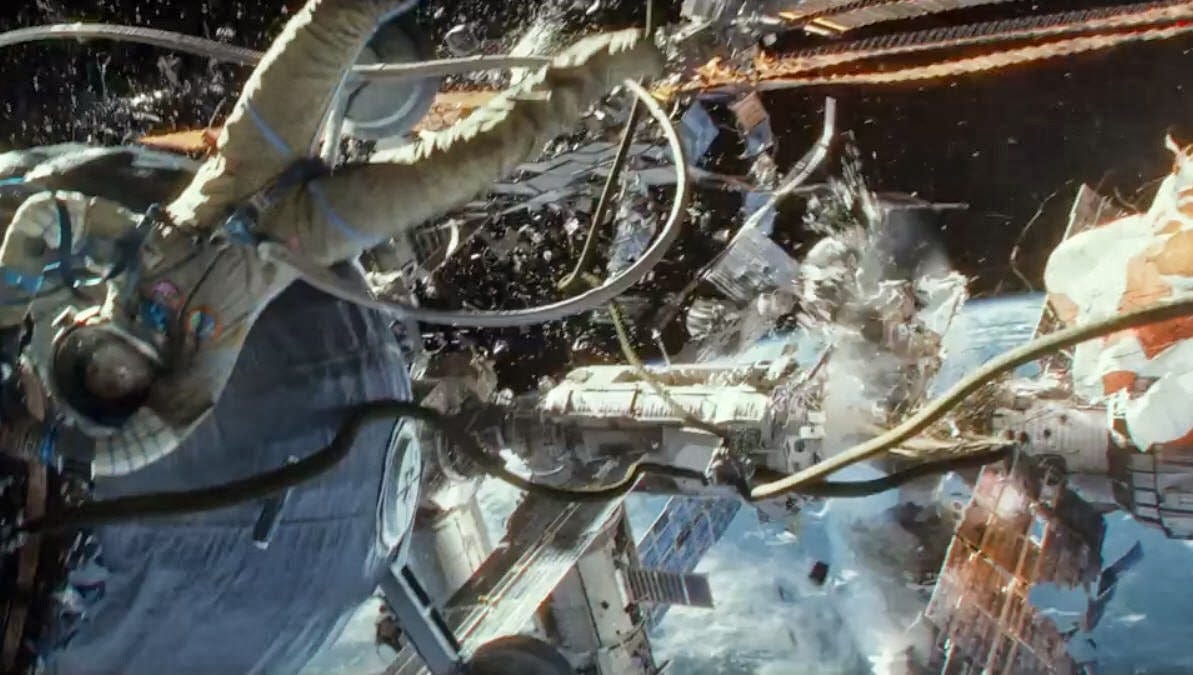
During this sequence, Matt says this:
Matt: Dr. Stone, detach! You must detach! If you don’t detach, that arm’s gonna carry
you too far!
Let’s keep that dialogue in mind for later reference. More bad stuff happens:
Once free, she is thrown far from the STS. Stone panics, trying to contact Houston or Kowalski. Kowalski, who is wearing a thruster pack, suddenly appears and attaches her tether to him. He flies them back to the STS, where they find the engineer Shariff, his helmet smashed and his skull mostly open and empty. They find that the STS Explorer has been catastrophically damaged. The station’s interior has been ripped open by debris and the remainder of crew are dead. Kowalski decides to use the thruster pack to get to the International Space Station (ISS), which is in orbit about 100 km (60 mi) away. Kowalski estimates they have 90 minutes before the debris field completes an orbit and threatens them again. With Stone’s oxygen reserve running low, they float through space to the ISS.
As they float through space, there is this exchange:
MATT: Okay. Pretty scary shit being untethered up here, isn’t it?
RYAN: Yeah, pretty scary shit.
MATT: Well, you did all right.
A second reference to ‘detach / untethered’. Again file that away for future reference.
In an attempt to calm Ryan down, Matt engages in what he thinks will be small talk:
MATT: That’s what I’m gonna miss the most. So where’s home, Dr. Stone? Ryan, where’s
home?
RYAN: Home?
MATT: Mm-hm. Down there. Mother Earth. Where do you pitch you tent?
RYAN: Lake Zurich.
MATT: Where the hell is that?
RYAN: Illinois.Matt floats, pulling Ryan behind him.MATT: Illinois. Central Time Zone. (sighs) That would make it roughly... eight PM. What
are the good people of Lake Zurich doing at eight o’clock?
RYAN: I don’t know. I’m not gonna make it. I’m slowing you down.
MATT: What would you be doing? Come on, Ryan. It’s eight o’clock. You've just left the
hospital after an eighteen-hour shift. Driving home.
RYAN: The radio. I listen to the radio.
MATT: There we go. Let me guess. NPR? Classical? Top forty?
RYAN: Anything. I don’t care, as long as they don’t talk. I just drive.
MATT: And where are you driving to?
RYAN: I just drive.
MATT: What do you miss down there? Is there a Mr. Stone?
RYAN: No.
MATT: Nobody special?Ryan slowly floats. The reflection of the Earth appears on her helmet.MATT: Somebody down there looking up, thinking about you? Ryan?
RYAN: I had a daughter.Matt glances at the mirror affixed to his wrist. The mirror on his wrist depicts the
reflection of Ryan.RYAN: She was four. She was at school playing tag. Slipped, hit her head, and that
was it. Stupidest thing. I was driving when I got the call, so... ever since then,
that’s what I do. I wake up, I go to work, and I just drive.
So here we have it, the entire backstory of her daughter’s death… with one significant detail left to be revealed down the road. What can we glean from this exchange?
* When Matt presses her about what people are doing in Lake Zurich, Ryan switches subjects: I don’t know. I’m not gonna make it. I’m slowing you down. The text of the dialogue is an expression of her anxiety about whether they will survive or not. The subtext suggests the subject of her home / personal life is an uncomfortable one, something she’d prefer not to discuss.
* Then this: Anything. I don’t care, as long as they don’t talk. I just drive. This calls back her line about liking the “silence” of space. Music she can handle. Talk she can’t. My interpretation of this is Ryan suffers from a neverending internal dialogue… and it is not a pleasant one. This chatter, the content of which I will discuss at a later point in this subplot, vexes her, and she uses music and driving to try to dull the noise. But there are other reasons for Ryan’s habit of “just driving” which we will discuss later below.
* I had a daughter. She was four. She was at school playing tag. Slipped, hit her head, and that was it. Stupidest thing. The raw, brutal truth of this tragic event is how mundane the circumstances were. Kids slip and fall all the time. For some mystifying, “stupid” reason, this time killed her daughter.
* I was driving when I got the call, so… ever since then, that’s what I do. I wake up, I go to work, and I just drive. She discovered her daughter had died while she was driving. Therefore my guess this has become something of a ritual for her in two respects: (1) Driving reminds her of that fateful call. For reasons yet unknown, it is important for her to keep that memory vivid in her experience. (2) Driving also does something else: It keeps her away from her house. What is in her house? A void created by her daughter’s absence. In other words: Space.
And that right there aligns with what I think Cuarón meant in large part when he said: “Outer space is a metaphor for the inner space of our character.” That inner space is this huge vacuum, a gaping hole which her daughter used to fill. What has been filling her now is the chatter of her mind, incessantly going over the details of her daughter’s death, the necessity to “just drive” as some sort of ritual related to the tragedy, listening to music to try to drown out the voices in her head, and the knowledge that when she goes home, she will confront an awful emptiness there.
In this regard, Ryan begins the story in a classic state of Disunity. Moreover she has made little progress in terms of her grieving process, almost in a state of psychic stagnation.
I think the single best question one can ask of a Protagonist character is this: Why does this story have to happen to this character at this time? Again Cuarón provides the key: “What we were trying to do was a film about adversity and the possible outcome of a rebirth” [emphasis added].
At a psychological level, the entire point of this disaster story is to compel Ryan to deal with her grief related to her daughter’s death, to force her to move out of her life-less state of suspended animation and be ‘reborn’.
Cuarón was intentional about mining this dynamic and we will see plenty of themes throughout the story that explore this dynamic.
How about you? What are your interpretations of what has transpired up to this point in the story? Do you feel it’s effective? Or not? If not, how would you have approached this ‘small’ story? Or maybe you have a different ‘small’ story you think would have worked better.
A reminder: As far as I’m concerned, there is no ‘right’ or ‘wrong’ when it comes to an individual’s experience of a story, so if you liked or disliked Gravity, feel free to wade into the discussion. At the end of the day, I’m hoping this series will underscore the importance of stories having a compelling inner life.
Hope to see you in comments!
For Part 1 of this series, go here.
Comment Archive