One way to write an action sequence
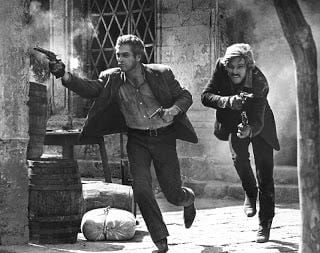
This is an excerpt from the very last part of the screenplay for Butch Cassidy and the Sundance Kid (1969)
CUT TO
BUTCH streaking, diving again, then up, and the bullets landing around him aren’t even close as —
CUT TO
SUNDANCE, whirling and spinning, continuing to fire and —
CUT TO
SEVERAL POLICEMEN dropping for safety behind the wall and
CUT TO
BUTCH really moving now, dodging, diving, up again and
CUT TO
SUNDANCE flinging away one gun, grabbing another from his holster, continuing to turn and fire and
CUT TO
TWO POLICEMEN falling wounded to the ground and
CUT TO
BUTCH letting out a notch, then launching into another dive forward and
CUT TO
SUNDANCE whirling, but you never know which way he’s going to spin and
CUT TO
THE HEAD POLICEMAN cursing, forced to drop for safety behind the wall and
CUT TO
BUTCH racing to the mules, and then he is there, grabbing at the near mule for ammunition and
CUT TO
SUNDANCE throwing the second gun away, reaching into his holster for another, continuing to spin and fire and
CUT TO
BUTCH and he has the ammunition now and
CUT TO
ANOTHER POLICEMAN screaming as he falls and
CUT TO
BUTCH, his arms loaded, tearing away from the mules and they’re still not even coming close to him as they fire and the mules are behind him now as he runs and cuts and cuts again, going full out and —
CUT TO
THE HEAD POLICEMAN cursing incoherently at what is happening and —
CUT TO
SUNDANCE whirling faster than ever and
CUT TO
BUTCH dodging and cutting and as a pattern of bullets rips into his body he somersaults and lies there, pouring blood and
CUT TO
SUNDANCE running toward him and
CUT TO
ALL THE POLICEMEN rising up behind the wall now, firing and
CUT TO
SUNDANCE as he falls.
The script’s writer, William Goldman, mentions this specific sequence in his book “Adventures in the Screen Trade” to make a point about action-writing. Read the sequence again and see if you notice something unusual about it. I’ll post the answer in a while.
UPDATE: From comments, we have the answer: if you track the entire sequence, you’ll see that it’s 293 words, straight through, until finally at the end, there’s a period. Goldman’s rationale behind making it one long run-on sentence was to not give the reader a break, to suggest one continuous flow of action and sentences with periods would have, in his view, interrupted the flow.