Pixar gets in touch with their inner shrink
I love Pixar. Just Google the blog to see the dozens of posts I’ve done about the company over the years. Their commitment to Story, love for Characters, and taking the time to get it right is unparalleled among contemporary studios, hence the source of my admiration and affection.
But then all the sequels starting happening. Cars 2. Toy Story 3. Monsters University. Finding Dory. The Incredibles 2.
Okay, I’ll give some of them a pass because the originals were so damn good. Yet one couldn’t help but be concerned about what was going on creatively up there in Emeryville. Had they run out of original ideas?
Then along comes Inside Out. Via Variety:
Until last month, when Pixar finally released a synopsis for the toon studio’s 15th feature, precious little was known about “Inside Out,” which takes place entirely inside the mind of an 11-year-old girl. But after director Pete Docter’s stunning presentation at the Annecy Intl. Animation Film Festival in southern France yesterday, one thing is clear: “Inside Out” will forever change the way people think about the way people think.
— —
“It’s based on a strong emotional experience I had watching my daughter grow up,” says the “Up” director, who noticed that when his daughter Elie turned 12, much of her childhood joy disappeared, and she became more moody and withdrawn. “There is something that is lost when you grow up” — and the film became a way to explore that change on an emotional level.
Okay, let’s stop right there. “…strong emotional experience I had watching my daughter grow up… explore that change on an emotional level.” This is such an example of how the creatives at Pixar think, grounding their stories in deep human experiences. Who of us hasn’t gone through the turmoil of adolescence? Which parent among us has not gazed upon their tween or teenage sons and daughters, and not wondered, “What the hell is going on there?” It is innately emotional terrain.
Pixar not only targets universal themes, but powerful ones with an emotional resonance.
The film centers on a young girl named Riley Anderson, “one of those kids who seems like she was born happy,” Docter says. “In truth, Riley is not our main character; she is our setting.” To demonstrate what he meant, Docter screened the first five minutes of the movie, a good segment of which was still in a pencil-drawn storyboard state. (The finished film will open June 19, 2015.) Sure enough, “Inside Out” takes place in Riley’s subconscious, where a crew of anthropomorphized emotions manage how the girl feels at any given moment from a control panel that looks something like the flight deck of the Starship Enterprise.
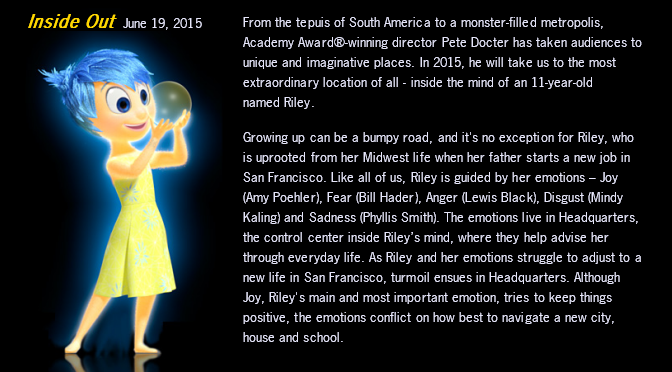
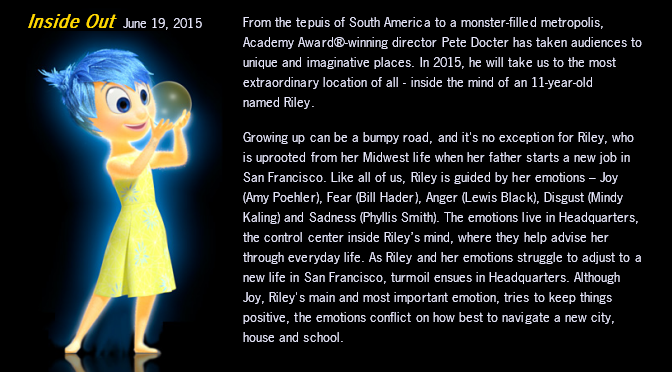
In the team’s research, they found many different scientific theories on how the mind works, including one from expert Robert Plutchik that defined eight primary human emotions, which Docter narrowed down to five: Fear (Bill Hader), Sadness (Phyllis Smith), Joy (Amy Poehler), Disgust (Mindy Kaling) and Anger (Lewis Black) — “like our version of Walt Disney’s Seven Dwarfs,” he jokes.
— —
“There’s this whole system that’s basically designed to operate in your subconscious,” he says. “All of the impulses that control your decisions, actions, stuff like that is out of your control, which is not the way I like to think of myself at all.”
Again Pixar instincts at work. They not only look for a key dynamic with which moviegoers can relate emotionally, they also seek a clean conceptual hook. And with Inside Out, apparently they have gotten in touch with their inner shrink: anthropomorphizing psychological dynamics.
Fear. Sadness. Joy. Disgust. Anger. Carl Jung would love this movie as each of these represents a different aspect of an individual’s psyche. Our task in life, what Jung called the individuation process, is to get in touch with, understand and embrace all aspects of who we are. That is the only way we can move toward a state of what he called ‘wholeness’.
I’m guessing this is pretty much the arc of Inside Out: Disunity to Unity.
It’s a great high concept, one to which we all can relate. I grew up in a religious family and went to Yale Divinity School, so I am steeped in Protestant theology. When I read this description of Inside Out, I was reminded of Romans 7:15 when Paul admits, “For what I am doing, I do not understand; for I am not practicing what I would like to do, but I am doing the very thing I hate.”
If you strip away the religious trappings, this has always struck me as an insightful psychological observation. We all know this feeling, when parts of our psyche work at odds against each other. From a writing standpoint, that puts us smack dab into conflict which is key to crafting a story with compelling drama.
Moreover with these five dynamics at work, one against and sometimes with each other, that suggests a lot of entertainment, distinct personalities with their own wants and needs.
But perhaps most importantly — and this brings the whole discussion back to Docter’s original impetus for the project — this is the kind of story that can speak to children and their parents, providing a way for families to converse about feelings and impulses. It takes the notion of four quadrant movie and elevates it beyond mere entertainment, transforming it potentially into a learning opportunity.
In sum, I love this story concept, perhaps more than any other Pixar movie since Up which is one of my absolute favorite of their movies.
Inside Out sounds like Pixar is growing up (along with the creatives’ children?) and taking on stories with more complex dynamics. Can’t wait to see it. How about you?
For the rest of the Variety article, go here.
Takeaway: As writers, whenever we consider a potential story idea, be sure to ask: What about it can connect with an audience on an emotional level? What specific dynamics in this concept can I use to create an emotional resonance with script readers?
And then this: How do I connect emotionally to the story content? We are much more likely to craft a compelling story if it’s something for which we have a passion to write.
Comment Archive