Profile: The Coen Brothers (Part 3)

Here is Part 3 of Trevor Hogg’s profile of writer-directors Joel and Ethan Coen. An excerpt that deals with the cult favorite The Big Lebowski:
Combining a case of a mistaken identity with a staged kidnapping, the Coen brothers produced a film which has established its own cult following — The Big Lebowski. “The narrative is suggested by Raymond Chandler’s Philip Marlowe novels,” stated Ethan Coen of the movie which gave performer Jeff Bridges his signature role of Jeff “The Dude” Lebowski. “It’s this episodic narrative about a character who’s not a private eye in this case, just a lay-about pothead who works his way through L.A. society trying to unravel this mystery.”
The other aspect which paid homage to the famous crime noir author was the cast for the picture. “We bore in mind Chandler’s pattern, a story like The Big Sleep [1946],” remarked Joel Coen. “We had a millionaire [David Huddleston] in Pasadena and, as so often with his novels, a mature and sophisticated woman, Maude, played by Julianne Moore [Boogie Nights], and a licentious and depraved girl, Bunny, played by Tara Reid [American Pie]. The main character is often involved in a romantic sub-plot with the first type of woman.”
Overseeing the proceedings is a narrator voiced by Sam Elliott [The Contender] who subsequently appears in the last scene. “The Stranger [Elliott] is a little bit of an audience substitute,” revealed Joel. “In the movie adaptations of Chandler it’s the main character who speaks offscreen, but we didn’t want to reproduce that though it obviously has echoes. It’s as if someone was commenting on the plot from an all-seeing point of view. And at the same time rediscovering the old earthiness of Mark Twain.”
To better understand the world of The Big Lebowski, the movie needs to be viewed from a certain social context. “The action itself takes place at the beginning of the nineties, but all the characters refer to the culture of thirty years ago, they are its aftermath and its mirror,” said Joel. “Jeff Bridges is an aging hippie, John Goodman is defined by his Vietnam experience, while Maude has for her blueprints the sixties New York Fluxus artists like Yoko Ono before she met John Lennon, or Carol Schneeman, who literally threw herself into her projects for physical support…Ben Gazzara [who plays loan shark Jackie Treehorn] also echoes people like Hugh Hefner from that period.”
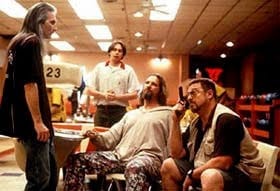
Portraying Treehorn’s three hoods as hapless German nihilist-pornographers was a matter of artistic license. “We are always looking to make characters geographically or sociologically or ethnically as specific as we possibly can,” replied Joel. “The more specific they are, the easier it is to develop them and make them more interesting for ourselves and for the audience. But people miss that, and they sometimes mistakenly extrapolate it into some grand statement about that region.”
Serving as a prominent motif for the picture is a particular recreational pastime. “We like the design aspects of bowling,” explained Joel. “The sort of retro aspects of it seemed like the right fit with the characters. One of the people this is loosely based on was in an amateur softball league in L.A. that really took up a lot of his time. We changed that to bowling because bowling seemed more compelling from a visual point of view.” He mischievously added, “It’s the only thing that calls itself a sport where you can smoke and drink beer.”
To read the rest of the profile at FlickeringMyth.com:
Part 1
Part 2
Comment Archive