Reader Question: How to balance writing theory and the actual writing?
What if learning theory and trying to put it into practice stymies creativity?
What if learning theory and trying to put it into practice stymies creativity?
From Traci Peterson:
I’m an intuitive/organic writer discovering the sometimes overwhelming scope of Joseph Campbell and Carl Jung’s influences on character and story.
Any suggestions on how to balance the two in order to get the first script down?
It can be overwhelming, especially on the front end of the process where a writer studies various theories, paradigms, and approaches to the craft. This is a necessary thing, at least for most writers, but how to make sense of all that information and intellectual stimuli? And then more to your point, how to balance all of those ideas with the actual practice of writing a story?
First off, I need to lay out my standard line: “There is no right way to write.” Every writer is different. Every story is different. Blake Snyder may work for Writer A, but not at all for Writer B, whereas Robert McKee may work for Writer C, but seem like a foreign language for Writer D.
Whenever you hear talk about a “writer’s voice,” this is part of that process. You learn what you learn, sort it out, pull together what works for you, and that becomes a key part of your voice.
With that frame, let me offer two words of advice on the matter. The first is a macro take, what we may call “A Writer’s Odyssey.” The second is a micro perspective, what we may call “Write Here, Write Now.”
A WRITER’S ODYSSEY
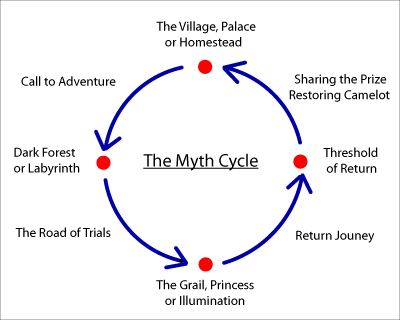
The very first moment we open a book, read an article or take a class about screenwriting, we begin an odyssey, our own Hero’s Journey. Along the way, we may experience something like the stages below:
Some things we learn, stick. Others, don’t. Some things we learn, help. Others, hurt. We cross thresholds, we get knocked back. We feel high, we feel low. Things make sense, things confuse the hell out of us. But all along, we are learning how to think about the craft.
Along the way, we are also writing. Much of what we write doesn’t work. Some of it may downright suck. But the more we learn and process what we learn, the more we write and process what we write, we advance along in our odyssey, hopefully getting better as screenwriters.
Now I don’t believe this odyssey ever ends, we are always on the road to discovery. However whenever we write a script, I like to think of myself as having gone around the circle and wound my way back home. It’s important to claim that, to assert to yourself, “I’ve learned what I’ve learned, know what I know, I feel passion for this story, and I’m going to write the hell out of it.” You are home now. Don’t worry about what you’ve learned in the past or what you will learn in the future, just be here now as a writer in direct contact with your story in the present.
WRITE HERE, WRITE NOW
All that stuff you’ve learned, all the theories, paradigms and approaches, you can use them in prep-writing as you wrangle your story. But along the way of prepping your story, you increasingly need to trust your gut. Great stories require all aspects of the writing psyche, but perhaps nothing as important than your instincts. Ideally as you work your way through story prep, your gut will be taking over the decision-making process.
Once you type FADE IN, it’s time to take all that theory, all those approaches, all those paradigms, and set them over there. Clear them out of your consciousness.
Be. Here. Now. Just you. Your story universe. Your characters.
Engage all that narrative material directly, then —
Write here. Write now.
Naturally your theories, paradigms and approaches will creep into your mind. Don’t freak out. They’re trying to help you, they’re your friends and they’re useful in their own way. Just very nicely tell them, “Hey, theories. Thanks for dropping by. But you know what? I’m gonna go with my gut right now. You remember, we’ve talked about this. You were there to help me during prep. You’ll be there to help me after I get done with this draft. But right now, I’ve got to write now. So why don’t you and approaches and paradigms go off and play a few rounds of miniature golf or something. I’ll catch up with you later. Ciao!”
When you are page-writing, that’s all you’re doing. Engaging your creativity with the story universe and those characters, a direct experience of each scene in the here-and-now.
Dare I say it? You go… into… the… story… and write what emerges.
Or as famed author Ray Bradbury said:
I’ve had a sign over my typewriter for over 25 years now, which reads ‘Don’t think!’ You must never think at the typewriter — you must feel. Your intellect is always buried in that feeling anyway.
Now when I say to tell your theories and what-not, you’ll be calling on them in the assessment part of the rewrite stage, I mean that. You will want to apply that stuff in helping you pull the story together. Use them in prep, use them in analyzing your drafts and figuring out what to do in rewrites. But when you are page-writing, go with your gut. And write here, write now.
How about it, GITS readers? What Traci asks is a hugely important question. How do you find the balance between screenwriting theory and the actual writing?