Reader Question: Is there a current screenplay formatting ‘norm’?
A question via email from Chaz Fatur:
Just a quick Q, in hopes for a lengthy A… the whole do or don’t do on properly formatting accentuated words in all CAPS, bold, underline,etc… In your best experiences and what the Industry now sees fit on proper formatting, what is the norm these days? These would be action or audible words in the action sequences… and in keeping with this tradition, how about words in dialogue, over-accentuated? Like a character nailing a point!
I’ve read a lot of books on screenwriting and am totally confused!
I understand your confusion. So many voices in the screenwriting universe bloviating about the subject of screenplay format. Odd, too, that a lot of the most vigorous online flame wars arise from those very embers of confusion, fanned by what I call ‘scripteralists’ (script literalists), acting on the assumption there are specific rights and wrongs about screenplay format, which presupposes there is a universally accepted rule book in Hollywood.
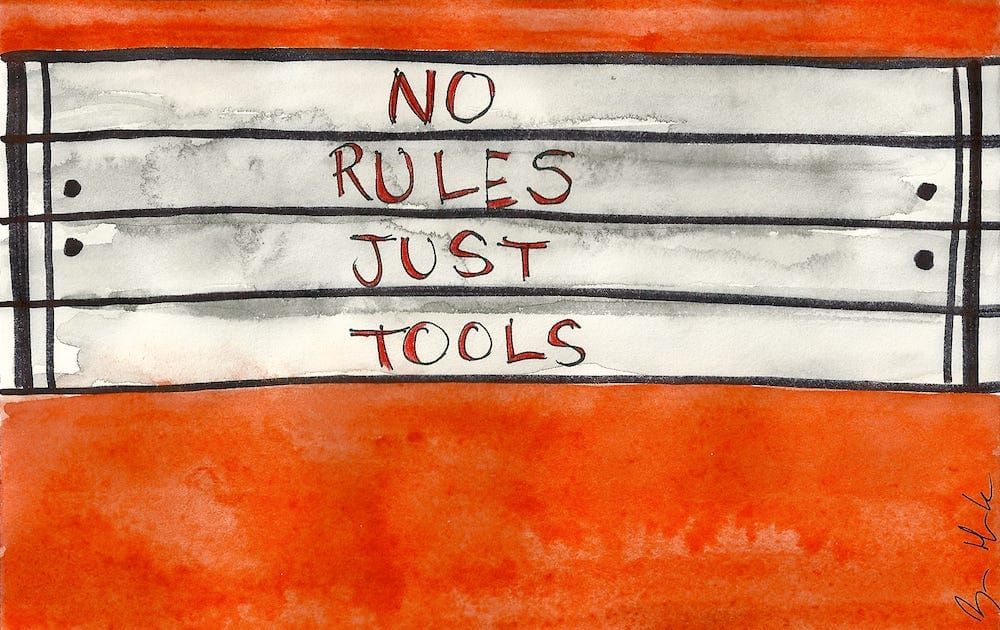
Fact: There is no such rule book. Indeed, there are no rules as I wrote here a few years back:
No matter what you have read. Or may have heard. Perhaps the source is a so-called screenwriting ‘guru.’ Maybe it’s a friend. A member of your writer’s group. Whoever it is, if they tell you there are screenwriting rules… they are flat-out wrong.
There are no rules.
Why do we know this? Because there is no universally accepted codification of how to write a screenplay.
Sure, there are tons of books, webinars, seminars, classes, downloads, columns, tweets, and blog posts. And there may very well be people who claim this or that to be a rule.
But that’s just bull shit.
Repeat: There is no single authoritative guide to screenwriting. So by definition, there can be no such thing as a screenwriting rule.
Here is what there are:
* Guidelines: There are generally known and accepted ways to approach script format that reflect how most professional screenplays look.
* Conventional Wisdom: There are certain axioms most people who work in the script acquisition and development universe carry with them when they crack open a screenplay for a read.
* Patterns: There are certain forms and paradigms related to story structure, character types and narrative which are held pretty much in common by these same people.
* Principles: We can even go so far as to acknowledge there are key precepts about story which derive from the relationship between human experience and our attempts to craft narratives about that experience which entertain the masses and convey some sort of meaning about life.
None of these constitute rules.
A good exercise would be to read the entire 15 part series I did on So-Called Screenwriting ‘Rules’. In that series, you’ll see my mantra re this subject: Tools, not rules.
As far as the use of capitalization, bold, underlining, and italics in scene description, bold and/or underlining slug lines / scene headings, I can clear up the confusion pretty quickly:
Do what works for you and the story. As long as you are consistent and clear about what you are conveying, you have the freedom to do what you want.
You want to underline and bold something to make sure a reader sees it? Go ahead. You want to capitalize an entire line of scene description because it involves incredible action? Be my guest. You want to bold, underline, italicize, and capitalize something because it’s the biggest goddammed thing to happen in the script? Knock yourself out!
As long as you service the story, are clear in your intent, and contribute to a reader’s ability to see your movie in their mind’s-eye, you can do that.
This is yet another reason why it is critically important to read contemporary movie scripts and spec scripts which have been sold or show up on the annual Black List. I promise, if you read 30 scripts, 1 per day for a month, you will see (A) the wide variety of approaches to writing format and style, (B) find ways which are attractive to your eye and fit with your own style, and © discover commonalities between scripts which give you a pretty good impression on what the Hollywood development community considers to be ‘conventional’ at this moment in time.
That said, once you understand those conventions, then make sure if you choose to differ from them, your choices in terms of format support your story.
For example, if you read my interview with 2015 Nicholl Fellowship in Screenwriting winner Andy Friedhof, his script “Great Falls” eschews the use of primary slug lines / scene headings. Instead Andy ‘directs’ the action using secondary slug lines / shots almost exclusively. It works, you never lose track of where the action is taking place, and it makes for a nice clean read.
There are style guides out there — you may download the Nicholl Fellowships guideline to script format here — and if you want to play it safe, which is a legitimate even practical choice, write to the convention.
However as your writing voice evolves and your style bumps up against format, inspiring you to try something different, you have that freedom, no matter what the scripteralists say.
Let the flame wars begin!