Saturday Hot Links
Time for the 254th installment of Saturday Hot Links, your week’s essential reading about movies, TV, streaming, Hollywood, and other things of writerly interest.
Most of 2016’s movies have been soulless, noisy, and dull.
Summer Box-Office Winners and Losers: From ‘Finding Dory’ to ‘Ben-Hur’.
What Does It Mean for a Movie to Be Record-breaking in 2016?
The Worst of the Worst: Suicide Squad as a Case Study in Oppressive Stock Characters.
DC films will be more “hopeful and optimistic” post-Batman v Superman.
Cinema Is Dead? Telluride Says Not Yet.
Movies Aren’t Dying, They’re Just Getting Smaller.
Hell or High Water: Why Hollywood should make them like they used to.
Toronto Hot List: 16 Market Titles Generating Buzz.
Toronto Film Buyers Beware: ‘Birth of a Nation’ Blowup Casts Shadow on Dealmaking.
17 movie sequels you didn’t know were in the works.
The 30 Most Polarizing Movies Since 2000: ‘Under the Skin,’ ‘Only God Forgives’ and More.
MPAA: U.S. Film & TV Industry Generates $121 Billion in Wages.
Diversity Report Shows Little Progress Among Top Films of 2015.
The Black List for Female Directors: New Survey to “Shine a Spotlight” on Rising Talent.
Why Sony Pictures Classics Thinks Backing Female Directors Is Good for Business and Art.
91-Year-Old Oscar Voter Says He’ll Sue to Fight ‘Inactive’ Status.
Studio Series: STX Entertainment and Studio 8 Try to Stay Ahead of the Curve.
‘Warcraft’ Secret Weapon Tencent May Hold the Real Keys to China’s Movie Market.
When you buy a movie ticket, where does that money go?
WGA Candidates Signal Tough Contract Talks.
Tom Hanks’ Sudden Transition to More Biopic Type Roles.
Christopher Nolan Talks Michael Mann’s ‘Heat’ With Cast and Crew at the Academy.
‘Deepwater Horizon’s Matthew Sand Reflects On Film & Brings New Heroes’ To Light With Next Project ‘Lionhearts’.
How an American Screenwriter Broke Into Bollywood.
Here’s Hollywood’s Newest Foreign Legion.
10 Famous Film Scripts and What You Can Learn from Them.
Tallying the Bottom Line for Independent Films Is Tricky Business.
Harvey Weinstein Isn’t Alone: Why Independent Film Distributors Are Taking a Beating.
In Defense of the Reboot: How Remakes Can Still Result in Great TV.
A Brief History of TV Shows Being Compared to Twin Peaks.
TV Takes a Prime-Time Chance: Kooky Comedy.
Why The Simpsons Is the Best TV Show Ever.
Westworld’ Has Five Seasons Completely Mapped Out.
Star Trek: How the Original Series Changed From Pitch to Execution.
10 of the Most Expensive ‘Star Trek’ Items Ever Auctioned.
God bless Netflix: Streaming service saves people from 150 hours of commercials a year.
Here It Comes: Sony “Aggressively” Moving Into Mobile Gaming After Pokémon GO.
ESPN to Launch ’30 for 30’ Podcasts in 2017.
‘Watchmen’ Writer Alan Moore Retiring from Comic Books.
Sharon Olds wins $100,000 poetry prize.
Chuck Wendig: In Writing, The Rules Are True, Until They’re Not.
Scriptnotes: Episode 266.
Watch: Supercut of 1980s Production Company Intros.
Watch: Gravity: A Falling Montage.
Watch: Yasujirō Ozu’s 1929 Short Film ‘A Straightforward Boy’ Has Been Found.
Screenwriting Master Class tip of the week
There are many intangibles about the craft of screenwriting. Much of that derives from the fact that story itself is organic. Stories — good ones, at least — are not formulas. They are not widgets. Rather they are living, breathing entities with a heart, soul, and even will of their own. They slip and slide as we develop and write them, creating a series of challenges as we try our best to solve their mysteries.
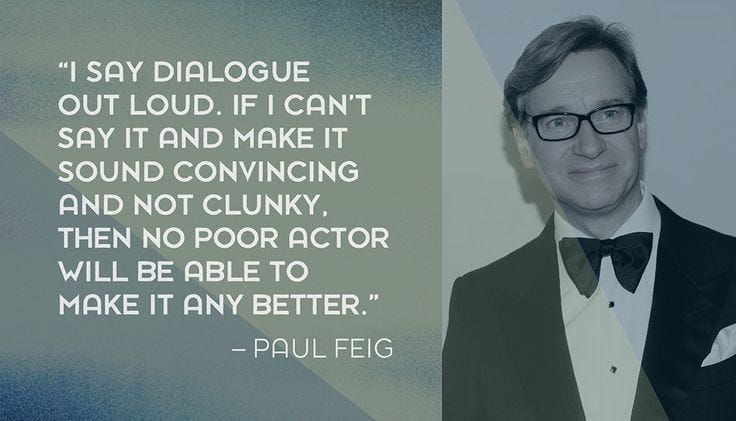
Perhaps nowhere is this more apparent than with dialogue. When I pose the question, “How do you write dialogue” to professional screenwriters, the most common response is basically this: I don’t know.
Common advice as to how to learn to write good dialogue:
* Listen to real-life conversations to get a sense of how people talk.
* Read scripts and watch movies — or better yet listen to movies — in order to grasp the feel and flow of film characters talking.
* Simply keep writing, that the more you pound out pages and knock out original screenplays, you will develop your ear for dialogue.
All of those are reasonable points. But aren’t there principles and practices we can learn to help bring into focus a writer’s ability to craft compelling, entertaining and effective dialogue?
That was my thinking when I sat down to create the fifth class in the Core curriculum — Core V: Dialogue.
As with everything I teach about screenwriting, it starts with character. Isn’t it obvious the more you know and understand about your story’s characters, the more likely their respective voices will emerge into your consciousness?
Beyond that, it’s not just about hearing them, it’s about choosing the most impactful dialogue to support the point of each scene and drive the plot forward.
Hence the fifth Essential Screenwriting Principle: Dialogue = Purpose.
In a screenplay, there is almost zero room for extraneous dialogue, rather every line should tie into the Plotline and/or Themeline.
In Core V: Dialogue, we dig deep into this subject through 6 lectures I have written:
Lecture 1: Introduction to Dialogue
Lecture 2: Finding Your Character’s Voice — Inward Journey
Lecture 3: Finding Your Character’s Voice — Outward Expression
Lecture 4: Subtext
Lecture 5: What Is Not Said
Lecture 6: Realistic Dialogue
In addition there are several Insider Tips, analysis of several movie scripts, opportunities to workshop dialogue in some of your own original scenes, a 75-minute teleconference, and much more.
A testimonial from a writer:
“Scott is so generous with sharing his knowledge and it’s a great blessing to those of us who are just starting off/been doing it for years/need a reminder/need inspiration. I just completed the Core Dialogue course and I can honestly say he delivers back your investment threefold.” — Sabina Giado
There is no right way to write. Every writer is different. Every story is different. And you can learn everything you need to know about the craft of screenwriting by doing three things: Watch movies. Read scripts. Write pages.
However if you want to explore the subject of dialogue in an immersive fashion and from a distinct character-based perspective, I invite you to join me for this 1-week online class which begins Monday, September 19.
For more information, go here.