Screenwriting Lessons: “The King’s Speech” — Part 2: Metamorphosis
Five-part series exploring lessons from David Seidler’s Oscar winning script.
Five-part series exploring lessons from David Seidler’s Oscar winning script.
The King’s Speech won an Academy Award for Best Original Screenplay in 2011. Originally developed as a play, the script is noteworthy in how well it takes a two-hander and making it work as a movie.
Today: Metamorphosis.
It’s perhaps the single most universal narrative archetype of all and at the heart of The Hero’s Journey: Metamorphosis. A character begins a story in one state of being and ends up in a different one. A significant reason for its ubiquity: We all want to believe we can change. Stories that feature metamorphosis reinforce that belief, hence we are drawn to them.
In The King’s Speech, screenwriter David Seidler works this dynamic of metamorphosis on two levels: The External World dealing with Bertie’s actual stuttering and the Internal World delving into Bertie’s psychological state as he struggles to deal with that to which he is eventually called — to become the King of England. The two are separate issues and yet ultimately inseparable given the public nature of Bertie’s position of high-standing.
While the entire movie does a superlative job tracking the arduous process of Bertie’s work with Lionel, both as therapist (stuttering) and mentor (psychology), we can see most clearly the scope of Bertie’s metamorphosis by comparing a few key scenes.
The first scene, which I featured in yesterday’s post, demonstrates the power Bertie’s stuttering holds over his tongue.
Bertie stands frozen, his mouth agape, jaw muscles locked.
But the second part of that paragraph of scene description takes us into the Protagonist’s Internal World:
He knows he’s considered by all, especially himself, unfit for
public life.
From the very beginning of the story, Bertie does not feel he is fit for public life, let alone to be King. Later when his older brother David (Guy Pearce) is having second thoughts about ascending to the throne following their father’s death, Bertie and Lionel have a heated discussion:
LIONEL
Your brother knew perfectly well by giving
you a document without warning...BERTIE
Are you saying he wanted me to fail?LIONEL
Are you insisting he didn’t? In the future
we can parse any document into manageable
phrases. You can sing them, swear them,
rehearse them til you get the rhythm and
flow; that, combined with your growing
confidence...Bertie doesn’t want to hear.BERTIE
Growing confidence? Growing dread!!! You’re
a wicked man, Lionel Logue, trying to get
me to thrust myself forward as an
alternative to my brother. Trying to get me
to commit treason!LIONEL
Trying to get you to realize you need not
be governed by fear. Again, why did you
seek me out? To take polite elocution
lessons so you could attend posh tea
parties?!BERTIE
How dare you! I’m the brother of a
King...the son of a King...back through
untold centuries. You presume to instruct
me on my duty? A jumped-up jackeroo from
the outback? The disappointing son of an
embittered clerk! You’re a monster, Doctor
Logue. I’m going to Balmoral to spend a
pleasant country weekend with my beloved
brother. And these sessions are over!
The text of the dialogue is outrage at Lionel’s intimation that Bertie consider himself a worthy successor to the throne, but the subtext is one of fear — a gnawing sense of inevitability confronting Bertie that he will have to assume the monarchical responsibilities and his own overwhelming sense of his inability to handle the job.
When that possibility becomes the reality, Bertie returns to Lionel, a chastened King-to-be:
BERTIE
(blurts out)
What’s the one essential thing a King must
do? He must believe he is King. How can I
possibly do that? For pity sake, Lionel, I
beg you: get me through! I’ll pay you
another shilling.
So the two story realms meet headlong: The External World (stuttering) and the Internal World (Bertie’s fear that he does not have the strength to be King). And they are both paid off in the movie’s Final Struggle — when Bertie delivers a radio speech to the nation, indeed, the whole world, responding to Germany’s declaration of war.
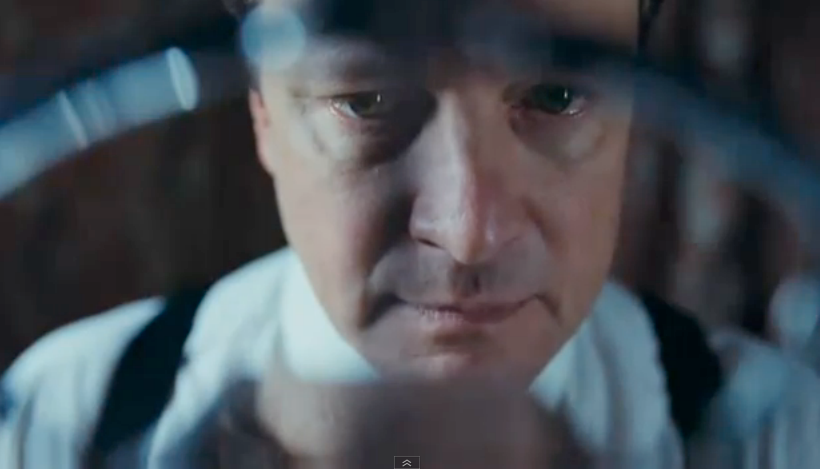
For those who have seen the movie, you will remember at least the tone, if not the words of Bertie’s speech. We can see and hear how he manages his stuttering. But it is the power behind the words and the sheer willfulness Bertie demonstrates in the moment that signifies his true ascension to the throne. Seidler writes in scene description as his daughters listen to Bertie over the radio:
Lilibet’s expression tells it all - she can hear it, her father
is truly King.
From a beginning state of this — He knows he’s considered by all, especially himself, unfit for public life — to an ending state of this — she can hear it, her father is truly King — Bertie’s metamorphosis is complete on both levels, overcoming both his stuttering and his fear of royal responsibilities.
Tomorrow: Talismans.