Script To Screen: “Adaptation”
A memorable scene from the 2002 movie Adaptation, screenplay by Charlie Kaufman and Donald Kaufman, book by Susan Orlean.
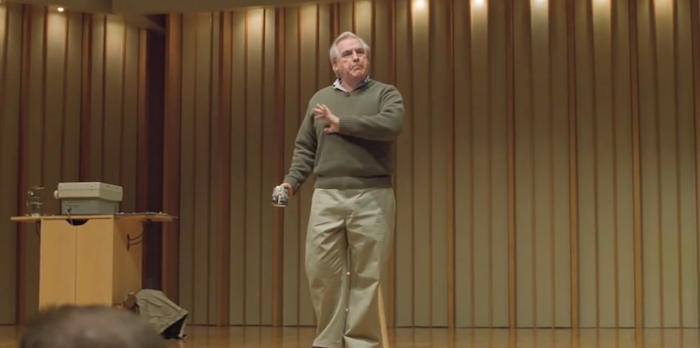
A memorable scene from the 2002 movie Adaptation, screenplay by Charlie Kaufman and Donald Kaufman, book by Susan Orlean.
INT. AUDITORIUM - MORNINGKaufman, bleary-eyed, sits in the back. McKee paces.MCKEE
Anyone else?Kaufman timidly raises his hand.MCKEE (cont'd)
Yes?KAUFMAN
You talked about Crisis as the ultimate
decision a character makes, but what if a
writer is attempting to create a story
where nothing much happens, where people
don't change, they don't have any
epiphanies. They struggle and are
frustrated and nothing is resolved. More
a reflection of the real world --MCKEE
The real world? The real fucking world?
First of all, if you write a screenplay
without conflict or crisis, you'll bore
your audience to tears. Secondly:
Nothing happens in the real world? Are
you out of your fucking mind? People are
murdered every day! There's genocide and
war and corruption! Every fucking day
somewhere in the world somebody
sacrifices his life to save someone else!
Every fucking day someone somewhere makes
a conscious decision to destroy someone
else! People find love! People lose it,
for Christ's sake! A child watches her
mother beaten to death on the steps of a
church! Someone goes hungry! Somebody
else betrays his best friend for a woman!
If you can't find that stuff in life,
then you, my friend, don't know much
about life! And why the fuck are you
taking up my precious two hours with your
movie? I don't have any use for it! I
don't have any bloody use for it!KAUFMAN
Okay, thanks.
The movie version of the scene:
When you write dialogue as stellar as this, you can probably expect the final product to pretty much stick to the script, like here.
I have to add this bit just preceding the scene above:
INT. AUDITORIUM - LATER
McKee scribbles a diagram onto a transparency in an overhead
projector. It's some kind of complicated time-line with act-
breaks and corresponding page numbers indicated. The
audience members take copious notes. Kaufman sweats.
KAUFMAN (V.O.)
It is my weakness, my ultimate lack of
conviction that brings me here with all
these desperate idiots lapping up
everything this bag of wind spouts. Easy
answers. Rules to short-cut yourself to
success. And here I am, because my jaunt
into the abyss brought me nothing. Well,
isn't that the risk one takes for
attempting something new. I should leave
here right now. I'll start over --
(starts to rise)
I need to face this project head on and --
MCKEE
... and God help you if you use voice-
over in your work, my friends.
Kaufman stops, looks up, startled. McKee seems to be looking
at him.
MCKEE
God fucking help you! It's flaccid,
sloppy writing. Any idiot can write
voice-over narration to explain the
thoughts of a character. You must
present the internal conflicts of your
character in image, in symbol. Film is a
medium of movement and image.
Kaufman looks around at people scribbling in notebooks. "Any
idiot..." writes the guy on one side of him. "Flaccid..."
writes the guy on the other side.
It’s one of the funniest, most clever bits in the movie, a kind of ultra-meta moment where Charlie is talking to himself with voice-over narration, then McKee busting in with his commentary about how voice-over is “flaccid, sloppy writing”. Great stuff!
One of the single best things you can do to learn the craft of screenwriting is to read the script while watching the movie. After all a screenplay is a blueprint to make a movie and it’s that magic of what happens between printed page and final print that can inform how you approach writing scenes. That is the purpose of Script to Screen, a weekly series on GITS where we analyze a memorable movie scene and the script pages that inspired it.