Script To Screen: “Citizen Kane”
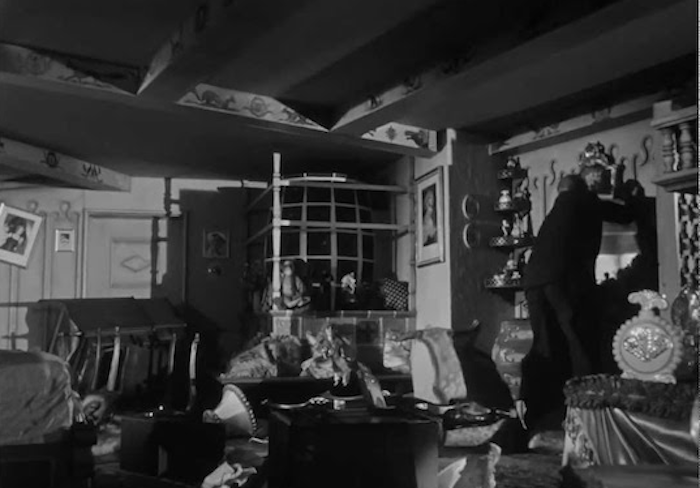
A memorable scene from the 1941 movie Citizen Kane, original screen play by Herman J. Mankiewicz & Orson Welles.
IMDb plot summary: Following the death of a publishing tycoon, news reporters scramble to discover the meaning of his final utterance.
Setup: Kane’s wife Susan has just left him.
Here is the scene from the script:
INT. CORRIDOR OUTSIDE SUSAN'S BEDROOM - XANADU - NIGHT -
The housekeeper, Mrs. Tinsdall, and a couple of maids are
near the door but are too afraid to be in front of it.
From inside can be heard a terrible banging and crashing.
Raymond hurries into scene, opens the door and goes in.
INT. SUSAN'S BEDROOM - XANADU -
Kane, in a truly terrible and absolutely silent rage, is
literally breaking up the room - yanking pictures, hooks
and all off the wall, smashing them to bits - ugly, gaudy
pictures - Susie's pictures in Susie's bad taste. Off of
occasional tables, bureaus, he sweeps Susie's whorish
accumulation of bric-a-brac.
Raymond stands in the doorway watching him. Kane says
nothing. He continues with tremendous speed and
surprising strength, still wordlessly, tearing the room to
bits. The curtains (too frilly - overly pretty) are
pulled off the windows in a single gesture, and from the
bookshelves he pulls down double armloads of cheap novels
- discovers a half-empty bottle of liquor and dashes it
across the room. Finally he stops. Susie's cozy little
chamber is an incredible shambles all around him.
He stands for a minute breathing heavily, and his eye
lights on a hanging what-not in a corner which had escaped
his notice. Prominent on its center shelf is the little
glass ball with the snowstorm in it. He yanks it down.
Something made of china breaks, but not the glass ball.
It bounces on the carpet and rolls to his feet, the snow
in a flurry. His eye follows it. He stoops to pick it up
- can't make it. Raymond picks it up for him; hands it to
him. Kane takes it sheepishly - looks at it - moves
painfully out of the room into the corridor.
INT. CORRIDOR OUTSIDE SUSAN'S BEDROOM - XANADU -
Kane comes out of the door. Mrs. Tinsdall has been joined
now by a fairly sizable turnout of servants. They move
back away from Kane, staring at him. Raymond is in the
doorway behind Kane. Kane looks at the glass ball.
KANE
(without turning)
Close the door, Raymond.
RAYMOND
Yes, sir.
(he closes it)
KANE
Lock it - and keep it locked.
Raymond locks the door and comes to his side. There is a
long pause - servants staring in silence. Kane gives the
glass ball a gentle shake and starts another snowstorm.
KANE
Raymond -
(he is almost in a
trance)
RAYMOND
Yes, sir -
One of the younger servants giggles and is hushed up.
Kane shakes the ball again. Another flurry of snow. He
watches the flakes settle - then looks up. Finally,
taking in the pack of servants and something of the
situations, he puts the glass ball in his coat pocket. He
speaks very quietly to Raymond, so quietly it only seems
he's talking to himself.
KANE
Keep it locked.
He slowly walks off down the corridor, the servants giving
way to let him pass, and watching him as he goes. He is
an old, old man!
Here is the movie version of the scene:
Really interesting to compare script to screen. Substantially the same and interesting insight into the focus of his rage, Susan’s “whorish accumulation of bric-a-brac.” I’ve seen the movie at least a half-dozen times and didn’t grasp until now that amidst Susan’s novels, Kane discovers a “half-empty bottle of liquor” — never made that connection from that moment [1:10 in the clip above].
But some key differences. First, the way the snow globe ends up in Kane’s hand. It doesn’t roll to the floor and Raymond doesn’t hand it to Kane as in the script. Rather Kane freezes his destruction when he notices the object on a side table. Picks it up himself. Gives it a shake.
And then a big shift: At that precise moment, Kane whispers, “Rosebud.” And that is the only dialogue in the movie version of the scene.
Why do you think Welles dropped those exchanges between Kane and Raymond? My guess: It’s unnecessary. We know he will cut Susan out of his life. Besides that dialogue distracts from the remarkable moment of Kane standing with the snow globe. First, we saw his rage, a raw emotion begun when Kane was yanked away from his idyllic Colorado home as a child. Now as he stares at the globe, the snow reminding him of that wonderful time in his life, tears well up in his eyes, and so rage gives way to sadness.
That moment is the key to grasping the wound to Kane’s psyche and which fuels everything he does as an adult to distract himself from that pain.
What else do you see in comparing script to screen in this scene from Citizen Kane?
One of the single best things you can do to learn the craft of screenwriting is to read the script while watching the movie. After all a screenplay is a blueprint to make a movie and it’s that magic of what happens between printed page and final print that can inform how you approach writing scenes. That is the purpose of Script to Screen, a series on GITS where we analyze a memorable movie scene and the script pages that inspired it.
For more articles in the Script To Screen series, go here.