Set pieces
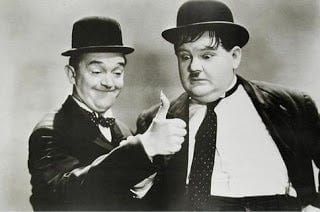
My youngest son, Luke, is a huge fan of slapstick humor. I guess that should come as little surprise seeing as he’s just turning 8 years old and everything that involves bodily humor is, therefore, ‘good’ humor. As a lark, I started recording old Laurel & Hardy movies . Well, Luke loves them, doubling over with huge paroxysms of laughter as the comic pair bash each other silly.
Watching one recently with Luke, I was reminded of the importance of something called a “set piece.” What is a set piece? John August on his excellent screenwriting blog johnaugust.com, defines set-piece this way:
SET-PIECE
A scene or sequence with escalated stakes and production values, as appropriate to the genre. For instance, in an action film, a set-piece might be a helicopter chase amid skyscrapers. In a musical, a set-piece might be a roller-blade dance number. In a high-concept comedy, a set piece might find the claustrophobic hero on an increasingly crowded bus, until he can’t take it anymore. Done right, set-pieces are moments you remember weeks after seeing a movie.
I suspect the phrase has its roots in the early days of filmmaking, where the script called for a sequence requiring a substantial set to be built for production. Over time, set piece has come to mean, as John August suggests, any big scene sequence. In theory, I suppose, when a script has a big set piece, that represents or is tied to a major plot point.
In Laurel & Hardy movies, you could pretty much expect the same thing, film after film: Plunk the pair into a different environment — the French Foreign Legion, World War I, Switzerland — and give the audience 7 or 8 good set pieces where the duo could milk humor for 5–7 minutes per piece, and voila — you’ve got a movie.
I’m also reminded of an Irving Thalberg quote which unfortunately I can not find, but to paraphrase, Thalberg told a screenwriter rather dismissively (he had a propensity for doing that with writers), “Just give me 5 big moments — and I’ll make the movie.” Set pieces. Memorable moments. Scenes that audiences will talk about to their friends and create buzz.
So take a macro look at that script you’re writing. How many set pieces do you have? Be honest. Only count the scenes where a lot happens, where the characters milk for the set piece for all its worth, a series of connected scenes where something of major significance to the plot transpires.
Do you have 4, 5, or 6 strong set pieces?
If you’re not sure you’ve got the concept down, screen some Laurel & Hardy movies. You’re sure to see set pieces in action — and two wonderfully comic actors at work.
By the way, here is one of the Laurel & Hardy set pieces. In their 1938 movie Swiss Miss, the pair get stuck working in a hotel in Switzerland. Imagine them decked out in the whole lederhosen motif, and they are tasked with moving a piano… across a rickety wood & rope bridge… overlooking a deep gorge. Oh, and because that’s not enough, the writers tossed in a gorilla to spice up the action. That’s a set piece.
UPDATE: Did more research. Laurel & Hardy made an unbelievable number of movies, albeit many of them in the 60–75 minute range.