“The Eureka Hunt”
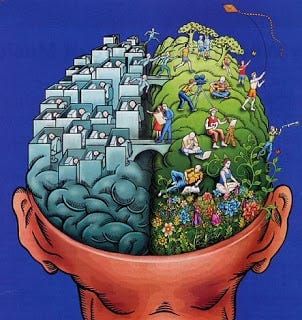
We’ve bumped around the subject of the human brain before here and its connection to the creative process. Well, the July 28th issue of the New Yorker magazine has an article called “The Eureka Hunt” that is right in my wheelhouse of interest. What happens in the human brain when a person has a “moment of insight,” or what scientists call the insight experience? How many times has this happened to you re your writing: you’re stuck with a story problem, your plot seemingly boxed in, then you’re off doing something entirely apart from writing, your mind elsewhere and boom — the solution comes to you? From the article:
Many stimulants, like caffeine, Adderall, and Ritalin, are taken to increase focus — one recent poll found that nearly twenty percent of scientists and researchers regularly took prescription drugs to “enhance concentration” — but, accordingly to Jung-Beeman and Kounios, drugs may actually make insights less likely, by sharpening the spotlight of attention and discouraging mental rambles. Concentration, it seems, comes with the hidden cost of diminished creativity. “There’s a good reason Google puts Ping-Pong tables in their headquarters,” Kounios said. “If you want to encourage insights, then you’ve got to also encourage people to relax.” Jung-Beeman’s latest paper investigates why people who are in a good mood are so much better at solving insight puzzles. (On average, they solve nearly twenty percent more C.R.A. problems.)
So sometimes, what’s required for creative insight is not concentration, but rather play, relaxation, or a change of scenery.
I worked on a TV pilot for NBC under the guidance of the show runner Roy Huggins. When you work with a person who created the TV shows “The Rockford Files” and “The Fugitive”, you tend to listen very carefully to their advice. Roy’s approach was to figure out each scene one after the other, no jumping around, go from scene one to scene two to scene three in straight linear fashion. I asked him if he ever got stuck and he said, “All the time.” What would he do? Roy liked to get in his car (I seem to remember he was fond of Jaguars) and drive. Just drive. He’d start off by thinking about the story problem, then his mind would wander. One time he said he got so engrossed in his thoughts, that when he finally solved the story problem, he discovered he had driven all the way to Arizona. But he drove back a happy man.
Sometimes you just need to slam your head against the story problem over and over to solve it. But it’s always possible that what you really need to do is go outside and play for awhile.
UPDATE: In comments per the question “how do you solve story problems,” Luzid says simply: “Weed.” Interesting because Carl Sagan was a long-time proponent of marijuana. He used to write stoned and edit sober, a variation on Mark Twain’s old line, “Write drunk, edit sober.”