“The great secret of death…”
For those of you writing a story now — or anytime — which deals with death, these words by Rilke are almost certainly relevant for your creative and thought process:
The great secret of death, and perhaps its deepest connection with us, is this: that, in taking from us a being we have loved and venerated, death does not wound us without, at the same time, lifting us toward a more perfect understanding of this being and of ourselves.
Just as we require Night to help define Day, and Evil to shape our perception of Good, so too Death to understand Life.
We know this from movies. For example in the words of Andy Dufresne (The Shawshank Redemption), “Get busy living… or get busy dying.”
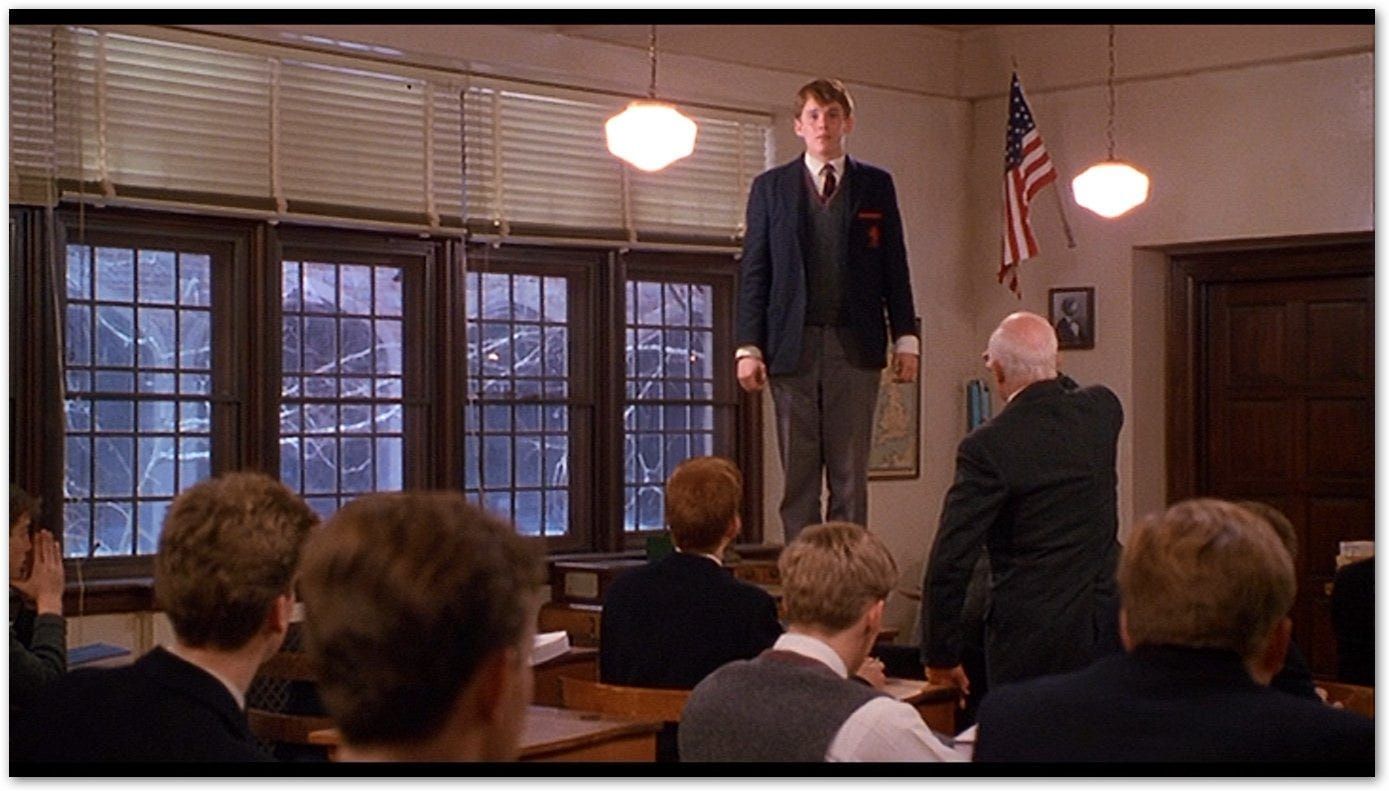
It’s also implied in the wisdom of John Keating (Dead Poets Society) when he implores his students to “Carpe diem”: Seize the day. The subtext: The Day will not exist forever. Night will come. Make the most of the Light before the Darkness enshrouds you.
Death need not be physical, it can be symbolic. The loss of a career. Romance. Dream. Indeed, I wonder if in some ways ALL stories are about death — either Big Letter “D”, actual loss of life, or small letter “d”, a more thematic type of ending.
In either case, that ending can create for a character a Beginning, a journey toward a new Understanding. In fact with regard to a Protagonist’s metamorphosis, if they do change, their Old Way of Being, the Inauthentic Life they’ve stitched together before FADE IN / Once Upon a Time, those Beliefs and Behaviors, Coping Skills and Defense Mechanisms must fall away so the Authentic Nature and True Self can be freed up to emerge into the Protagonist’s consciousness and embraced as a New Way of Being in response to the events of their Adventure.
Again Rilke: “The trees you planted in childhood have grown too heavy. You cannot bring them along. Give yourselves to the air, to what you cannot hold.”
The Protagonist has to let go — let die — the ‘trees’ they have allowed to grow in their Old Life in order to go on their story’s journey and enable the ‘stuff’ of their Core Of Being to take flight — come to life — and in breathing deeply that ‘air,’ become stronger and stronger as they head toward their Final Struggle and in most stories Unity.
I am speaking thematically, of course, but think of your favorite movie Protagonists. One great example is from a movie I’ve mentioned: Dead Poets Society. Todd Anderson (Ethan Hawke) struggles mightily, but in the end moves to free himself from the clutches of his ‘trees,’ symbolized by that famous scene in saying good-bye to Keating.
Contrasted to Neil Perry (Robert Sean Leonard) who tries to escape the ‘trees’ of his father’s life — “You will become a doctor” — but cannot stand up to him and the death of his dream to become an actor results in his own Death.
Finally and on a more general note, Death as a theme or central dynamic in a story has a universality to it because each of us is born with a termination date. Morbid stuff, I know, but we ALL know that, yet somehow go about our lives with that knowledge sequestered in a lock box within our psyche. Stories allow us to open that box and explore our feelings, thoughts, and emotions about Death, helping us to prepare for the loss of loved ones… and our own finite place in Life. As Rilke says, “toward a more perfect understanding… of ourselves.”
So as you write this story or one upcoming, consider how (D)eath or (d)eath plays a part. What does it MEAN to the characters? In particular, how does it influence the Protagonist on their journey?
You can tap into a wellspring of significance, emotion, and narrative power by exploring this psychological terrain.
Comment Archive