The importance of an outline
You probably get sick of me harping on the importance of ‘breaking’ your story in the prep-writing phase, ideally ending up with a comprehensive outline. So I have featured interviews with screenwriters who extol the virtues of outlines like Dustin Lance Black, who wrote the screenplay for Milk:
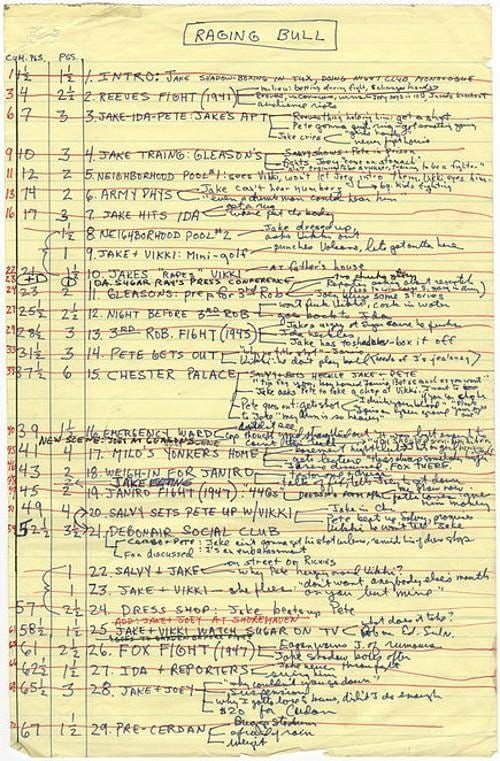
But allow me to make this point even more tangible for you. Here is a photograph of Paul Schrader’s outline for the Raging Bull script:
This corroborates what I have posted before from an interview with Schrader:
“I know exactly where I’m going beforehand. I know to the half page if I’m on or off target. I draw up charts before I do a script. I endlessly chart and re-chart a movie. Before I sit down to write, I have all the scenes listed, what happens in each scene, how many pages I anticipate each scene will take. I have a running log on the film. I can look down and see what happens by page thirty, what happens by page forty, fifty, sixty and so forth. I have the whole thing timed out to a hundred and five, a hundred and ten pages. You may go two, three pages ahead or behind, you may add or drop dialogue or scenes; but if you’re two pages ahead or behind, you have to work that into the timing. Especially if you get five pages ahead, or, worse, five pages behind, then something you had planned to work on page forty may not work the same way on page forty-five.”
Let’s add one more chip to the pot to get you to go all-in and embrace outlines. You can go here to download the “step sheet” for the Chinatown screenplay, crafted by Robert Towne and Roman Polanski. It is in effect an outline with considerable detail for each scene.
This is what most professional screenwriters and all TV writers do: Wrangle the story in prep.
Okay, I get it, prep-writing is hard. Working up an outline is a pain in the posterior. But here’s the thing: You are going to have to do the hard work anyhow. Why do it after you type FADE IN, spending all that time and energy wandering around, stopping, starting, going back, re-starting with a very good chance you won’t ever finish the draft because you will get frustrated at being lost… when you can ‘break’ your story in prep, then type FADE IN with confidence since you already have a strong sense of the narrative’s structure.
So yes, consider this a sales pitch for the online workshop I created five years ago: Prep: From Concept to Outline. I have worked with countless writers who absolutely loathed outlines who, after learning this approach to prep, now swear by them.
In the end, by breaking your story in prep, you will save time… exponentially increase the chances you will actually finish your script… and be able to enjoy the page-writing process because you pretty much know where your story is heading.
[clears throat]
Chinatown: Academy Award, Best Writing, Original Screenplay [1975]
Raging Bull: Nominated, Golden Globe, Best Screenplay [1981]
Milk: Academy Award, Best Writing, Original Screenplay [2009]
[drops mic]
My next session of Prep: From Concept to Outline begins Monday, March 2. For more information and to enroll, go here.
Comment Archive