The Metamorphosis of Darth Vader
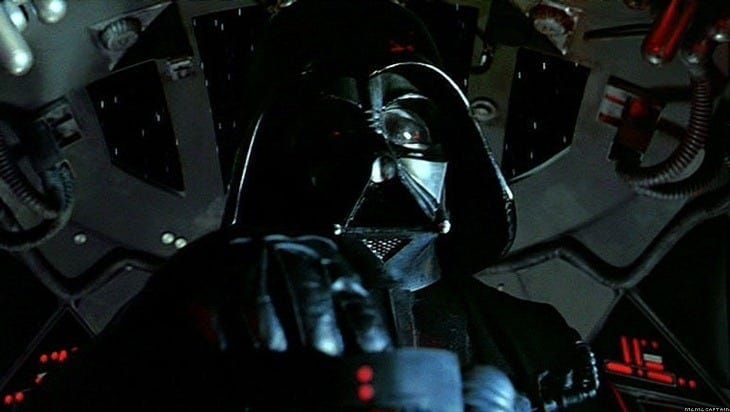
With the new Star Wars movie a week away, I was reminded of a note I had jotted down a few months ago — to do a post tracking the metamorphosis of Darth Vader, how his narrative function changes from SW:IV to SW:V to SW:VI.
In A New Hope, clearly Vader is a Nemesis figure:
- When we meet him, he kidnaps Princess Leia and is a threat to her well-being.
- He fights, then slays Obi-Wan Kenobi
- And ultimately he goes one-on-one in a classic Final Struggle with Luke Skywalker, the story’s Protagonist.
In The Empire Strikes Back, Vader becomes intrigued, then seduced by the idea of turning Luke to the Dark Side of the Force. Even as he fights Luke at the end of the movie, he veers from enemy — trying to hurt Luke, indeed, cutting off his hand — to an attempt to be his ally by wooing Luke (“You have controlled your fear. Now, release your anger. Only your hatred can destroy me.”)
This shift, back and forth — enemy to ally, ally to enemy — is the clearest sign of a Trickster character. Whereas a Nemesis provides opposition to the Protagonist, a Trickster tests their will, which Vader definitely does with Luke during their light saber battle, playing mind games with Luke capped off by this:
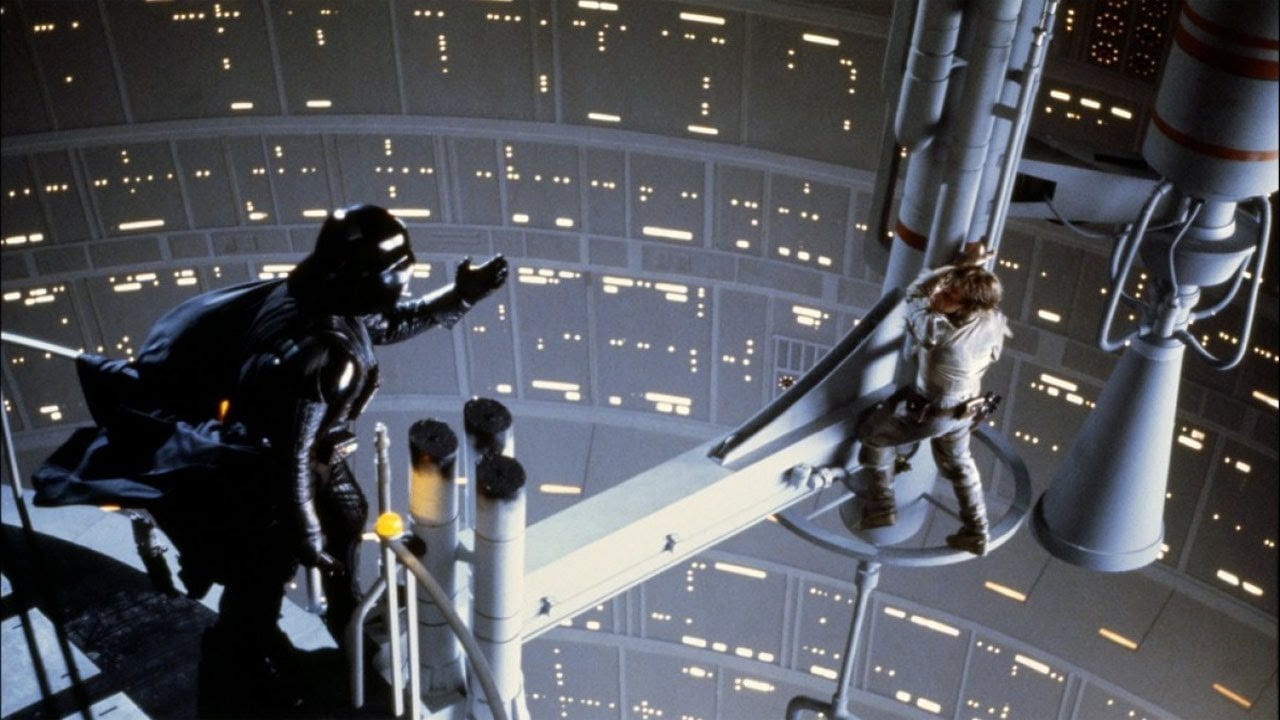
Tricksters play tricks. Vader’s revelation about his relationship to Luke is a huge one!
But Vader’s function in Return of the Jedi shifts once again. Now that Luke has accepted the fact Vader is his father, while Vader still tries to work on Luke in order to bring him to Emperor Palpatine at the Emperor’s demand, Luke turns the table and attempts to reach whatever shred of humanity still exists within Vader’s psyche:
Luke: Your thoughts betray you, Father. I feel the good in you, the conflict.
Darth Vader: There is no conflict.
Luke: You couldn’t bring yourself to kill me before and I don’t believe you’ll destroy me now.
— —
Darth Vader: You cannot hide forever, Luke.
Luke: I will not fight you.
— —
Luke: Search your feelings, Father, you can’t do this. I feel the conflict within you. Let go of your hate.
Indeed, it works as Vader, mortally wounded, saves Luke from Emperor Palpatine, sending the latter to his demise just before Luke would have ended up dead. Leading to this scene:
In their last moments together, Luke and Vader achieve a level of connection worthy of a father-son relationship. The exchange is a deeply emotional one and demonstrates how far both have evolved in their feelings toward one another.
In this respect, I would argue that Vader’s narrative function in Return of the Jedi is ultimately that of Attractor. This character type is most closely associated with the Protagonist’s emotional development and that is precisely what lies at the heart of the Luke-Vader relationship in the movie.
And so Vader shifts narrative functions over the course of the three movies: From Nemesis to Trickster to Attractor. That is quite a metamorphosis!
Who knows? In The Force Awakens, maybe we’ll see Luke Skywalker shift from Protagonist to Nemesis.
NOTE: This article was posted in 2015.