The Most Profitable Movies of 2011
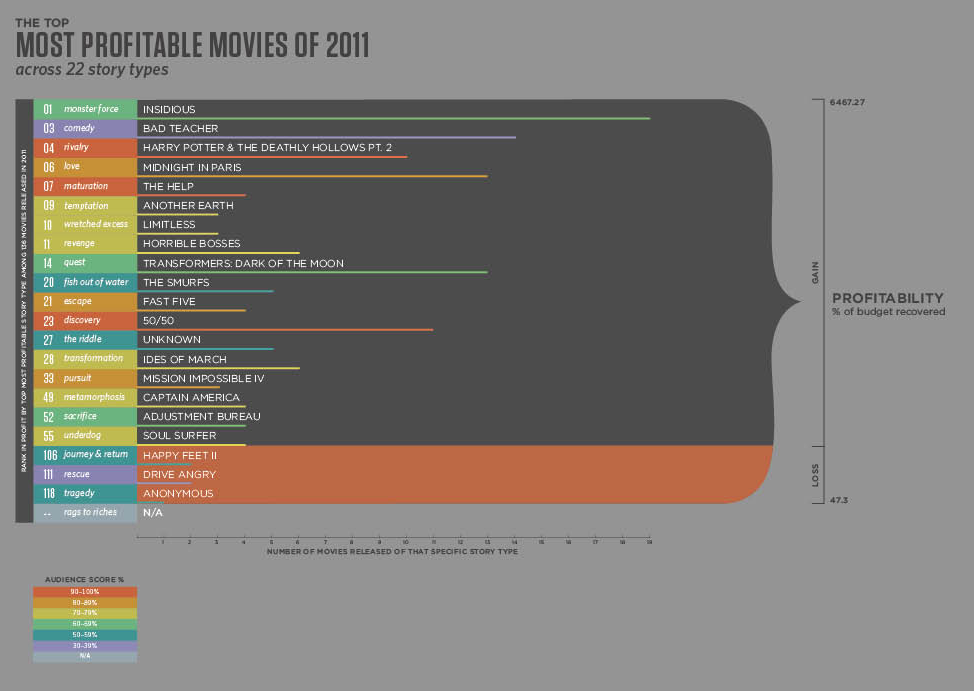
Franklin has been tracking this: The Information Is Beautiful Awards [celebrating excellence in data visualization and information design] and their most recent challenge: Hollywood! Here is the winner:
Three things based on my initial analysis of the chart:
* First there only seems to be a marginal connection between positive audience score and successful results, whereas there does seem to be a correlation between negative scores and poor B.O. performance. For example, Bad Teacher is the 3rd most profitable movie, yet is in the group with the most negative audience reaction. Possible overriding causes for success: R-rated comedies which are hot right now, sexy teacher fantasy, and Cameron Diaz playing a Bad Girl. In other words, sometimes bad is good [B.O.].
* Only 2 of the top 20 most profitable movies [as defined by this graph] are big budget films: Harry Potter and Transformers. And that doesn’t take into account gross profit positions of talent tied to these sequels which would eat into the studio’s profit. Yet Hollywood is obsessed with developing big budget franchise movies. What does that tell us? Whereas Insidious may have generated over 6000% in revenues compared to its budget [according to Box Office Mojo $97M worldwide B.O. vs. $1.5M budget], $95M while nice profit is nowhere near what a franchise film can generate in terms of sheer numbers [e.g., HPDH:P2: $1.3B in B.O. revenues]. And that doesn’t include ancillary streams such as merchandising, nor the value of the title to the studio’s catalog, its potential as a remake vehicle, etc.
* Specific per the chart: I’d like to see a breakdown of what they mean by their “story types.” For instance, what is the difference between “Transformation” [Ides of March] and “Metamorphosis” [Captain America]? Frankly that confuses me right there on the face of it because I would argue a vast majority of movies have that dynamic in play. Same thing with “Journey & Return” [Happy Feet II]: Whether it’s an actual physical / geographical journey or more of a psychological one, isn’t that the central narrative archetype of most stories?
That said it’s a pretty cool chart and does spotlight some interesting numbers.
What do you think?
To see the other winners in the competition, go here.
Comment Archive