The Narrative Connection Between Protagonist and Antagonist

I normally don’t promote content involving the screenwriting ‘guru’ set for a variety of reasons, however here is a post via an outfit called StudioBinder, who approached me, which pretty much aligns with how I write and what I teach. The post, inspired by this video, lays out what it calls “Four Essential Principles for Creating the Ultimate Antagonist” and uses The Dark Knight for examples.
The subtext of these four principles is this: There is a narrative connection between the Protagonist and the Antagonist (I prefer the term Nemesis). It’s not a random choice, at least with good Nemesis figures. And this is where I go deeper into the subject.
To really delve into the richness of the Nemesis character, we should explore the psychological connection between that character and the Protagonist. Here is an excerpt from a post I wrote back in 2010, responding to a reader question about how to “build a powerful villain”:
First, answer this question: How does your villain function as a Nemesis character in relation to the Protagonist? Because if you take a psychological approach to stories, I would argue that most mainstream movies are, at their core, transformation journeys — where the Protagonist goes through a series of events which result in them changing from one emotion state (Disunity) as evidenced in Act One into eventually another and different emotion state (Unity) by the end of Act Three. And quite often, one of the keys in that process is their engagement with the Nemesis who in effect is the physicalization of the Protagonist’s shadow self, the repressed and suppressed aspects of their psyche that the Protagonist has — in their life up to FADE IN — been fearful of acknowledging, let alone interact with.
The classic cinematic example of this is in the movie Star Wars: The Empire Strikes Back when Luke Skywalker ventures deep into the swamps of Degobah to encounter his Nemesis Darth Vader — only to sever Vader’s head off Vader’s body, his helmet explodes, revealing that the face within is Luke’s.
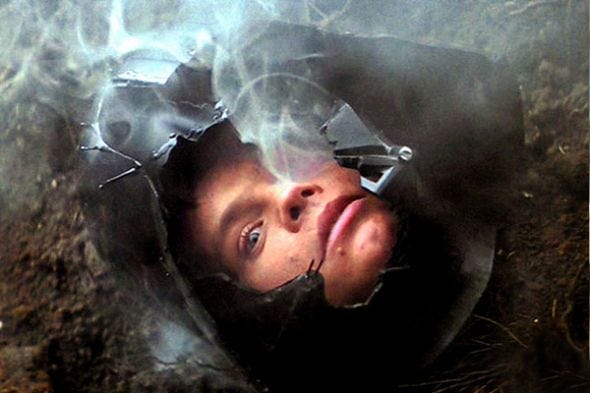
In other words, Luke has within him the dark side of the Force as well as light side — just as all humans have ‘good’ and ‘bad’ instincts. As Carl Jung would argue, we can not move toward any approximation of wholeness or unity unless we engage all of the aspects of our psyche and that includes those parts of who we are that we fear most, which he called the shadow.
So as a writer, you can dig into your Protagonist and ask these questions: What are you most afraid of? What are you hiding? What fears and anxieties are you repressing? Those psychological elements can instruct you in the way you craft your Nemesis. Build a character where those very bad / weak / frightful elements are a core part of their essence, and you’ve got the makings of a powerful villain, well-armed to stand in opposition to the Protagonist, not only in terms of what they can do in the Plotline, but also what they represent emotionally and psychologically in relation to the Protagonist in the Themeline.
Whether it’s Miss Gulch to Dorothy in The Wizard of Oz, Mr. Sheldrake to C.C. Baxter in The Apartment, the sleazy TV director Ron to Dorothy Michaels a k a Michael Dorsey in Tootsie, Buffalo Bill to Clarice Starling in The Silence of the Lambs, or the Joker to Batman in The Dark Knight, to craft a worthy Nemesis, we do well to explore the psychological connection between the characters. If the Nemesis is in some way a projection of the Protagonist’s shadow aspect of their psyche, you not only zero in on a specific connection, you also set into motion a great ongoing conflict wherein the Protagonist has to face that which they fear the most: Their own dark impulses.
Here are some more GITS links to posts on the subject of writing a good Nemesis / Antagonist character:
Is it okay for the Antagonist drive the Plot?
Does a story absolutely need an antagonist?
Is it possible to have a screenplay without a specific Antagonist character?
How to build a powerful Nemesis?
The psychopathology of heroism
Readers, what say ye? Your thoughts on crafting a worthy Nemesis. Love to hear from you in comments.
Comment Archive