The Physics of Story Concepts
One of the aspects of teaching that is fascinating to me is how situations arise which engender new metaphors and takes on content that not only enlighten the writers who take my courses, but also provide new insights for me. For example in my current Core II: Concept class, the title of Lecture 1 is “The Concept of High Concept”. In that lecture, I posit this:
Most people in Hollywood would probably define ‘high concept’ this way: A story that can be summed up in 1–2 lines. However just because you can summarize a story in a few lines does not necessarily mean it’s a high concept. For example the description, “A manipulative woman and a roguish man carry on a turbulent love affair in the American South during the Civil War and Reconstruction” does not make Gone With The Wind a high concept movie. It isn’t. In fact the film is in some ways the antithesis of high concept because it is a sprawling epoch featuring dozens of characters, numerous semi-independent subplots, and a multitude of themes. It’s also proof a movie does not have to be a high concept to be both great and successful.
No, in defining ‘high concept,’ we need to be more specific: A story idea that can be summed up in 1–2 lines. A high concept movie must have a clean, simple, and basic idea.
We can even go more granular by talking about story-conceit, which I would define as the “central premise of the story.” With the movie K-9, it was the premise of a human cop teamed up with a dog cop. With Inception, it’s the premise that people can enter into other people’s dream states. With Groundhog Day, it’s the premise that someone has to relive a day over and over again.
One of the writers in the class, Rob Hoskins, asked if I could clarify the idea of a story-conceit. As I was thinking about how to approach my answer, I was struck by an example from the field of physics. Here was my response:
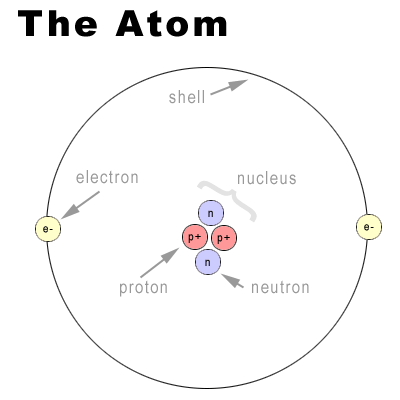
Consider the shape of an atom:
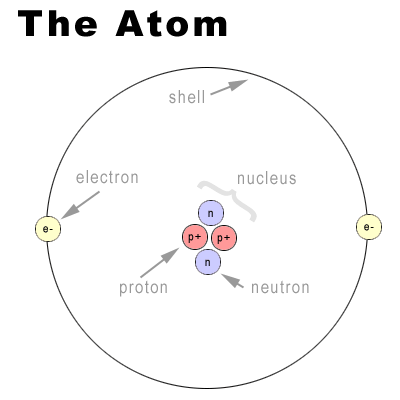
Imagine the path of the electron, that circle, is your logline. It’s longer, more expansive 20–25 words.
Now imagine the nucleus at the center of the atom. That is your conceit. It’s what is at the heart of the logline, the most basic narrative elements, perhaps 4–6 words.
So let’s consider the logline for E.T. the Extra-Terrestrial: “A troubled child summons the courage to help a friendly alien escape Earth and return to his home-world.” That’s the circular electron shell.
What would be the nucleus, the most basic narrative element? How about this:
Boy befriends alien.
It’s that single identifiable and unique aspect of the story that lies at the foundation of the narrative, the center of the atom, if you will.
How about It’s a Wonderful Life: “An angel helps a compassionate but despairingly frustrated businessman by showing what life would have been like if he never existed.”
What’s the conceit, the nucleus at the center of the atom?
What if you never had been born?
As you generate, assess and develop story concepts, one angle to focus on is that granular level which I suggest we can call story-conceit: The single, identifiable element that hooks a reader/listener (this ties into my principle: Concept = Hook).
One way to think about it is physics: If the logline is the electron shell, the story-conceit is the nucleus.
Consider the story you’re working on now: What is the conceit? What is the story’s nucleus? That single element that is the very foundation of your story’s narrative appeal?
I don’t know about you, but the response from participants in my Core II: Concept class was immediate. This metaphor crystallized everything. They got it. And so did I in a new and refreshing way.
The thing is this type of illumination and education goes on all the time in my classes, the result of conversations between writers and myself. Never ceases to amaze me.
Note: As I made clear in the class, a writer doesn’t have to traffic in high concepts to succeed at the craft. It is, however, the lifeblood of the Hollywood development system and has been for decades. So at the very least, it’s beneficial to understand that mindset.
Comment Archive