The Relationship of Character to Plot
We had such an active and great group for my recent Pixar and the Craft of Storytelling class, I have extended our time together for another week. In one of our teleconferences, I was talking about the importance of working with our characters to inform the plotting process. Indeed, I said that what I have been exploring for years now are ways to put meat on the bones of the old adage: Character = Plot. One of the writers in the Pixar class, Deborah, posted this on the course site forums:
Have had an instructor counterpoint when I shared your point on Character = Plot:
Plot is what tests character.
Thoughts? Further exploration of this subject? Mutually exclusive or synchronized companions?
My response:
I would not disagree with that. The events in the Plot serve as obstacles, roadblocks, and reversals, each of which offers a challenge. However I would argue that in a well-constructed story, those events are not random, but in fact are intimately tied to the characters in the narrative, most importantly the Protagonist. The specific nature of the Protagonist’s life circumstances — who they are and what they do — as well as their psychological journey — their Narrative Imperative, if you will — will almost inevitably inform the creative process when surfacing possible plot elements.
So, for example, why did Indiana Jones get called in to look for the Ark of the Covenant? Of course, he is an archeologist and known for finding lost treasures, so his life circumstances create the opportunity for the ensuing adventure. But in terms of his psychological journey, he begins the story as a skeptic about anything related to the supernatural. The Ark proves itself to be quite supernatural, so by the end of the story, Indiana has had his world view expanded on that front. That represents something of a change for his character.
Another minor example: Snakes. He hates snakes. Well, so a smart writer like Lawrence Kasdan will come up with the idea of dropping Indy into a pit filled with them.
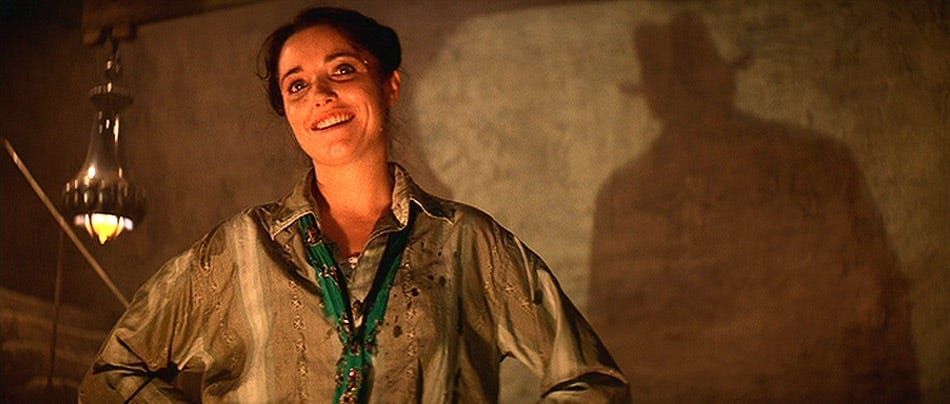
Yet another example: In order to pursue the Ark, he needs a headstone which just so happens to be in the possession of Marion Ravenwood… who just so happens to be an ex-flame of Indy. Actually not coincidence at all as one could argue that this is part of Indiana’s Call To Adventure: To resolve an unresolved love affair.
I find this to be a fruitful way to think about the relationship between character and plot, that the latter emerges from the former. It hearkens back to that question I love to ask: Why does this story have to happen to this character at this time? The Call To Adventure is not random, but specific to the Protagonist. It is the Universe’s way of saying to them, “Enough of this inauthentic life you’ve been living. You need to leave your Old Ways of Being and go out into the New World to discover your True Self… which is lying dormant inside you, but now ready to wake up and come to life.”
So yes, plot tests character. But in a well-constructed story the events of the plot are intimately tied to, indeed can emerge from the very nature of the Protagonist’s life circumstances and psychological destiny.
At the end of the day, these type of aphorisms are best looked at as tools to help develop and craft stories. If one works for you, great. If not, don’t use it. I happen to like very much the idea of Character = Plot if for no other reason than it constantly reminds me to focus my energy on the individuals whose story it is: The Characters.
What are your thoughts? If you have some observations, head to comments for further discussion.
I’ve got another excellent 1-week Screenwriting Master Class course starting on Monday exploring six story summaries any writer looking to work in Hollywood would be well-served in learning: Logline, Synopsis, Breakdown, Treatment, Scriptment and Beat Sheet. Why don’t you join me and the terrific group of writers who have already signed up for the class? For more information, go here.