“The script will write itself”
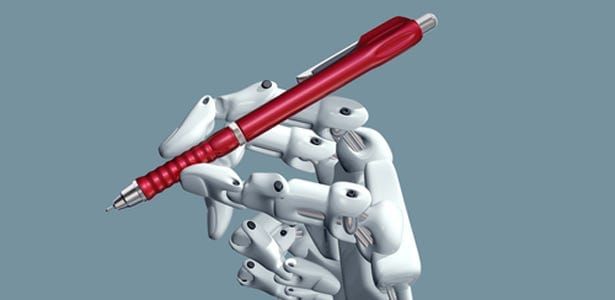
Over the weekend, @UnkScreenwriter tweeted something with this startling headline: “UNIVERSAL PICTURES READY TO TURN SCREENWRITING OVER TO COMPUTER ALGORITHMS”. Clicking on the link, I read this:
Hollywood, CA — For years computers have been making the job of making movies easier and easier, more efficient in some areas, more expansive in others. They have also, as they have done in all fields, dramatically reduced the cost of labour. Now it appears one studio, Universal, has decided to go a step further and will use a new algorithm to produce screenplays, cutting out one major expense for their products.
“At first we were sceptical [sic] about the technology, of course, we still very much exist in an analogue world here but after a few tests it was pretty clear that this was the future. We compared screenplays produced by the program to ones produced by humans and there was very little difference, except in cost, and that made our decision for us,” said a Universal spokesperson.
Low end screenplays cost well into six figures while some get into the millions before they the movies are completed. The software will produce the same words for only a few thousand at a time.
“This is really cost-benefit analysis. We are getting essentially the same product for dramatically lower amounts of money, and no hassle. We feel that the computer generated scripts are of equal quality to any produced by humans and are confident that filmgoers [sic] will not notice the difference, something which is essential to the process. We are very excited about this technology,” continued the spokesperson.
Clearly this has to be a piece of… what? Satire? Fun? Hooey? But as absurd as this idea may sound, believe me, ever since the days of Hollywood’s first great movie producer Irving Thalberg, who had a contentious relationship with the writers under contract at MGM in the 1930s, there have been plenty of people on the studio side of things who have wished for precisely this: Can’t we get rid of these pesky writers!
In the 1992 movie The Player — “A Hollywood studio executive is being sent death threats by a writer whose script he rejected — but which one?” — there is a scene which makes this point. Up-and-coming story executive Larry Levy, played by Peter Gallagher, is taking part in a creative meeting with other suits when this conversation goes down:
Larry: I’m just saying there’s time and money to be saved… if we came up with these stories on our own.
Q: Where are these stories coming from?
Larry: Anywhere. It doesn’t matter. The newspaper. Pick any story. ‘Immigrants protest budget cuts in literacy program.’ Human spirit overcoming human adversity. Sounds like Horatio Alger in the barrio. Put Jimmy Smits in it and you’ve got a sexy Stand and Deliver. Next. Come on.
Q: This isn’t my field.
Larry: It doesn’t matter. Give it a shot. You can’t lose here.
Q: How about ‘Mud slide kills dozens in slums of Chile’?
Larry: That’s good. Triumph over tragedy. Sounds like a John Boorman picture. Slap a happy ending on it, the script will write itself.
The script will write itself.
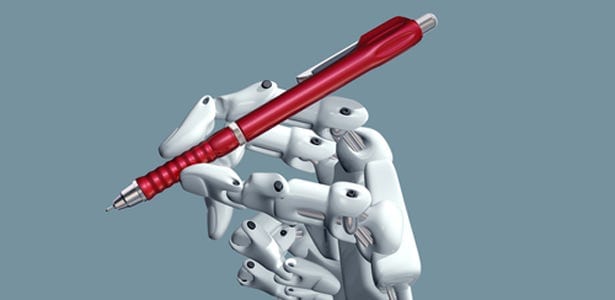
I have no idea if the studios actually have IT minions chained to their desks, slaving away on algorithms and programming code to create software which eventually will replace screenwriters, but I do know this: We writers do ourselves no favors when we promote the idea there are, in fact, formulas for storytelling. Whatever books we buy or screenwriting ‘gurus’ we follow, if the cumulative effect of that learning derives in us asserting there are specific patterns and paradigms which, if we follow in plug-and-play fashion, will result in a good story, that hurts us. How? At least two reasons.
First, if we follow a formula, almost invariably we will end up with a formulaic story. In a nice bit of synchronicity this weekend as I was stewing over the ‘article’ about Universal Studios cited above, screenwriter Stephany Folsom (2013 Black List script “1969: A Space Odyssey or: How Kubrick Learned to Stop Worrying and Land on the Moon”) reblogged this on her Tumblr site from the site of another screenwriter Seth Lochhead (Hanna), citing yet another screenwriter (and director) Alexander Payne (Election, About Schmidt, Sideways, The Descendants):
There’s a strong tendency right now toward formula. Like this is how a screenplay is written: By page 30 this has to happen, your Act Two goes to page 90…That’s just horse shit. I think a badly crafted, great idea for a new film with a ton of spelling mistakes is just 100 times better than a wellcrafted stale script.
For example, Scorsese talks not about three acts in a script, but rather five sequences. Or you watch Fellini films you watch “Nights of Cabiria” or “La Dolce Vita” or “8 1/2” and you get a sense not of a three act structure, but of episodes with one character going through all these episodes. Then you get to the end of the film and there’s a sudden realization or a moment that pulls a loose string suddenly taut through the whole movie you’ve been watching up until that point.
(We need) different mental models of what a film can be, and if you pay too much attention to these books, by Syd Field and Robert McKee and I don’t know who else, they’re only presenting one cultural paradigm, and that’s really, really dangerous to the act of creation and to our cinema, which needs new ideas and new blood now more than ever. Hollywood films have become a cesspool of formula and it’s up to us to try to change it. — Alexander Payne in 1999
As writer-director David Seltzer (The Omen, Lucas, Punchline) succinctly put it: “If you go in with formula, you come out with formula.”
The second thing is what I alluded to above: If we, as screenwriters, subscribe to the theory there are these hard and fast rules or schematics about the nature of story structure, these formulas, we feed the mythical beast stewing in the darkest corners of The Suits’ imaginations: Why do we need writers? The script will write itself.
Moreover we diminish our very craft. Great stories feel organic when we read a script or watch a movie because they are organic by nature. A writer can only find a great story by completely immersing him/herself in that story universe and with those characters. We know it takes enormous time, sweat, courage, persistence and creativity to start any story, wrangle it to the ground, write and rewrite it, then deliver it to the world.
No matter what we think of screenwriting, it is at least a craft. And since it is a craft engaged with stories, there is by its very nature each time we type FADE IN the reality that what we are doing in part is wrangling magic.
To approach the process of screenwriting with a specific formula steering the way squashes the very possibility of finding that magic. The resulting tsunami of formulaic scripts that wash in and out of Hollywood year after year hurts how we are perceived on virtually every level.
So let’s all do this: Read that goofy article about screenwriting-as-computer-algorithms here. It may be satire now. But if large swaths of writers, aspiring or otherwise, persist in promoting and supporting the very idea there are specific formulas to successful storytelling, I can totally see this writing credit in our collective future:
Written By: Computer Algorithm

Think about it…
Comment Archive