The theology of “This is the End”
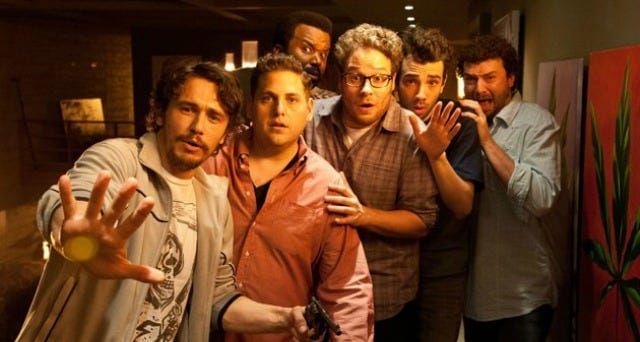
Unlike most moviegoers this weekend, I passed up on a certain big blockbuster that opened like hotcakes and instead went to see This is the End. Why? First, I’ve been tracking this project since the pitch teaser went online in June 2008:
Second, This is the End has been rated fresh on Rotten Tomatoes [85%], not only by regular moviegoers, but also film critics, an almost unheard of phenomenon for an outrageous, dumb R-rated comedy. In contrast, the other big movie that opened this weekend is not fresh at 56%.
Third, if I’m going to show my support on opening weekend, I’ll do it for an original movie every time, over a reboot, sequel, or prequel, especially if the latter is an origin story.
What I experienced with This is the End is a hugely funny movie. Stupid funny. Gross funny. Guy funny. But most of all funny funny. I can’t remember laughing in a screening this much since Bridesmaids, another stellar R-rated comedy.
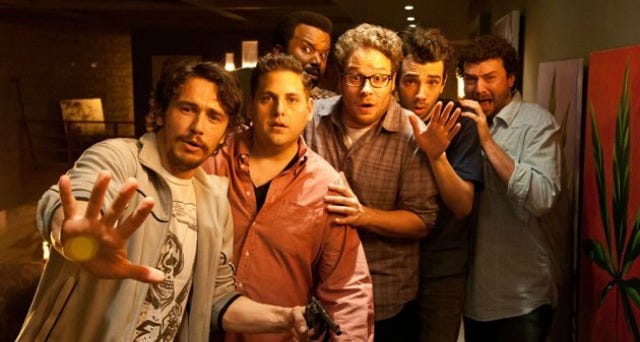
Some have critiqued the movie as coming across as more of a “sketch rather than a story”. I didn’t feel that way at all. Were there comic bits which dragged on too long? Sure. But they were fun and entertaining nonetheless. Moreover the script, written by Seth Rogen and Evan Goldberg, is a classic Hero’s Journey with a clear Beginning (Separation), Middle (Initiation), and End (Return).
In fact, I was pleasantly surprised at how well Rogen and Goldberg worked with the characters. The first act takes quite a bit of time setting up key individuals, their respective conflicts and issues before the shit hits the fan. Then no matter where the comedy goes from sequence to sequence, they always come back to the characters, everything from moments of reflection to heated conflict to expressions of their most inner fears. Appropriate to the smart-stupid comedy it is, of course, but clearly the filmmakers knew that against the backdrop of The Apocalypse, they had to create small stories with characters to give the audience some emotional context for the big events.
Moreover there are a ton of setups and payoffs, that alone suggesting this is not a script that was slapped together, but rather thought through pretty thoroughly.
But what I really found interesting was the theology of This is the End. If you’d like to join that discussion, hit more. Be forewarned, there are plot spoilers involved.
Watching This is the End provides, I think, a pretty accurate take on what the general populace understands a Christian view of the End Times to be:
* There is the Rapture: People who have lived worthy lives get taken up into heaven, visualized in the movie by shafts of glowing blue light transporting mortal bodies up to Heaven.
* There is Destruction: Fiery pits and generalized Tribulations against the Earth.
* There is the Devil: Various Dogs From Hell, along with Satan himself, and demon possession.
The thing is, there is no unanimous perspective on the End Times in Christianity. There is Postmillennialism and Amillennialism. Where This is the End comes down is what is known as Dispensational Premillinealism, that is the Rapture occurs, then all hell breaks loose on Earth.
Of course, these are reflections of a certain kind of Christianity, one that takes the Bible literally, not metaphorically. Many if not most religious scholars look at prophetic texts in scripture as being symbolic. And if there is any actual historical connection for, say, the Book of Revelation, it is to the context in which its ideas and language evolved, the 1st and 2nd century experience of the primitive church, not recognized as an official religion by the Roman Empire, and therefore suffering — generally — persecution from civil authorities. The judgment to rain down on the world is in a way a sort of wishful thinking of the faithful for how God and true believers will win out ultimately against the ‘false’ Powers That Be (i.e., Rome).
But that hasn’t stopped a variety of Apocalyptic interpretations from arising throughout the centuries, especially so in the 1800s and 1900s, and especially in the United States among fundamentalists, Pentecostals, charismatic communities, and a whole host of sects.
From the perspective of the storytellers behind This is the End, a literal perspective of the Book of Revelations makes the most sense. It fits with the general conceit of an Apocalypse so audience members will be able to relate to the ideas presented in the narrative, the actual Rapture of ‘saved souls’ creating tension among those left behind to suffer the traumas of the Tribulation, and creates both a dilemma and an end point for the plot, i.e., figuring out a path to get to Heaven.

It’s here where we get what I think is the common view of what a Christian view of salvation is: An individual has to do something selfless and fundamentally good in order to merit a one-way ticket up to Heaven.
In fact, this is entirely opposite to what a sizable portion of the academic and faith community believes, that salvation is not based on the works of a person, but rather the grace of God which is freely given. For a longer discussion of this concept, go here, but to quote theologian Frederick Buechner:
Grace is something you can never get but only be given. There’s no way to earn it or deserve it or bring it about any more than you can deserve the taste of raspberries and cream or earn good looks or bring about your own birth.
The grace of God means something like this: Here is your life. You might never have been, but you are because the party wouldn’t have been complete without you. Here is the world. Beautiful and terrible things will happen. Don’t be afraid. I am with you. Nothing can ever separate us. It’s for you I created the universe. I love you.
There’s only one catch. Like any other gift, the gift of grace can be yours only if you’ll reach out and take it.
While that may work in terms of religious faith, it’s problematic for a screenplay. Accepting Grace would come off on-screen as a pretty passive act. Much better to work from the conceit that a character has to do something worthy, good and selfless to end up in the shaft of light leading to Heaven.
In This is the End, we have a case of a common misconception of Grace actually servicing the needs of the writers in terms of the plot. For by making a character’s path to Heaven dependent on what they do, that creates a psychological and spiritual destination to which the key characters can go to resolve their individual storylines as well as the overall plot.
Additionally there are all sorts of moments with theological things going on, everything from reading and interpreting the Book of Revelation in the Bible to attempted exorcisms to discussions about the danger of using the Lord’s name in vain, and so forth.
So amidst all the idiotic hilarity, gross-out humor and laugh out loud comic bits, there is a good bit of theology going on in This is the End. Characters who achieve Salvation. Characters who realize Redemption. And Danny McBride, who along with having one of the greatest entrances in recent movie history, loses his humanity, and goes the way of all flesh — literally!
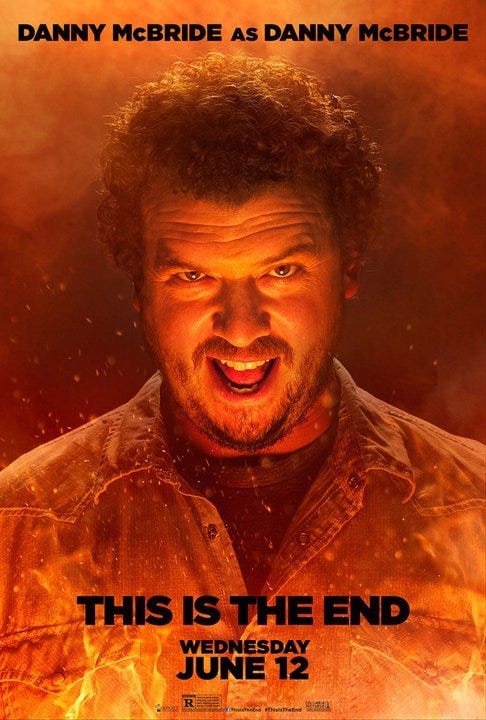
This is the End is a raucous comedy that pokes fun at celebrity self-indulgence and commonly perceived notions of a religious Apocalypse. As to if there is a Heaven, and if there is as the movie suggests, it’s one big party featuring the Backstreet Boys as an angelic chorus…
Who the hell knows?
[BTW the Backstreet Boys were a backup plan to how This is the End was supposed to initially… well… end.]
Anybody see This is the End? What did you think of it? I’m hoping for a small drop-off in business in week 2 and hopefully some decent numbers from overseas. The movie cost $32M to produce, right at the top end of where studios want to be with comedies nowadays. It opened strong. Spread the word if you want to see more original movies.
Comment Archive