The Toughest Scene I Wrote: William Nicholson on “Les Misérables”
All hail Vulture for this:
Over the next few weeks, Vulture is talking to the screenwriters behind 2012′s most acclaimed movies about the scenes they found most difficult to crack. What pivotal sequences underwent the biggest transformations on their way from script to screen?
In this article, Les Misérables screenwriter William Nicholson provides insight into an especially tricky transition in the narrative:
When Tom Hooper came on board as director, about eighteen months after we’d started work, he made a crucial, brave, and brilliant decision: to have the movie be sung throughout, just like the show. This meant my dialogue inserts had to be reconfigured as recitative, and scored along with the rest of the music; and this job could only be done by the original team of composer-writer-lyricist, Claude-Michel Schonberg, Alain Boublil, and Herbert Kretzmer. Because this was a slow process, Tom asked me to rewrite the new dialogue as lyrics myself, so that he could assess the effectiveness of the screenplay as he evolved his shooting plans. I did this. My new material was then worked on by the show’s authors, who recast it in their own way, so that the lyrics and music kept a unity of style and voice with the material taken unchanged from the show. My job was therefore essentially structural — to build a new structure, assign new material to its place, and stand back while it was integrated into the score.
This can best be explained by a specific example. In the show, after Valjean tears up his ticket of leave, the action moves straight to the factory in Montreuil, with the anthem “At the End of the Day” creating the junction. Several problems arise. We never learn how Valjean has become rich. When Fantine is dismissed by the lecherous foreman, Valjean seems to have very little responsibility for her plight, which is damaging, because his guilt over Fantine motors all his subsequent actions. And later, in the red light district scene, Javert shows up in Montreuil in a manner that is unexplained and over-coincidental.
To solve all these problems we did the following:
1. The junction song “At the End of the Day” became Javert’s journey across France, which allowed us to show the plight of the poor of the nation, and to indicate that Javert is moving to a new posting.
2. Javert’s arrival in Montreuil coincides with Fantine’s scuffle in the factory. This means, crucially, that Valjean’s initial intention to involve himself in the dispute on the factory floor is overtaken by his sudden chilling realisation that Javert has followed him. He abandons Fantine in fear for himself. This is a proper basis for his subsequent guilt.
3. We then created a new scene in which Javert introduces himself to Valjean in his capacity as the new chief of police. This scene gave room to establish that Javert half-recognises Valjean, and allows us to sneak in a little information on Valjean’s business. It also enhances the tension, of course: We’re now waiting for Javert to expose Valjean …
Here is that section of the script:
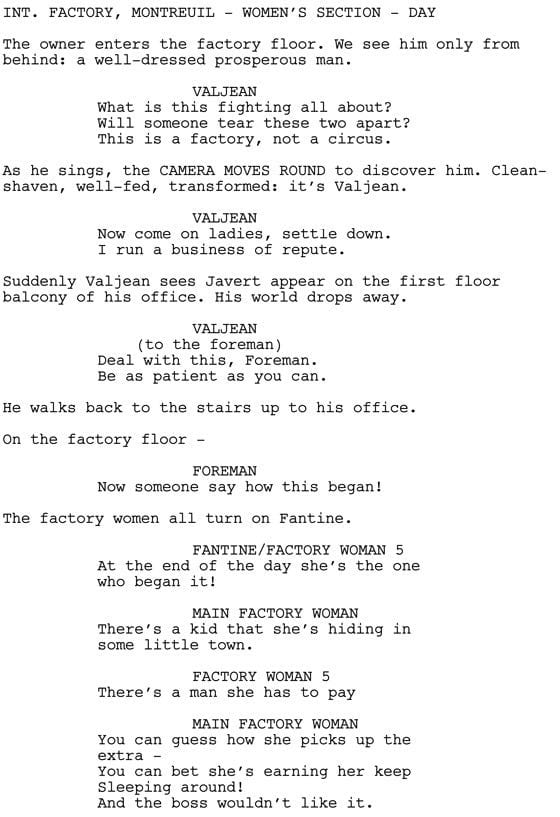
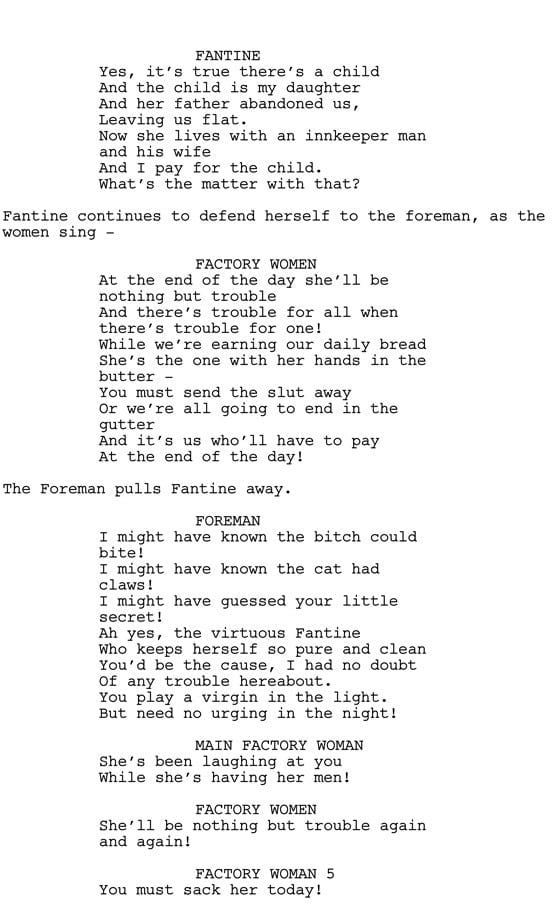
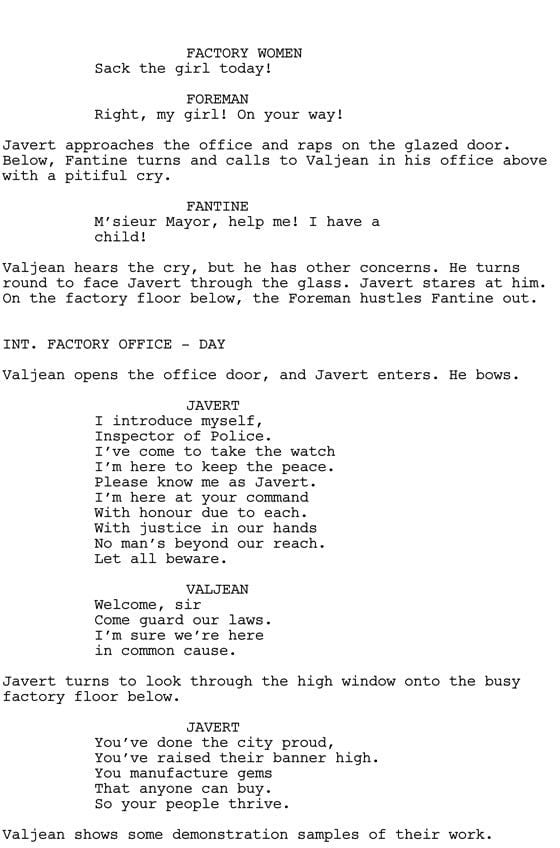
Amidst the mammoth undertaking of adapting a hugely popular play as well as writing dialogue as lyrics, Nicholson faced one set of problems everyone of us confronts: Transitions. A few takeaways from Nicholson’s object lesson:
* We begin and end with character as everything has to flow from who characters are, what their goals are, and how a reader may expect them to act.
* Visualizing movement can help, such Javert’s journey across France, helps to convey the reader from one location to the next, one scene to the next.
* We find conflict compelling, and so Fantine’s scuffle serves as a point of entertainment.
* Do what we must to avoid coincidence. If, for example, Javert were to show up in Montreuil unexplained, that would come across as a coincidence and therefore smack of writer’s convenience.
Nicholson’s illustration reminds me a line I picked up somewhere along the way: “Make the problem the solution.” In this section of Les Misérables, Nicholson was confronted by a set of problems as noted in the article. The solution he came up with not only solved the problem, it makes for solid entertainment. Remember that the next time you confront a problem area in your script: It has the potential solution within it, you also have the opportunity to find and write something to make your story more compelling.
For the rest of the article, go here.