The value of cliffhangers in screenwriting
We kicked off a new Script Analysis series this week and if the level of discourse exhibited by participants thus far is any indication, this could be one of the most valuable exercises ever on Go Into The Story.
Case in point: After inviting people to do a scene-by-scene breakdown of the script for the movie Argo, then take a whack identifying its major plot points, yesterday we explored the screenplay structure from the perspective of sequences leading to a fascinating discussion which you can read here. I want to spotlight a commentary by pgronk (Paul) included here in its entirety:
FWIW: using the “reel” scheme, here is a first pass of how I would break out sequences as if the movie was a reel serial, like the kind that use to play in early movie theaters.
Serials — then and now — end on a cliff hanger beat, raising a dramatic question to hook the audience to wait in the dark for the next reel (then), or tune in next week for the next chapter (now). And that’s where I looked to determine the end of each sequence (except the last, of course).
Notice that I made the call to break out the actual escape into 2 sequences, the first ending on the cliff hanger question of whether Siegel will answer the phone. Others might choose another cliff hanger moment — there plenty of them during the escape.
The important point, it seems to me, is one feature of an effective sequence is that it ends on a cliff hanger beat, a complication or question that raises suspense, makes the audience want to know what happens next. And the next sequence should answer that question… and raise another.
(Of course, there are also long-term questions raised in addition to the short-term cliff hanger questions. Questions that won’t be answered until the last act. Like, the dramatic question raised at the mid-point after Mendez gets the green light: will the “Argo” plan work?)
Reel #1(PP1–10): The American embassy in Tehran is occupied.
Cliff hanger question: What happens to the 6 employees now?
Reel #2 (PP10–26): Ticking Clock Forces Action.
Cliff hanger question: Can someone come up with a rescue plan before it’s too late?
Reel #3 (PP27–32) A Man with A Plan.
Cliff hanger question: Can Mendez recruit people and assemble a production company and movie project?
Reel #4 (PP27–43) Putting Together a Team and a Movie Project.
Cliff hanger question: Can Mendez and sell “Argo” to the industry — and to the CIA?
Reel #5 (PP43–56) Making the Sale.
Cliff hanger question: Can he get into Iran as a “Canadian” producer?
Reel #6 (PP56–66) Crossing the Threshold into Iran.
Cliff hanger question: How will he rally and prepare the employees?
Reel #7(P66–78) Plans, Doubts and Escalating Jeopardy.
Cliff hanger question: Will the employees, particularly Joe, be able to play their roles?
Reel #8 (P78–87) Successful Test Run.
Cliff hanger question: Can they escape before the Iranians close in on the house?
Reel #9 (PP87–95) All is Lost: Washington pulls the plug.
Cliffhanger question: What will Mendez do now to save the day, save the employees?
Reel#10 (P96–107) Approaching the Threshold to Freedom.
Cliffhanger Question: Will Siegel pick up the phone in time?
Reel#11 (P107-P122)The Flight to Freedom.
I would imagine most of you are too young to remember the serials, but I’m not. Saturday matinees at the theater, then TV shows like “Commander Cody: Radar Men from the Moon”:
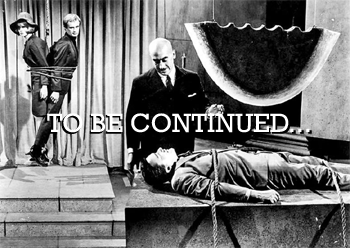
At key points in the story, there would always be moments like this:
Known as ‘cliffhangers,’ there emerged an entire oeuvre of entertainment with this type of suspense hook such as these:
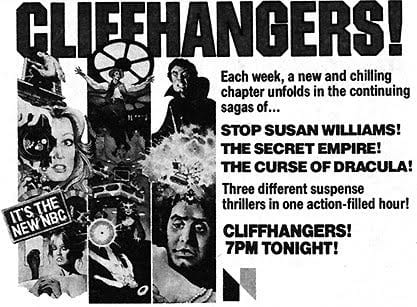
Actually the origins go back to the very beginning of cinema. At first, there were one-reelers, audiences packed into nickelodeons to watch a short film anywhere from 8–15 minutes in length. However movie fans demanded longer and longer stories. Filmmakers were happy to oblige, unfortunately there was a problem: With only one projector, when Reel #1 came to an end, the projectionist would have to take off that reel, load up Reel #2, thread the film through the camera, insert film lead into the rear reel, then start up the camera again. This could take a few minutes.
The concern for filmmakers: How to keep the audience ‘into’ the story while all of that was going on? The solution: Cliffhangers. End each reel with a suspense-filled moment where the resolution was unclear and that would keep audiences involved in the story while the projectionist did their thing.
As a result, writers in the 1900s, 1910s and 1920s would craft sequences with a beginning, middle and end, topped off with a scenario which raised a question: What’s going to happen?
With that in mind, circle back to Paul’s analysis of Argo. Note how each sequence as broken down there ends with a question or a kind of cliffhanger.
Why is this important? I’ll pose that question and see what responses it elicits. The point is cliffhangers have worked for over 100 years of filmmaking and you should be aware of that in your own writing.
As for the weekly Script Analysis series, I encourage all of you to track it and especially get involved in the discussions. William Goldman famously said, “Screenplay are structure.” This series promises to take us straight into the heart of this concept week after week, analyzing one notable movie scripts after another.
Next week: Gravity with a scene-by-scene breakdown created by Matt Duriez. To download a free, legal version of the script for Gravity, click here.
Comment Archive