Thinking like Hitchcock
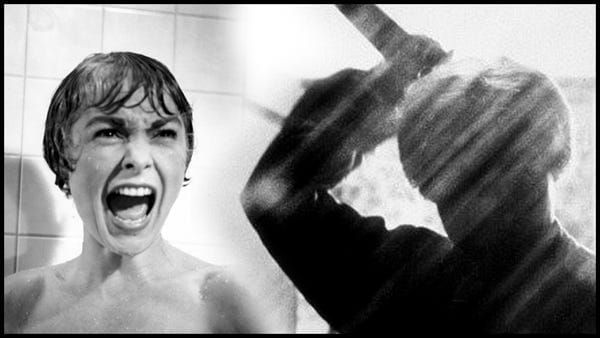
Recently I posted something about how as a writer, we can wear a ‘director hat’, bringing that sensibility to bear on scenes we craft. Here is an excerpt from a 1964 interview with Alfred Hitchcock in which he discusses three approaches to film editing with visual references to the movie Psycho:
The three approaches:
* Assembly: Using the example of the shower scene in Psycho, Hitchcock refers to the “78 pieces of film in about 45 seconds,” creating a kind of visual montage.
* Orchestration: Referring to the second murder in Psycho in which the detective climbs the stairs only to meet his death, Hitchcock talks about the use of foreknowledge — “the audience was already aware there’s a monster around, so they were apprehensive for him, but they didn’t know when it would happen” — and varying shot “sizes” — medium, long, close-up — to create shock. He compares it to an orchestra with the buildup is “tremolo” and the close-up is “brass instruments” to drive home the impact of the attack.
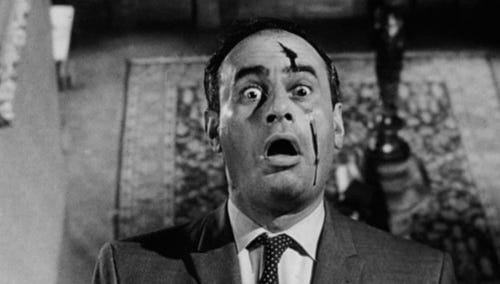
* Pure Cinematics: Hitchcock uses an example of three shots: Close-up of a man looking at something off-screen / A mother playing with a baby / Close-up of the man smiling. Impression: A kindly old man. Now remove the middle scene and replace it with an image of a woman in a bikini. Same man looking. Same man smiling. But “what is he now? He’s a dirty old man.”
Takeaway: While stylistically it’s no longer common for a screenwriter to specify actual camera shots in scene description, we can infer them in our writing. Here is actual scene description from the Psycho script (screenplay by Joseph Stefano, novel by Robert Bloch), adapted to reflect contemporary screenwriting style:
BATHROOMMary drops her robe, steps into the tub, and turns on the shower.The bathroom door, not entirely closed.Mary washes and soaps herself.The bathroom door slowly pushed open, the noise of the shower
drowning out any sound.The shadow of a woman falls across the shower curtain.Suddenly a hand reaches up, grasps the curtain, rips it aside.Mary turns, a look of pure horror erupts in her face.The flint of a knife blade.It slashes downward, again and again.Mary screams, arms flailing to protect herself.Silence.The woman hurries out of the bathroom.A dreadful thump as Mary's body falls in the tub.
You could take an even more minimalistic approach:
BATHROOMMary in the shower.Door pushed open.A woman's shadow on the shower curtain.A hand with a knife.Mary turns. Screams.Slashing. Flailing. Blood. Silence.The woman vanishes.Mary slumps to the floor. Dead.
The choice of how you approach the scene description depends on several factors most notably your choice of narrative voice, how you’ve been handling the script style in relation to the genre of the story throughout the screenplay. But the overall point stands: We can infer camera shots through individual lines and paragraphs without using directing jargon or camera lingo. As such, we can give expression to our inner Hitchcock!