Update: Reflections on Scripted Introductions of Female Characters
File this under “Lessons Screenwriters Have Yet To Learn”.
File this under “Lessons Screenwriters Have Yet To Learn”.
In April 2016, I posted this:
By now I’m sure many of you have seen something about this Twitter feed: @femscriptintros. Here is its description from movie producer Ross Putnam who hosts the site:
These are intros for female leads in actual scripts I read. Names changed to JANE, otherwise verbatim. Update as I go. Apologies if I quote your work.
Here are some examples:
The Twitter feed currently has 52 tweets and 62K+ followers. Its emergence in February kicked up a ruckus including articles here, here, here, and here. Ross has been interviewed by KPCC and featured in an episode of the John August-Craig Mazin podcast Scriptnotes. All of which is to say, the way females often get introduced in screenplays points to a bigger, more systemic issue about attitudes toward women, a concern which is clearly resonating in our zeitgeist.
In a chat with Jezebel, Ross made these comments:
But the more that I read, the more I started to recognize some pretty awful constants. For every confused “you’re” and “your,” there’s just as much latent misogyny and sexism in the scripts I read. Women are first and foremost described as “beautiful,” “attractive,” or — my personal blow-my-brains-out-favorite, “stunning.” They’re always “stunning” in a certain dress or “stunning” despite being covered in dirt because they’re a paleontologist — or whatever. I found myself posting to Facebook far too often “here comes another script with our 45 year-old male lead dating a 25 year-old woman,” and decided I was going to keep track of the female character introductions in scripts I read for a few weeks.
Women are almost always, first and foremost, described based on their physical attractiveness. Which is, you know, subjective anyway depending on the person. But there’s a standard of beauty to which you know these writers are referring. The suggestion is that women are only valuable if they’re “beautiful.” It’s not always true, but it’s an underlying current. Beyond that, scripts always make a point of quite distinctly saying when someone “isn’t beautiful.”
Changing the names to JANE for me, while maintaining that focus on systemic issues, also — at least, I think — demonstrates how female characters are often thought about in the same, simplistic and often degrading way. Giving them all the same name, I hope, emphasizes that. Jane is described in all these ways, because Jane has no control over her role in this world — which is far too often to be solely an object of desire, motivating the male characters that actually have agency in the script.
To drive home the point, Slate staff writer Christina Cauterruci wrote a recent article: If Male Characters Were Introduced in Scripts Like Women. Here are some examples:
A vision in brown robes that caress his shapely curves, OBI WAN strides toward LUKE, placing his thick, pleasure-ready fingers over LUKE’s eyes before revealing the supple visage beneath his hood in a rapid striptease.
New Boston Globe editor MARTY BARON, as quirky as he is adorable, gazes through spectacles and a fringe of sultry lashes. His muscular, feline torso is poured into a “fuck-me” button-down.
All conversation stops, all eyes turn to look JED BARTLET up and down. Though he’s an alluring, auburn-locked looker, he will let slip a few crucial bits of knowledge from inside his pretty little head.
JACK strides with purpose into the hotel ballroom. Fit but not fussy, his is a solid, powerful body you want to be under; his carelessly masculine features inspire a heady mix of attraction and intimidation. His hair may be thinning, but his cock-confidence is as full as ever.
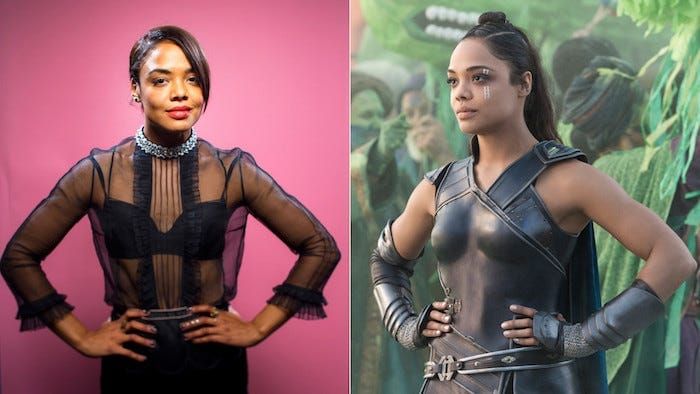
The reason for this replay is comments from actress Tessa Thompson and Thor: Ragnarok director Taika Waititi from an Los Angeles Times feature:
“There’s an unfair position that women are sometimes put in, in the context of superhero movies and action movies where at once they have to be very strong and fierce, but also sexy,” Thompson said. “Obviously, it’s still a superhero movie and so you’ve got to figure out when you need to stand with your hands on your hips and what makes sense. But we wanted to create a character that occupied her own iconography.”
“There’s one word I hate in all scripts in Hollywood at the moment in describing women, and that is the word ‘badass.’” Waititi explained. “That word has just crept into every script that is pushed around this town now. It’s terrible, because it doesn’t mean anything. It’s a dumb male writer’s way of saying, ‘Ah, uh, she’s like, she, uh, she’s tough.’ Then straight after that it’s like, ‘She’s badass, but she’s got a beauty about her. And she’s sexy. Unconsciously sexy.’” [emphasis added]
Apparently some screenwriters decided they could handle the critique from 2016 by adding the word “badass” to a female character’s description, then continue with the whole “unconsciously sexy beauty about her” thing.
As I said in my 2016 post:
There is a key takeaway from this entire discussion and it’s this: As writers, if we dwell on the surface of our characters, male or female, our scripts are going to fail. If, however, we go into our characters, engage them directly, learn about their personal histories and backstories, come to know them as unique individuals worthy of our respect and understanding… then our scripts have a chance.
Not only that, we put ourselves on the path to crafting multidimensional characters and in knowing them, in reaching out to them, in embracing them, the story will emerge from those interactions. After all, it’s their story.
But specifically with regard to female character introductions, we need to move beyond their physicality and focus on their personhood, who they are, communicating something of their core essence, providing the reader a sense of their unique humanity.
C’mon, folks. We can do better.
For the rest of my 2016 post, go here.