Video: The Hero’s Journey — Supercut
Joseph Campbell’s theory throughout movie history
Joseph Campbell’s theory throughout movie history
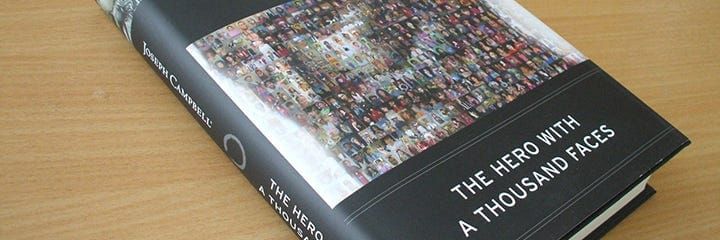
I first read “The Hero With a Thousand Faces,” Joseph Campbell’s seminal work, when I was in my third year as an undergraduate at the University of Virginia as part of the Religious Studies Honors Program. It’s very definitely an academic work and was a challenging read. Therefore you can imagine my surprise when I made the rounds in Hollywood back in the late 80s and spied copies of Campbell’s book in the offices of studio executives and producers.
I discovered two reasons how an academic tome had made its way into the bookshelves of movie development types.
First, there’s this: A fellow named George Lucas was a fan. Here’s a quote from the filmmaker in the book “Joseph Campbell: A Fire in the Mind”:
…it came to me that there really was no modern use of mythology…so that’s when I started doing more strenuous research on fairy tales, folklore and mythology, and I started reading Joe’s books. Before that I hadn’t read any of Joe’s books…. It was very eerie because in reading “A Hero with a Thousand Faces,” I began to realize that my first draft of Star Wars was following classical motifs.
The other influence was the book “The Writer’s Journey: Mythic Structures for Writers” by Chris Vogler. While working for Disney, Vogler put together a brief overview of Campbell’s theory, distilling seventeen aspects of the Hero’s Journey to twelve. I saw Vogler at at WGA presentation in 1988 and still have my notes from that session. His book expands on those initial ideas.
The excellent site Film School Rejects ran a post the other day featuring this video below, a supercut of images taking viewers on a cinematic hero’s journey. Check it out:
While a huge fan of Campbell and his theories, it concerns me how there seems to be a perception floating around screenwriting circles that the Hero’s Journey is a specific pattern of sequential events which must be followed in order to fit into a narrative structure.
That’s not how Campbell viewed it. He did think the narrative elements in the Hero’s Journey were by and large universal to stories around the world, but not necessarily in a specific pattern. The danger as far as screenwriting is concerned is to take something which is by nature malleable and routinize it into a restrictive paradigm. That’s why when I teach it, I prefer to focus on the way Campbell describes the Hero’s Journey here:
“A hero ventures forth from the world of common day into a region of supernatural wonder: fabulous forces are there encountered and a decisive victory is won: the hero comes back from this mysterious adventure with the power to bestow boons on his fellow man.”
It’s basically an initiation rite in which the Hero separates from their ordinary world, goes through a series of adventures in the new world, and returns home a transformed individual. All the rest — Call to Adventure, Crossing the Threshold, etc. — are wonderful assets for a writer, but to avoid turning the Hero’s Journey into a formula, I find it best to think in terms of the broad strokes of the narrative’s arc.
In any event, videos like the one above are helpful in reminding us of the presence of elements and themes universal to storytelling around the world.
“The happy ending of the fairy tale, the myth, and the divine comedy of the soul is to be read, not as a contradiction, but as a transcendence of the universal tragedy of man. The objective world remains what it was, but because of a shift of emphasis within the subject, is beheld as though transformed.”
For a wealth of background on the subject, check out the site for the Joseph Campbell Foundation.