Vladimir Propp’s “31 Narratemes”: Another approach to story structure
If you were a member of The Black Board, The Official Writing Community of the Black List and Go Into The Story, you might have seen this post by Dean Scott. It refers to a Russian scholar named Vladimir Propp. From Wikipedia:
Vladimir Yakovlevich Propp (Russian: Владимир Яковлевич Пропп; 29 April [O.S. 17 April] 1895–22 August 1970) was a Soviet formalist scholar who analyzed the basic plot components of Russian folk tales to identify their simplest irreducible narrative elements.
Propp referred to these “narrative elements” or “units” as narratemes and asserted there were 31 of them. Here they are as presented from the site ChangingMinds.org:
1st Sphere: Introduction
Steps 1 to 7 introduces the situation and most of the main characters, setting the scene for subsequent adventure.
- 1. Absentation: Someone goes missing
- 2. Interdiction: Hero is warned
- 3. Violation of interdiction
- 4. Reconnaissance: Villain seeks something
- 5. Delivery: The villain gains information
- 6. Trickery: Villain attempts to deceive victim
- 7. Complicity: Unwitting helping of the enemy
2nd Sphere: The Body of the story
The main story starts here and extends to the departure of the hero on the main quest.
- 8. Villainy and lack: The need is identified
- 9. Mediation: Hero discovers the lack
- 10. Counteraction: Hero chooses positive action
- 11. Departure: Hero leave on mission
3rd Sphere: The Donor Sequence
In the third sphere, the hero goes in search of a method by which the solution may be reached, gaining the magical agent from the Donor. Note that this in itself may be a complete story.
- 12. Testing: Hero is challenged to prove heroic qualities
- 13. Reaction: Hero responds to test
- 14. Acquisition: Hero gains magical item
- 15. Guidance: Hero reaches destination
- 16. Struggle: Hero and villain do battle
- 17. Branding: Hero is branded
- 18. Victory: Villain is defeated
- 19. Resolution: Initial misfortune or lack is resolved
4th Sphere: The Hero’s return
In the final (and often optional) phase of the storyline, the hero returns home, hopefully uneventfully and to a hero’s welcome, although this may not always be the case.
- 20. Return: Hero sets out for home
- 21. Pursuit: Hero is chased
- 22. Rescue: pursuit ends
- 23. Arrival: Hero arrives unrecognized
- 24. Claim: False hero makes unfounded claims
- 25. Task: Difficult task proposed to the hero
- 26. Solution: Task is resolved
- 27. Recognition: Hero is recognised
- 28. Exposure: False hero is exposed
- 29. Transfiguration: Hero is given a new appearance
- 30. Punishment: Villain is punished
- 31. Wedding: Hero marries and ascends the throne
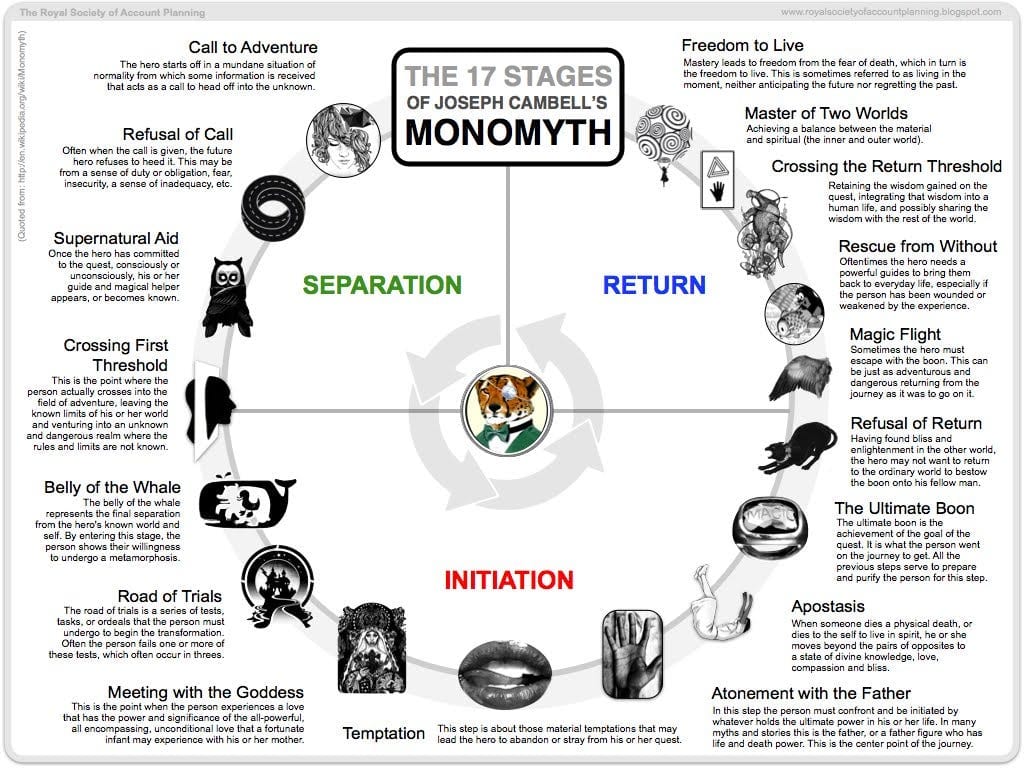
This is interesting in a number of ways. First, it mimics some of what Joseph Campbell proposed as narrative elements common to The Hero’s Journey.
Second, it reinforces the idea of Aristotle’s articulation of narrative structure:
“A beginning is that which is not itself necessarily after anything else, and which has naturally something else after it. An end is that which is naturally after something itself, either as its necessary or usual consequent, and with nothing else after it. And a middle, that which is by nature after one thing and has also another after it.”
Beginning. Middle. End.
Separation. Initiation. Return.
Introduction/The Body of the Story. The Donor Sequence. The Hero’s Return.
Third, Propp’s take is proof — once again — there are no golden formulas universal to all stories. Yes, many, even most stories may contain some or even many of these narratemes, but not all. Nor in the order laid out above. Nor necessarily with the function for each as elucidated above.
Further in my view, the more specific narrative paradigms are, like this one with 31 “narrative units,” the less relevant they become precisely because they begin to feel like a formula.
That’s why I prefer thinking of screenplay structure in more meta terms: Three acts. Major Plotline Points. The arc of the Protagonist’s metamorphosis. Then allow the story to evolve and emerge during the process of writer engaging narrative in a direct, immersive and organic way, trusting in the characters to take us into and through the story-crafting process.
That said, there can be some value in considering Propp’s narratemes as each of the 31 is recognizable as something we see from story to story. To the degree they help your creative process, great. If they start to confine your creativity and box you in like a formula…
Deposit in the nearest virtual trash bin.
While you’re here, why not go join The Black Board. It’s a great community hosted by super-moderator Shaula Evans and it’s totally free.
Comment Archive