What can we learn from the movie “Neighbors”
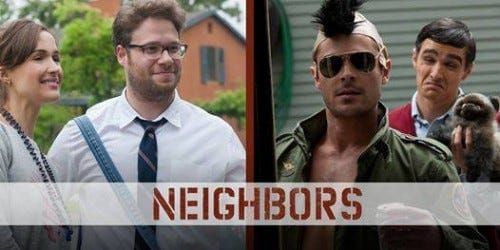
How many of you predicted the comedy Neighbors would knock off The Amazing Spider-Man 2 and become the #1 box off movie over the weekend? Nobody, that’s right! The numbers:
Neighbors: $51.07M
The Amazing Spider-Man 2: $37.2M
Granted it was the 2nd weekend for TASM, dropping 59% from its first weekend haul. And true, Spidey 2 has done $551M in worldwide box office revenues thus far which ain’t chump change. But everybody was expecting the movie to ‘net’ [pun intended] those kind of dollars.
Neighbors? A movie with a production budget of $18M, which would just about cover craft services on some of these gargantuan superhero movies? Spidey 2 probably cost 10 times that much. Meanwhile the little comedy starring Seth Rogen, Rose Byrne, and Zac Efron has already grossed $85M worldwide and it’s conceivable it could reach $150M or more before its theatrical run is through.
That is an impressive R.O.I. in the making. And when a movie comes along that does that well, especially one that overperforms expectations in so many ways — 53% of the moviegoers were female! — we would do well as writers to see what we can learn from it.

To that end, I’d like to pull some excerpts from a Studio System New interview with Nicholas Stoller, the movie’s director.
SSN: In the film the audience will side either with the frat boys or the adults. There is no clear villain. Was that intentional?
Stoller: With comedy it’s all about relatability. It’s, ‘Do I see myself in these characters?’ People laugh harder the more they see themselves. You can’t see yourself in a villain; a villain does not have a legitimate point of view, so you stop laughing, you lose sympathy. It’s satisfying to watch a character figure their shit out and with a villain there’s no lesson, he’s just bad.
SSN: Did you watch other frat films before taking on this project?
Stoller: My list of movies was very strange. I re-watched Animal House and Old School, just to make sure we weren’t doing anything that had been done before. Besides being funny, I wanted this movie to be really cool and feel like a party, and I am not cool and I don’t go to parties. So I watched Project X and a Gapsar Noé film called Enter the Void.
— —
SSN: What do you think of the R-rated genre, which is very popular with comedies these days?
Stoller: We live in an R-rated world. People curse [and] talk about sex. In Sarah Marshall, I was like, it has to be R because no one in history has ever been dumped and not said ‘fuck.’ (laughs) So for me to tell honest stories that tear the house down, the R-rating is the way to go.
SSN: The perception is that most comedies don’t translate well overseas. Do you feel pressure to cater to that audience with your R-rated films?
Stoller: At the beginning of my career there were very few R-rated movies. I think Judd had a big hand in blowing that door open and showing how much money you can make with them. Studios always crush the budgets because they don’t think they’re going make money internationally, but if you look at Horrible Bosses, Ted, Bridesmaids, and the Hangover movies, they all made a lot overseas.
SSN: To what do you attribute that to?
Stoller: We live in a more global world and people understand more about different cultures. With Neighbors, the advertising overseas is ‘young people versus old people.’ You don’t need to know anything about frats to understand. Neighbors lends itself well to big visual gags, which translate internationally because it’s not verbal humor.
SSN: What do you see as the common thread between your R-rated comedies and the family films you write such as Yes Man, The Muppets, Muppets Most Wanted, and the upcoming Captain Underpants?
Stoller: Even if some of them have dirty words and jokes, there’s an innocence to [them]. I don’t think I’ve ever made a cynical movie. Even if the characters are doing crazy stuff, they’re all trying to figure out how to be better people.
Okay, there’s a lot here:
* “With comedy it’s all about relatability”: A term I use is audience identification or in the case of a script reader identification). There have to be points of connection between the characters and situations in the story, and the audience or reader, the more they identify with what’s going on in the story, the more likely they will become emotionally invested in it. With a comedy, if we identify with characters, that can intensify how much we laugh at and with them, as well as feel for or against them.
* Watch movies: Stoller immersed himself in key movies to “make sure we weren’t doing anything that had been done before” and to help him achieve a sense of verisimilitude in terms of parties. The same goes for whenever we write a script: As part of our research, we should watch and analyze several movies for a whole host of reasons including specific narrative elements, pace, tone, visuals, character types, tropes, and so forth.
* “Tell honest stories”: While Stoller is specifically referring to why he had to make Neighbors an R-rated movie, just in general we should strive to tell stories that come across as authentic. In other words, we need to gain the trust of a script reader. And if we are writing something set in 17th century Virginia, then we’d better do the research necessary to create a story world that feels like an honest representation of Virginia in that time period. Likewise if we are writing a movie about a battle between a married couple and some frat guys, we need to present characters, situation and tone, including F-bombs, that make the experience come across as real.
* The conventional wisdom in Hollywood is comedies don’t “travel” well internationally: This prejudice exists. And whereas many action, science fiction and thriller movies do 70% or more of their box office overseas, many comedies do not. However…
* “Neighbors lends itself well to big visual gags, which translate internationally because it’s not verbal humor”: Visual humor does travel better because you don’t need much in the way of dialogue to convey what’s going on when two guys are fighting each other using dildos [2:08 in the trailer below].
* “With Neighbors, the advertising overseas is ‘young people versus old people.’ You don’t need to know anything about frats to understand”: Strong high concepts still work. Young People vs. Old People. I saw Seth Rogen on “The Daily Show with Jon Stewart” and he trotted out that exact line in describing the movie. It’s a simple idea and oftentimes with comedies, a simple idea can be key to a great idea.
* “Even if some of them have dirty words and jokes, there’s an innocence to [them]”: Not to suggest that Judd Apatow and talent who have worked with him discovered the wheel, but Neighbors is in the tradition of 40 Year Old Virgin, Knocked Up, Bridesmaids and many more: Edgy R-rated humor mixed with a humanistic core. As Stoller says: “Even if the characters are doing crazy stuff, they’re all trying to figure out how to be better people.”
I tweeted this yesterday:
Comedy’s reputation has taken a jab to the chin the last few years. To put it in perspective, during the 80s and 90s, studios annually put out dozens of high concept comedies. For decades, comedy was the #1 genre in terms of spec script sales. That all changed starting in 2011 when Action and Thriller became the most common spec scripts to sell. But strong high concept, lower budget comedies ($20M and below) with proven talent, visual humor, and an ‘innocent’ emotional core… it’s not like that has ever really gone away, but rather more about Hollywood rediscovering how this approach can be quite successful.
Just like Neighbors.
For the rest of the Study System News interview with Nicholas Stoller, go here.
If you saw Neighbors over the weekend, I’d love to hear your opinion. Click Reply and hit me up with your thoughts in comments.
Comment Archive