What is Theme?
Theme is perhaps the most nebulous of all screenwriting concepts.
Theme is perhaps the most nebulous of all screenwriting concepts.
Writers casually toss it around in conversations, studio executives want to zero in on it in script meetings, directors ponder it in terms of the movie’s overall visual narrative, and actors ask how it impacts their character’s attitude and behavior. But what does theme really mean?
The question is all the more important because in order to write a successful screenplay, a good screenplay, it is critical to understand and handle a story’s thematic elements.
Surprisingly there is a dearth of literature about the subject in relation to screenwriting and this fact contributes to the lack of clarity that exists.
A starting point for discussion is Lajos Egri’s seminal work “The Art of Dramatic Writing.” The book, originally published in 1946, is essential reading for any screenwriter, TV writer or playwright. In it, Egri begins his entire argument by positing the idea that writers should look at theme as premise [P 1–2]:
Everything has a purpose, or premise. Every second of our life has its own premise, whether or not we are conscious of it at the time… Others, especially men of the theater, have had different words for the same thing: theme, thesis, root idea, central idea, goal, aim, driving force, subject, purpose, plan, plot… For our own use we choose the word ‘premise’ because it contains all the elements the other words try to express and because it is less subject to misinterpretation… Professor Brander Matthews: ‘A play needs to have a theme.’ He means premise.
And what does Egri mean by premise?
“Premise: a proposition antecedently supposed or proved; a basis of argument. A proposition stated or assumed as leading to a conclusion.”
Egri cites several examples including these from Shakespeare [P. 2–4]:
- Romeo and Juliet: “Great love defies even death.”
- King Lear: “Blind trust leads to destruction.”
- Macbeth: “Ruthless ambition leads to its own destruction.”
Next let’s consider the ruminations of screenwriter John August who has been blogging about the craft (johnaugust.com) since 2003. In this post, he reflects on the subject of theme by responding to a question from a reader:
I suspect what your pro-theme writer friends were talking about was some essence that permeates every moment of a good film. Something that’s in its DNA. You feel it when it’s there, and notice it when it’s missing — even when the script otherwise seems solid… I don’t know that “theme” is really the best word for this DNA quality I’m describing. But I think it’s what we mean when we say it… The alternate version I’m positing above — the core idea or DNA — is practical and actionable. Once you feel confident what your unwritten movie wants to be, you make sure every scene and character and line of dialogue services that ideal.
August lists the core ideas / DNA of several of his movies:
- Charlie’s Angels: Three princesses must save their father, the King.
- Charlie and the Chocolate Factory: Charlie Bucket was lucky even without the ticket, because he was surrounded by family who loved him.
- The Remnants: The end of the world isn’t so bad.
- Snake People: Mother is a monster.
- The Variant: You are still your younger self.
- The Nines: A creator’s responsibility to his creations.
- Go: You cross a line, then your only way out is to accelerate.
Theme as premise. Theme as DNA. There is merit to both of these articulations. However let’s consider a different take on the concept:
Theme = Meaning
This is the Seventh Essential Principle of Screenwriting as laid out in my Core courses and it speaks to the glue that binds together a story, the psychological impact of what transpires in every event and incident in the plot.
Theme is not about an intellectual exercise, an exploration of the ins and outs of a tenet like “absolute power corrupts absolutely,” but rather something personal, human, and affective. In my view, a story’s thematic elements should connect to a reader or viewer’s very soul, they should feel the themes, not just think about them.
Therefore if you really want to grasp the concept we will be working with in this course, you may look at it this way: Theme is the emotional meaning of a story.
In the paradigm we use here — Narrative Throughline — there are two realms of the screenplay universe:
The External World where we see and hear characters through their Actions and Dialogue. We may call this the Plotline.
The Internal World were we interpret and intuit characters through their Intention and Subtext. We may call this the Themeline.
EXTERNAL WORLD>>>>>> ACTION — DIALOGUE >>>>> PLOTLINE
INTERNAL WORLD>>>>> INTENTION — SUBTEXT >>>>THEMELINE
In this construct, themes are grounded in the Themeline, what we may think of as the story’s emotional narrative.
The Plotline answers the question: What is the story about?
The Themeline answers the question: What does the story mean?
A story with events that have no meaning is nothing but sound and fury.
A story with events that are filled with meaning is resonant and memorable.
Theme in the movie True Grit
Generally I am not a fan of remakes, but what Joel and Ethan Coen did with True Grit represents powerful filmmaking, not the least of which how they interweave the story’s central theme throughout. Indeed this theme is revealed in the first few seconds of the movie. Over opening credits in the soundtrack, we hear a piano version of the old hymn “Leaning on the Everlasting Arms”.
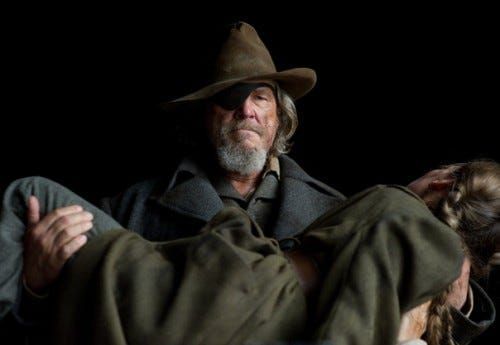
That melody is repeated over and over again in the movie, underscoring the importance of the emerging dynamic between Mattie Ross and Rooster Cogburn. It is paid off dramatically in the Final Struggle, where Cogburn takes Mattie, who has been bitten by a rattlesnake, on an arduous journey to save her life. On horseback until the horse breaks down, then…
IN HIS ARMS! Carrying her for miles and miles until he finds a house in the wilderness. So she is literally leaning on his (Cogburn’s) everlasting arms.
It’s a beautiful end point of Mattie’s innocence-to-experience journey: She starts off cocksure and assertive, lots of head-learning but minimal knowledge of the ‘real’ world. She leaves the Ordinary World of her family’s Arkansas farm and ventures into the New World, represented by the wilderness of the hunt for her father’s killer. Over time she opens up — slowly — to the assistance of others. In the end, she actually needs help, and help she gets from Cogburn who symbolically becomes her surrogate father.
Here are the lyrics of the hymn, which by the way is the song that’s sung when the end credits roll:
What a fellowship, what a joy divine, leaning on the everlasting arms;
what a blessedness, what a peace is mine, leaning on the everlasting arms.
Refrain:
Leaning, leaning, safe and secure from all alarms;
leaning, leaning, leaning on the everlasting arms.
O how sweet to walk in this pilgrim way, leaning on the everlasting arms;
O how bright the path grows from day to day, leaning on the everlasting arms.
(Refrain)
What have I to dread, what have I to fear, leaning on the everlasting arms?
I have blessed peace with my Lord so near, leaning on the everlasting arms.
How perfectly those lyrics fit Mattie’s hero’s journey. In the External World (Plotline), she pursues her conscious goal: find and kill Chaney, the man who murdered her father.
In the Internal World (Themeline), Mattie’s journey is about her metamorphosis from fierce independence to dependence on others, going from the disconnect of her existence as an adult-child, separating her from anyone else, to finding a connection, then ultimately trust with Cogburn. In a way, Cogburn becomes the Christ figure of the hymn.
That is why when Cogburn goes to the extraordinary lengths he does to save Mattie’s life at the end of the movie, we see the theme played out not in an intellectual way, but a powerful emotional fashion. During that three-minute series of scenes, there’s hardly any dialogue, almost all visuals, primarily of Mattie leaning into Cogburn’s shoulders (on horseback), then hanging from Cogburn’s arms (on foot).
It is the perfect resolution of this central theme. You can see a lovely video here featuring the saga in brief accompanied by the hymn “Leaning on the Everlasting Arms.”
The ironic thing is that Mattie, as an adult, does not change, at least discernably. As we see in the Denouement, she is still the fierce, independent woman she was as a 14 year-old. She might well have moved from her position of disconnect to other people to connection had it not been for the fact that her experiences on the trail with Cogburn [especially] as well as LeBouef were so profound, they became these sort of archetypal ideals to which no other humans could possibly compare. Who could she meet in life who could personify wisdom as much as Cogburn (Mentor) or cut as romantic a figure as LeBouef (Attractor), each representing aspects of her own psyche?
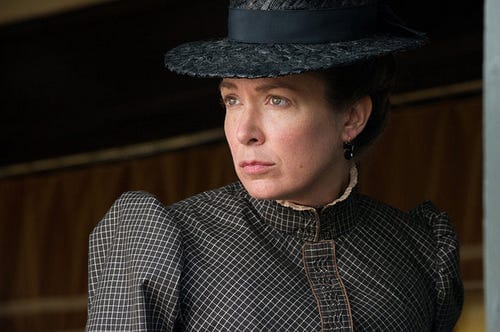
For the rest of her life, Mattie need only look at her missing forearm to be reminded every moment of every day of those pivotal experiences, so deeply seared into her consciousness. She had found a connection, all right. It was, however, with two powerful figures who dwarfed everything else that followed in her life.
It’s that type of texture, those kind of multilayered levels of interpretation and emotional meaning we think of as arising from a story’s themes.
We could choose to look at True Grit with the idea of theme as premise. Perhaps this: “Revenge takes a toll.” Or theme as DNA. Maybe this: “Mattie begins as an adult, then becomes a child.” Those are true in their own way.
But at its core, this story is about a relationship between Mattie and Rooster, the metamorphosis arc from their contentious beginning to her salvation as he carries the girl in his everlasting arms. That is a theme rife with emotional meaning.
Summary
Let us cut through the confusion and work with this principle: Theme = Meaning. This take allows a writer to use themes to touch every aspect of a story — characters and scenes, dynamics and subplots, and the interweaving of Plotline and Themeline — and in a coherent, consonant way.
Theme is much more than the moral of the story, an intellectual premise, or a central idea, it is organic and dynamic arising from the emotional, psychological and spiritual life of a story. As such in most stories, we can find multiple themes at work, but only if we have the eyes to see them. That is the subject of Lecture 2 where we consider the concept of theme as expansion.
Note: The hymn “Leaning on the Everlasting Arms” was composed in 1887 by Anthony Showalter and Elisha Hoffman. It refers to Deuteronomy 33.27: “The eternal God is your refuge, and underneath are the everlasting arms…” Interestingly Showalter came up with the refrain as he was writing letters to two former students, each of whom had recently lost their wives to premature deaths. Could the Coen brothers possibly have known this history of the hymn and its thematic connection to Mattie who had also lost a loved one?
If you are interested in learning more about this approach to theme and its many practical applications to writing, you may check out my 1-week online class Core VII: Theme here. The course begins today.