Zero Draft Thirty: Story Prep Fun With Index Cards!
It all started with this blog post in October 2015: Who’s with me to pound out a script in November?
That led to this: Zero Draft Thirty: Write a Script in a Month Challenge.
Every day for 30 days in November, I did a Zero Draft Thirty post with inspirational writing quotes, videos, and handed out a daily Award to the person deemed worthy for their efforts in supporting our collective cause.
A Facebook group emerged from the process, now with over 1000 members. The Challenge was written up in Indiewire. Translated into Spanish. Got its own hashtag on Twitter: #ZD30SCRIPT.
Eventually over a thousand writers joined up for the Challenge. Via Facebook, Twitter, or email, nearly 200 writers let me know they had finished their Zero Drafts.
So we decided to make the Zero Draft Challenge a twice a year thing: Every March, like we did here, and every September. Here we are, just about a month out from the Zero Draft Thirty 2016 Autumn Challenge.
It’s simple. Pick a script-writing project. Type FADE IN on September 1. Type FADE OUT on September 30.
And you are cordially invited.
In the days leading up to ZDT, I figured we could spend some time talking about story prep as well as psychological prep for our collective writing effort. I began that process in this post yesterday sharing some tips on how to break a story in prep. Today we get down to brass tacks ‘coz I’m talking… index cards.
This is an index card. In a digital world, it is a decidedly analog thing. But for most screenwriters and TV writers, it is one of the most indispensable tools of the trade.
See this?
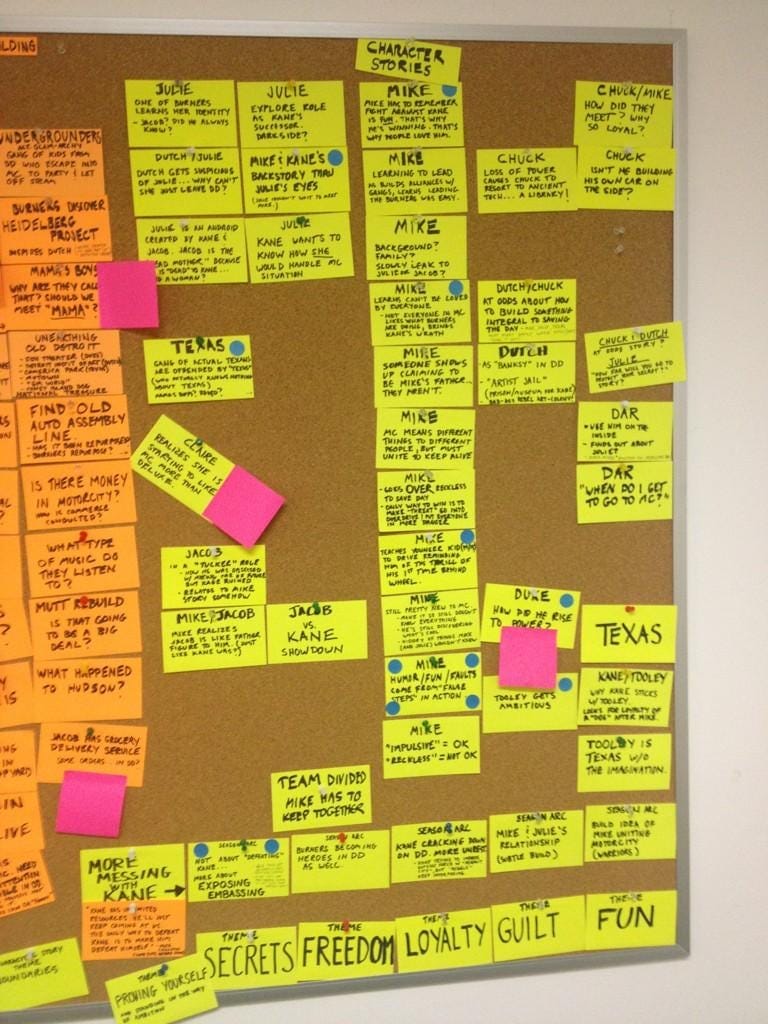
This is what a wall in a TV writers room may look like at any given time, cluttered with index cards.
How can you use index cards?
* Brainstorm: Any time you have an idea for a scene, beat, character, line of dialogue, theme, whatever, you jot it down on an index card, and tack it up on your wall. That way you have it somewhere so you won’t forget the idea.
* Connections: More important, seeing all that story ‘stuff’ laid out in front of you can lead to interesting creative associations, kinda like what Carrie did in the TV series “Homeland”:
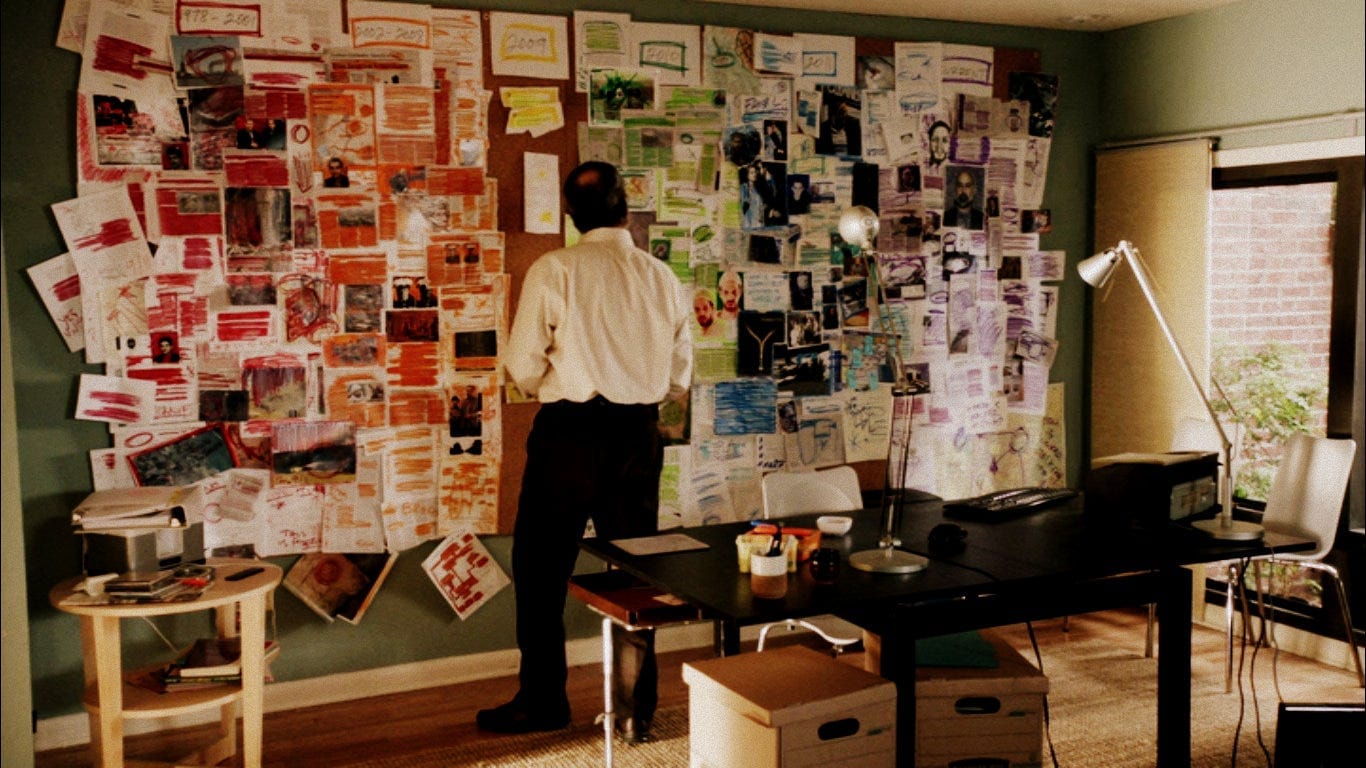
Saul looking at Carrie’s wall going all WFT?!?!
* Plotting: This is where index cards can be really handy. Let’s say you write down every beat and every scene you can think of, one for each index card. If you’re writing a movie script, divide the cards into four piles: Act 1, Act 2A, Act 2B, Act 3. Sort the cards into what pile you feel like they might go in. Then work through each pile, scene by scene, trying to construct a linear flow. Some scenes will feel out of place, so you move them to another pile. Some scenes will feel useless, so you set them aside. There will be gaps from this scene to that, so you simply pick up an index card and write on it, “Need a bridge scene here,” put it into its place, and move on, eventually brainstorming the requisite scene. Then you put all the four piles together into one stack. Now go through that stack over and over and over again, telling the story so it flows one scene to the next. Then tack your story up onto the wall like this:
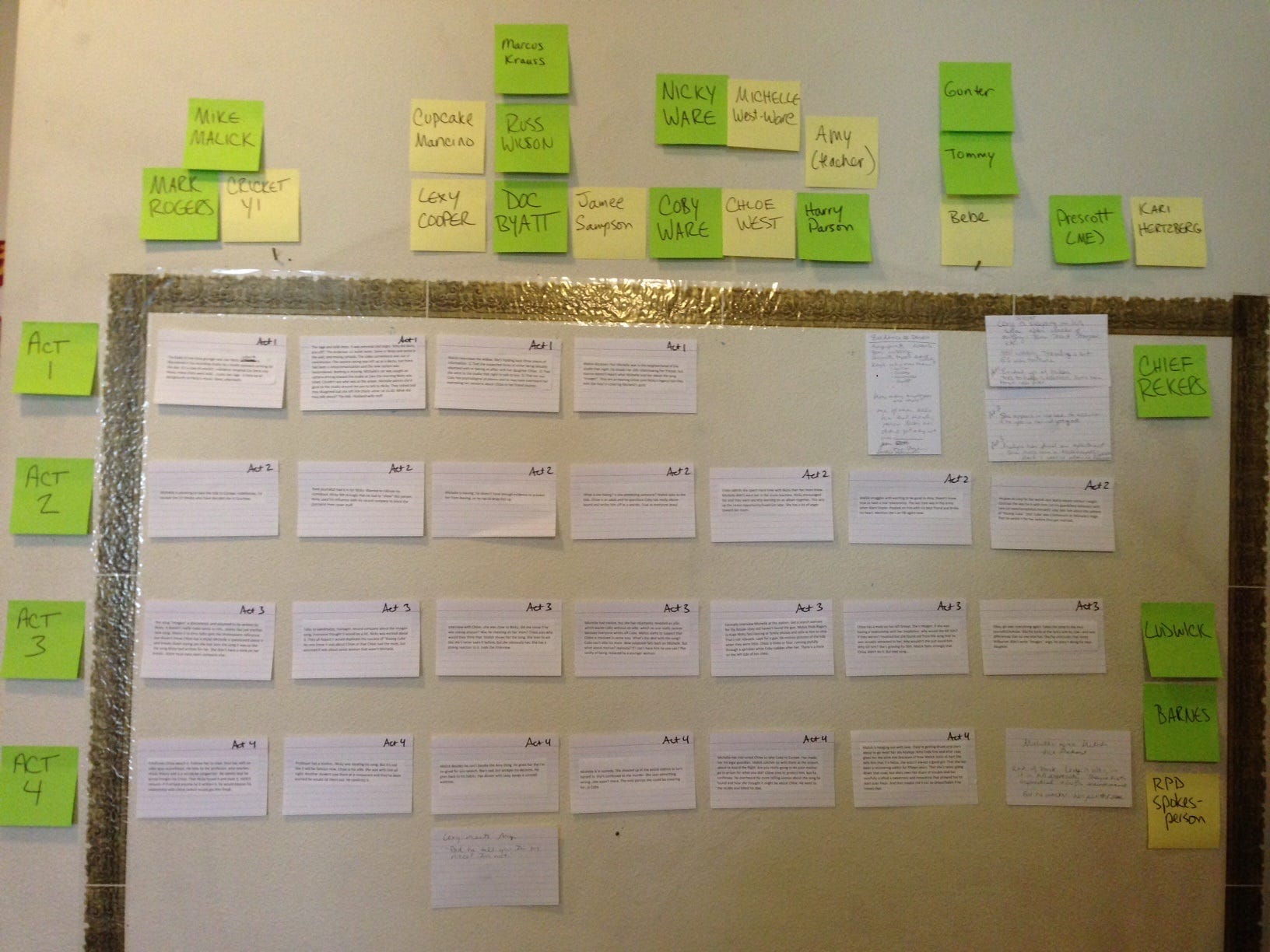
Or on a table like this:
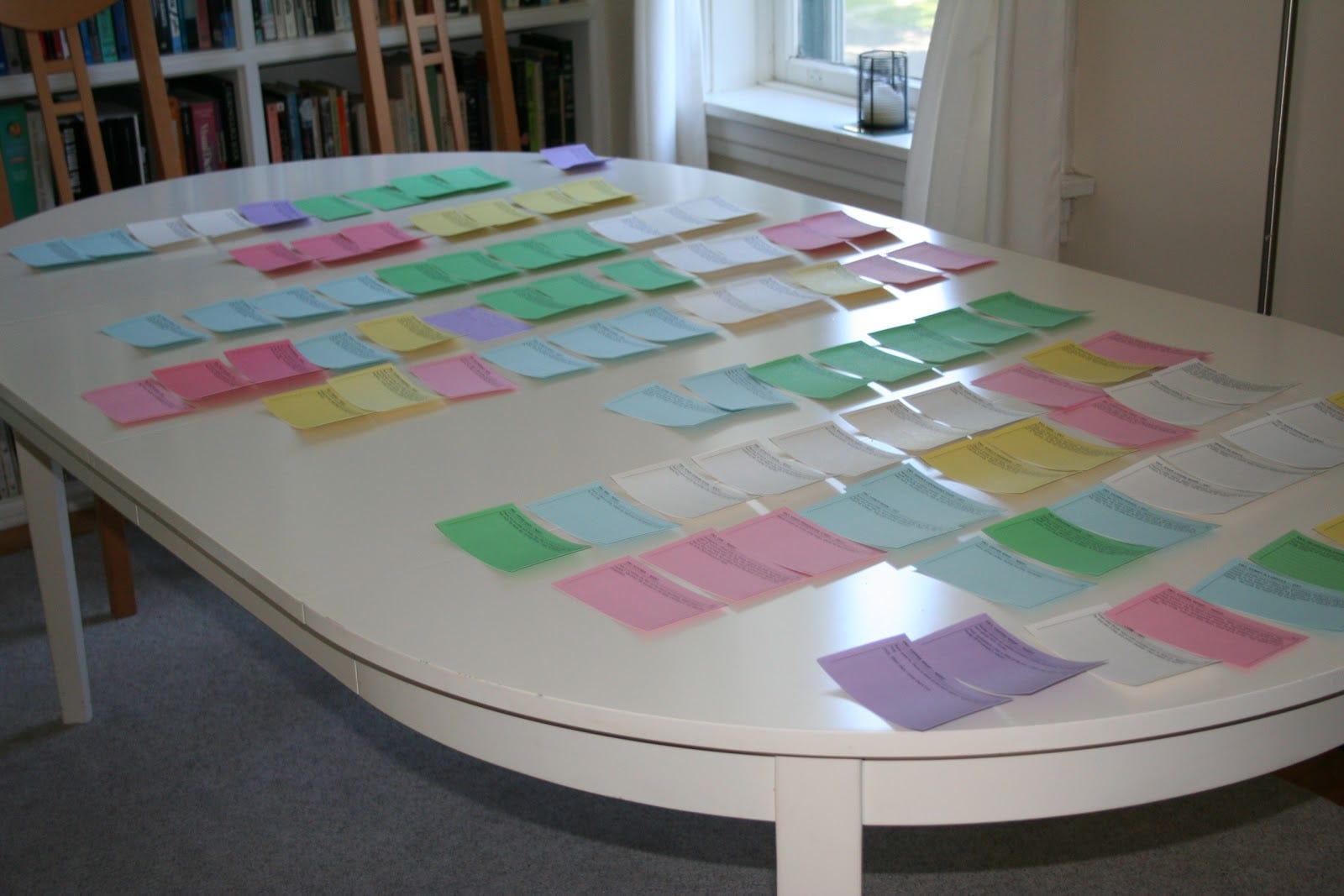
I interviewed Academy Award winning screenwriter Dustin Lance Black (Milk) and he said this:
Then what I do is find the scenes that speak to that, and I put them on note cards. I have this table in my kitchen that’s of a certain size that I think is about two hours. And I start laying out these note cards and if they start to spill over the table, I know I’ve got to cut stuff. I keep doing and doing and doing it, going through it and through it and through it, combining things, telescoping time, combining characters if I have to until these cards fit on this table, then I think, will this collection of cards communicate the reason for this film? And hopefully do so in a dramatic and entertaining way.
In the spirit of Show It, Don’t Say It, go to 1:40 of this interview clip with Lance and see what he’s talking about… including the table!
* Outline: Once you have your story sorted out, you can create an outline. Then you are ready to type FADE IN.
BTW you will notice many writers use different color cards. Typically that’s about tracking various subplots: White for the Plotline, blue for this subplot, yellow for that subplot, and so on. This is helpful because you can visually tell how you are cross-cutting between storylines which can help in terms of pace, transitions, etc.
I know some of you will chime in and suggest a variety of software programs that replicate index cards. And if that works for you, fine. But at the risk of sounding like an old farting Luddite, allow me to praise the simple 3x5 inch index card.
It is tactile.
You can feel it in your hands.
You can cram tons of information on each card — dialogue, scene description, theme, questions, reminders, all in ink, your words, another tactile experience. You know, actual writing.
When you have your stack of cards, holding it in your lap, there’s actual heft to it, substance.
This is your story… and these cards represent it actually having come into being.
Then when you lay it out on a table or tack it up on a wall, you can step back in actual physical space and stare at it, let your eyes roam back and forth.
It’s not squished onto 14" computer monitor, little electronic bits of data.
Hell, no. It takes up a whole goddammed wall of paper, ink and tacks!
Again a tactile experience: It’s a story and it’s real!
So here’s to the humble index card, pawns in our creative chess game. But if we keep working them and working them until the story emerges into life, we can crown those pawns and turn them into queens.
And our story will rise to glory.
[Cue heroic soundtrack, writer weeps, audience cheers… and black].
Back to the Zero Draft Thirty challenge.
September 1: Type FADE IN.
September 30: Type FADE OUT.
30 days. A first draft of an original screenplay. TV pilot. Or a rewrite of an existing script.
For background on the Zero Draft Thirty challenge, go here.
Don’t forget the Zero Draft Thirty Facebook group. A terrific collection of folks who post things every day, even when we’re not in a challenge.
So calling all Zeronauts, Outlaws, Scamperers, and Writing Warriors. Who’s up for pounding out a Zero Draft in September? LET’S DO THIS THING!
Hashtag: #ZD30SCRIPT.