Movie Analysis (Part 7): “Gravity”

This week, I’m going through the script for the movie Gravity, excerpting every scene that touches on its primary ‘small’ story: Ryan Stone (Sandra Bullock) dealing with her grief related to the death of her young daughter. I laid out my rationale for this exercise in Part 1 of the series:
I’m not suggesting the small story in Gravity is wholly responsible for its ginormous box office success. What I am saying is this:
* At least some of the positive BWOM (By Word Of Mouth) about this movie derived from the audience’s emotional connection with a mother who has lost her child and is forced to cope with her grief under remarkable circumstances.
* If the filmmakers themselves looked at the movie as a metaphor for the Protagonist dealing with her personal issues, then it makes sense for us to think about the story that way as well.
* No spectacle movie can be considered to be great unless it has a compelling small story at work in it.
Here is what I propose: Over the next week, I’m going to go through the script for Gravity and strip out every single scene that references the movie’s small story. In that process, I am going to focus on three dynamics:
1. The overall arc of that subplot moving from Beginning to End.
2. How the metaphor of outer space services the psychological nature of this subplot.
3. Stone’s metamorphosis as she is forced to grapple with her grief.
More generally, I am hoping each of us will come away with an appreciation for the importance of the machinations of a story’s Internal World balanced against the entertainment value of all the action in its External World.
SPOILER ALERT: If you have not seen the movie and don’t wish to know what happens, do not click on More. If you do want to track the series, I’ll see you below the fold.
Plot Summary: A medical engineer and an astronaut work together to survive after a catastrophe destroys their shuttle and leaves them adrift in orbit.
Background: Dr. Ryan Stone is a biomedical engineer on her first Space Shuttle mission. She is accompanied by Matt Kowalsky (George Clooney) and Shariff (voiced by Phaldut Sharma).
Here’s where we left off yesterday per the IMDB Plot Summary:
The Tiangong station’s orbit has deteriorated due to hits by the debris field and it begins to break up on the upper edge of the atmosphere. Stone is unable to separate the capsule from the space station, and she resigns herself to her fate, whatever it may be.
As the space stations begins to break up, the Shenzhou capsule is broken off from the station, and Stone fires the device that separates the capsule from the rest of the spacecraft. As the capsule falls towards earth, it rights itself and descends through the atmosphere. The radio crackles with traffic from Mission Control, who are tracking the capsule, and tell her that rescue is on its way. The chute automatically deploys and Stone lands in a lake near the shore. The cabin is full of smoke, and after she blows the hatch the capsule tilts, allowing water to enter. Just when she thought she was safe, she’s unable to exit the capsule. The capsule sinks to the bottom with Stone inside. Stone finds a bubble of air inside the capsule and exits the capsule, shedding her spacesuit so she can get to the surface.
Here is today’s excerpt from the shooting script:
EXT. LAKE - DAYRyan surfaces. She floats on her back.The CAMERA TILTS UP TO the sky. Burning debris from the space station
soars through. TILT BACK DOWN TO Ryan swimming.She crawls onto the shore and lies down, exhausted.RYAN: (chuckles) Thank you. No.She struggles to her feet. She unsteadily walks off.OVER BLACKEND CREDITS.
Ryan has survived the Final Struggle — her reentry through Earth’s atmosphere and her descent into the lake’s water. Both recall religious imagery: The “refiner’s fire” (Malachi 3:2) and baptism (Matthew 3:13–16). The act of being submerged in water, then raised up out of it is symbolic of one’s old life being washed away, and emerging into a new life. Clearly this reinforces the nature of Ryan’s metamorphosis.
As Ryan makes her way to shore, the moment brings to mind another theological image: The creation myths of the Old Testament with Ryan in the role of Eve, the First Woman. Indeed that image is underscored by the paradise type quality of her immediate surroundings, a version of the Garden of Eden.
As she struggles to her feet, this recalls Matt’s words (actually her own words projected into a phantasm of Matt): “You gotta plant both your feet on the ground.” Now that she has landed, she does precisely that, her first steps into a New Life.

Standing there and peering up toward the heavens, once again we are reminded of The Shawshank Redemption:
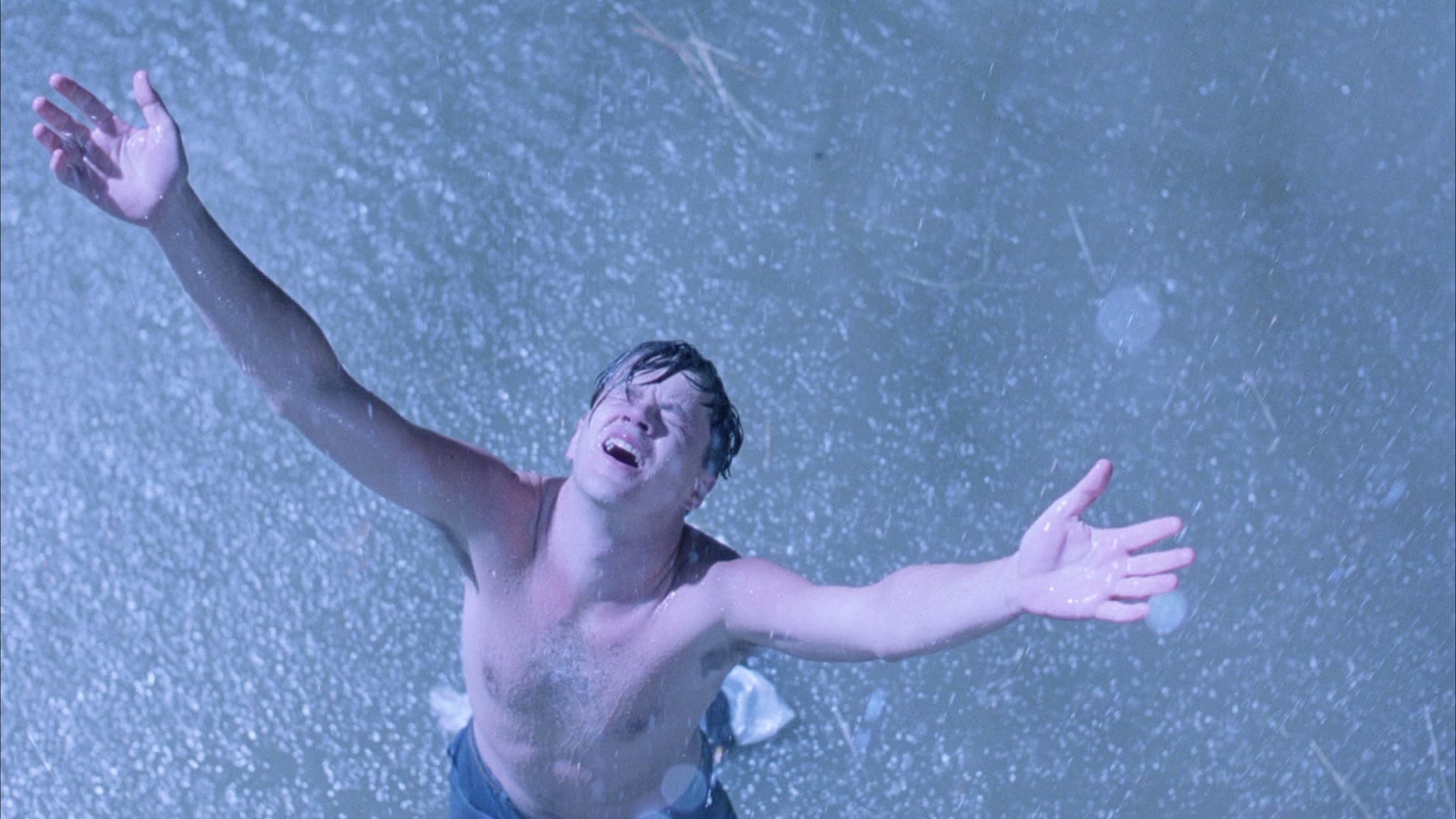
All of this brings us back to this observation by Alphonso Cuarón from the very first installment of this series:
Did you have to fight for the film to be more of a small, character-focused piece? Instead of focusing on all of the destruction?
When we set up to write the script, it was about that. What we were trying to do was a film about adversity and the possible outcome of a rebirth. All of things that fall apart metaphorically, and in the life of this woman (Ryan Stone).
Rebirth. Ryan began this story in a life-less state, trapped in a purgatorial existence by a combination of her grief and guilt over her daughter’s death. From a purely psychological level, therefore, the ‘big’ story of Gravity, all of the crazed machinations of the Plotline, exist to service the ‘small’ story of Ryan’s rebirth.
In a nice bit of synchronicity, movie producer Megan Ellison (American Hustle, Her) tweeted this today: “There is only one god and his name is Death. And there is only one thing we say to Death: Not today.” I thought that summed up the ‘small’ story of Gravity quite nicely. There Death took the life of Ryan’s daughter. Death almost took Ryan’s life as well. But in the end, Ryan made a choice and told Death: Not today.
Whether you resonated with the ‘small’ story in Gravity or not, one thing is clear: The filmmakers were intentional in crafting it. And if there is a bottom line takeaway from this series it’s something I have noted before, but it bears repeating: Your stories have to be about something. There must be some emotional meaning to the events. To do that, you have to conscious of it and work on it. The Internal World of your screenplay universe is every bit as important as your External World. adsf
For Part 1 of this series, go here.
Part 2, here.
Part 3, here.
Part 4, here.
Part 5, here.
Part 6, here.
Comment Archive