Movie Analysis: “Spotlight” — Themes
Another in our bi-weekly series in which we analyze movies currently in release. Why? To quote the writing mantra I coined over 5 years ago: Watch movies. Read scripts. Write pages. You will note which one comes first. Here are my reflections from that post about the importance of watching movies:
To be a good screenwriter, you need to have a broad exposure to the world of film. Every movie you see is a potential reference point for your writing, everything from story concepts you generate to characters you develop to scenes you construct. Moreover people who work in the movie business constantly reference existing movies when discussing stories you write; it’s a shorthand way of getting across what they mean or envision.
But most importantly, you need to watch movies in order to ‘get’ how movie stories work. If you immerse yourself in the world of film, it’s like a Gestalt experience where you begin to grasp intuitively scene composition, story structure, character functions, dialogue and subtext, transitions and pacing, and so on.
Let me add this: It’s important to see movies as they get released so that you stay on top of the business. Decisions get made in Hollywood in large part depending upon how movies perform, so watching movies as they come out puts you in the same head space as reps, producers, execs, and buyers.
This week’s movie: Spotlight which won the 2016 Academy Award for Best Picture, written by Josh Singer and Tom McCarthy. You may download. the script here.
Our schedule for discussion this week:
Monday: General Comments
Tuesday: Plot
Wednesday: Characters
Thursday: Themes
Friday: Dialogue
Saturday: Takeaways
For those of you who have not seen the movie, do not click MORE as we will be trafficking in major spoilers. If you have seen Spotlight, I invite you to join me in breaking down and analyzing the movie.
The first theme I’d like to focus on is one raised in comments the other day by screenstudent:
I thought Mike had an incredibly powerful arc. Mike has, as Tom McCarthy has said, his own crisis of faith. Once Mike gets the documents from Garabedian, there is no question of the Church’s innocence or guilt. And this is the point at which Mike loses his religious “faith.” It’s a real moment of crisis, especially for a guy raised Catholic in one of the most Catholic of cities (maybe hard for LAers to relate to how embedded this is is Boston?) The net result is that Mike doubles down on his secular “faith” in the journalistic investigative process on which he has embarked. And his drive to get to the truth kicks into an even higher gear. (BTW, from the journalists I know, this driving and all-consuming “faith” in their investigative cause when on an important story rings absolutely true. You see it in All The President’s Men as well. That is what great journalists do.) This whole turning point for Mike was brilliantly done.
Further, it’s not just an individual’s turn. To a large extent, it’s an entire generation’s turn as well. The priests’ abuse was horrific. This is and should be a story about the victims’ permanent scars. The film also shows how the church’s cover-up has furthered the very erosion of the institution they were trying to protect. Mike in that sense stands in for many who lost their faith in the wake of the abuse scandal…
A crisis in spiritual faith led Mike to a kind of concentrated faith in his job. It’s as if he needed the latter to make up for the sins of commission by the Church relative to the former.
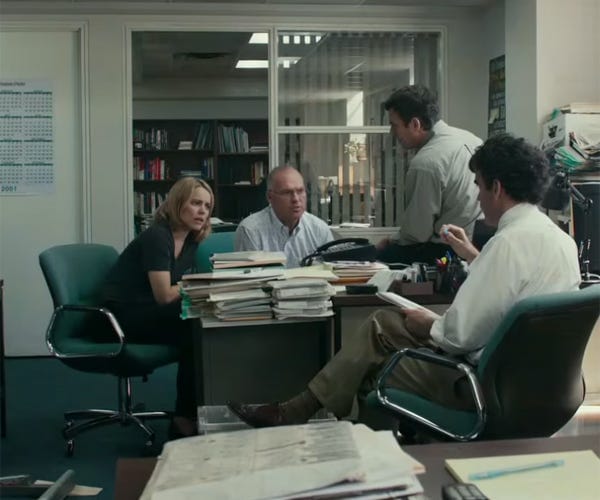
A second theme: Brotherhood. Again this draws upon a contrast between Church and Journalism. On the one hand, the brotherhood of the priesthood and the clerical ‘family’ which did what it could — including bribes — to keep quiet the molestation scandal. On the other hand, the secular Spotlight family who working together break the case.
What other themes do you see in play in Spotlight? Share your thoughts and add to the archival value of this series for writers and movie fans.
Comment Archive