Interview (Part 3): Isaac Adamson
The top rated screenplay on the 2015 Black List is “Bubbles” and it was written by Isaac Adamson. It’s a terrific story, one of the most, if not the most unique ways to approach writing a biopic I have ever seen: The story is a snapshot of Michael Jackson’s life told from the perspective of his pet chimpanzee Bubbles. I would have been interested in interviewing Isaac simply based on the creative inspiration of that idea — I mean, who thinks like that — but when it hit #1 on the Black List charts last year, it was a no-brainer. I reached out to Isaac’s manager Lee Stobby and we finally arranged a time in Isaac’s busy schedule to spend an hour together over the phone, talking with Isaac from his home in Portland, Oregon.
Today in Part 3, Isaac talks about some of the remarkable anecdotes in the script which are based in truth and some other stories he omitted which are equally bizarre:
Scott: That hierarchical thing is a big point of connection. Of course, Michael Jackson the King of Pop and the way that Bubbles sees the world was really like that, right? There’s this, who’s at the top of the food chain in terms of the animal realm, that parallel going on.
Isaac: Yeah, definitely. It’s another one of those things where I just lucked out that Michael Jackson’s known as the King of Pop, and showbiz itself tends be pretty hierarchical, too. You get that a little bit in the scene where Prince and Michael are kind of sizing each other up during the meeting about the proposed “Bad” duet.
But I think It’s also coming of age story about a character trying to find their place in this world and figuring out that they’re not really suited for it, which also worked, because I think that was largely true of Michael Jackson as well.
Scott: Yeah. I picked up on that. I don’t know if this was intentional or not, on Page 6 Bubbles says, “So much of our lives are read in our youth. A time largely, beyond our control, a time when events unfold without our consent. Perhaps, all of life is ever thus.”
I made the connection this not only pertains to Bubbles, but to Michael Jackson, who grew up with his father, Joe, very much a domineering type of a figure. With regard to The Jackson Five, Michael didn’t really have a choice in that matter.
Many of the choices and actions by Michael Jackson we see in the script are taken in response to this authoritarian type of dynamic he experienced as a child.
Isaac: Yeah, very much.
Scott: Also, I thought it was funny the script has a little bit of that Shakespearean in Love dynamic where there are things happening in the life of Will Shakespeare he incorporates into his plays. In your script, there’s a moment where very early on, Michael Jackson’s dealing with Bubbles saying, “I’m bad. No, you’re bad. Let’s try again. Who’s bad, who’s bad.”
[laughter]
Isaac: Right. I just thought that scene would be fun. I always wondered where Michael Jackson got the lyrics for “Bad”. I’ve always wondered that with songs in general. That one, the lyrics are so goofy when you can actually see them printed on page, but when you listen to the song, it sounds great. A lot of songs are that way I guess. But yeah, having Bubbles be partly responsible for the origins of “Bad” just struck me as a funny idea.
Scott: You mentioned this pecking order like that scene where Prince comes and Bubbles gets little worried. There’s several times where he’s like that, he gets anxious about his place in Michael Jackson’s kingdom.
In fact on Page 23, he says, “I knew only then that they had usurped the King’s attention. I was determined to find some way to win it back.” That brought to mind the Woody and Buzz relationship in Toy Story, how Woody is concerned about being relegated to a secondary position behind Andy. Does that parallel register to you at all?
Isaac: I hadn’t thought of that, but now you say it, it’s definitely accurate.
Scott: You say you’ve got all this material you accumulated about Michael Jackson. There’s a very funny scene in Japan where Bubbles spends the night partying with Bon Jovi. First of all, is that fact or fiction?
Isaac: That is fact. I read Bon Jovi’s account of that in one of the books I was reading about Michael Jackson’s business acumen. Bon Jovi was talking about how Michael was all about resting his voice and relaxing the night before a show. They really wanted to party with him but he didn’t want to go. But he did send down Bubbles.
They got in this huge rock and roll party and they trashed their hotel room. [laughs] They basically blamed it all on Bubbles the next day when their manager found out about it.
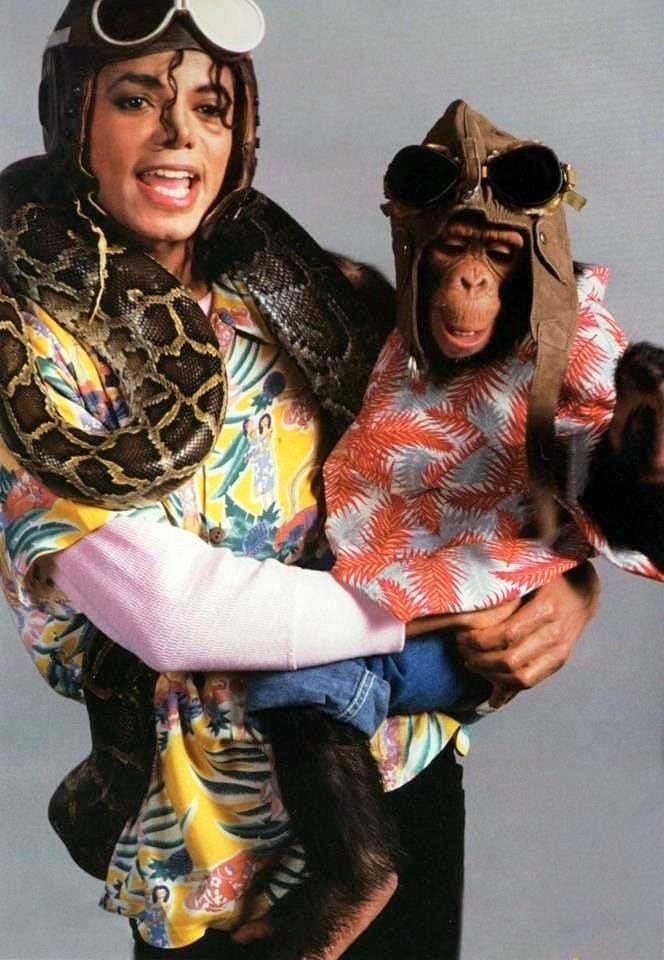
Michael Jackson, Bubbles, and unnamed snake
Scott: That’s terrific, and part of the bridge that leads Michael to essentially turning away from Bubbles. That leads me to a question that, given this wealth of narrative material, how did you decide which things to omit from the script?
Isaac: It’s really done on a case-by-case basis. Does it add to the story, is it too similar to another scene that’s probably better? I’ll give you one example, of a scene which I liked but I left out. During this time he was recording “Bad,” Michael was obsessed with the idea of doing duets with all these different famous performers.
He invited Freddy Mercury of Queen to come and record a track with him. Freddie Mercury got freaked out by Bubbles’ presence, and specifically that Michael, whether jokingly or not, was consulting Bubbles on various takes of the tracks to see which one Bubbles liked. [laughter] The story is that Michael excused himself to go to the rest room or something, and then Freddie Mercury got on the phone to his manager and he was like, “You’ve got to get me out of this. Come pick me up.” And he just walked out of the studio.
It’s a scene I liked, but I felt that it was just a little bit too close to the Prince scene because it’s the same kind of thing, a performer with this royal name. That’s an example of one that I would have loved to keep if I had infinite space, but it’s a scene that’s almost a double beat, so I left it out.
Scott: That’s interesting because you’ve got King of Pop, you’ve got Prince, you would have had a lead singer from Queen. It’s a whole monarchical theme.
Isaac: Who knows maybe Freddie Mercury will wriggle his way back in there someday.
Scott: The script is certainly not lacking for real‑life human beings with people such as Corey Feldman and Elizabeth Taylor, a panoply of talent there.
Isaac: For sure. It’s funny, since the script came out I’ve been going to meetings and talking with various people in Los Angeles that had interactions with him. I’ve probably collected enough anecdotes for a whole another Michael Jackson movie, although it would be a much different one.
Tomorrow in Part 4, Isaac and I discuss some themes at work in the script “Bubbles”.
For Part 1 of the interview, go here.
Part 2, here.
Isaac is repped by CAA and Lee Stobby.
Twitter: @isaacadamson.