“All villains have mothers”

kiwichick made an interesting observation in another thread:
“Clint’s “give-the-horse-a-drink-first” moment reminds me of Jean Reno in The Professional — he’ll take out anyone that needs taking out but don’t you dare touch his plant. Nothing more appealing than a broody ‘closed shop’ of an alpha male who really does care deep down. Who really does respect life.”
The reference to Jean Reno in The Professional is spot on. It can often be something simple to dimensionalize a character, even a villain. Remember in Three Days of the Condor, Max von Sydow’s hit-man character had that one moment where we saw him hand painting tiny military figures with classical music softly in the background. Or in Diva, the hit-man was constantly listening to something on his headphones, only revealed at the very end, I believe when he was shot and killed, to be opera music.
There’s a great line, I can’t quite place where it came from, but it’s, “All villains have mothers.”
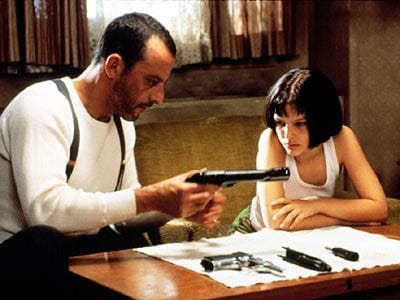
It’s so easy to create stereotypical “bad guys” when it doesn’t take much digging and imagination to give them some depth, some distinctive personality traits or quirks, that reveal their humanity. And if you can get a reader to identify with a villain’s humanity, that always makes for a more interesting character.
[Originally posted 5/23/08]
UPDATE: Mike Scherer solved the mystery of whose quote “all villain have mothers” is:
When asked why he writes crime novels at all, Leonard said, “I just feel more secure in a situation where I know a gun can go off at any time if things get boring.” To write about criminals, he said, “I [try] to put myself in [a criminal’s] place. He doesn’t think he’s doing an evil thing. … I see convicts sitting around talking about a baseball game. I see them as kids. All villains have mothers.”
Thanks, Mike!
Comment Archive