“Back to the Future” came out 31 years ago today
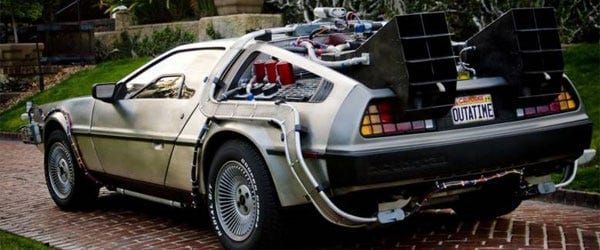
July 3, 1985. The day Back to the Future debuted in North America. And I am inclined to agree with the sentiments of this Vox article: Back to the Future is the most perfect blockbuster ever made.
Here are the reasons as detailed in the article:
1) It boasts the best blockbuster script ever written.
2) Everything in the movie is a ticking clock. Everything.
3) Director Robert Zemeckis had something to prove.
4) Back to the Future is now a double period piece.
5) The movie features wonderful themes of reconciliation.
How about this? It’s funny. It’s smart. The cast is fantastic. The directing superb. The pace is pitch perfect. And there’s this:
The DeLorean! I defy you to come up with even one thing about this movie which doesn’t work. Which brings me to the very first point in the article: The script. It is a master class in so many respects, but if you want to up your understanding of the craft, when you watch the movie — and hopefully read the script — zero in on two things: Subplots and Setups / Payoffs. Absolutely brilliant how screenwriters Bob Gale and Robert Zemeckis make every single relationship between characters, which constitute most of the story’s subplots, work together seamlessly to tie together the entire narrative. And setups and payoffs galore!
I have written extensively about Back to the Future over the years. Links to some of those posts:
Analysis: “Back to the Future” and “The Wizard of Oz”
Great Characters: Dr. Emmett Brown (“Back to the Future”)
Great Scene: “Back to the Future”
Movie Analysis: “Back to the Future”
Movie Analysis: “Back to the Future” — Plot
Movie Analysis: “Back to the Future” — Characters
Movie Analysis: “Back to the Future” — Themes
Movie Analysis: “Back to the Future” — Takeaways
Opening Sequence: “Back to the Future”
Subplots: “Back to the Future”
The original theatrical trailer for the movie:
A quote from Bob Gale about the origin of the story concept:
“The inspiration for coming up with the story [Back to the Future] is that I was visiting my parents in the summer of 1980, from St. Louis Missouri, and I found my father’s high-school yearbook in the basement. I’m thumbing through it and I find out that my father was the president of his graduating class, which I was completely unaware of. So there’s a picture of my dad, 18-years-old… The question came up in my head, ‘gee, what if I had gone to school with my dad, would I have been friends with him?’ That was where the light bulb went off.”
Here are two additional reasons why I have such a connection to this movie:
* The very, very beginning of my screenwriting education was a copy of “Screenplay: The Foundation of Screenwriting” by Syd Field and three scripts: Witness, Breaking Away, Back to the Future. BTTF was the first screenplay I ever read.
* My wife Rebecca and I were married in Ventura, California on July 27, 1985. We spent the first night of our honeymoon in Santa Barbara. After dinner as we walked down State Street, I peered up at the marquee of a movie theater there: Back to the Future. I looked at Rebecca. She looked at me. We bought two tickets and saw BTTF on our honeymoon night. I love my wife for many reasons, but the fact she put up with my obsession with movies to the point where we spent 2 hours of our first day of marriage watching Marty McFly, Doc Brown, and the rest of the BTTF gang earned her a free pass to my personal Hall of Fame and my eternal gratitude.
How about you? Do you remember the first time you saw Back to the Future? And do you agree with the Vox article that it may be the “most perfect blockbuster ever made”?
UPDATE: In comments, Paul L notes that the final version of the script is considerably different than the first draft. That version dates from 1981 (the final version is 1984) and here are some of the differences:
- The present is 1982, not 1985.
- Hill Valley does not exist (i.e. it is never named), only a place described as a “small Midwestern town”.
- The time machine resembles a refrigerator, and is powered by the “Power Converter”. (This idea was dropped because of the fear that children would imitate what they saw and lock themselves inside refrigerators.)
- Professor Brown lives in an abandoned Orpheum theater.
- Professor Brown has a monkey named Shemp.
- Marty’s girlfriend is Suzy Parker.
- Marty is a streetwise video pirate alongside being an aspiring musician. (The studio had refused to make a film where the hero was a video pirate.)
- Marty’s mother is Eileen Baines and lives in the same house as Marty in 1952.
- Government agents shoot Professor Brown.
- Instead of capturing Emmett’s demise via a JVC camcorder, an audio tape recorder is used (granted home video cameras were in short supply in 1980).
- Marty travels back to March 11, 1952.
- Marty’s alias is “Marty Lewis”, perhaps a reference to Huey Lewis.
- Brown got his ‘revelation’ when, at a party, a girl hit him on the head with a bottle.
- Biff’s catch phrase is “A-hole” instead of “butthead”.
- The dance is named “Springtime in Paris” instead of “Enchantment Under the Sea”.
- The all-black band is Lester Moon and the Midnighters.
- The song that George and “Eileen” have their first kiss with is “Turn Back the Hands of Time”, though Marty still plays “Johnny B. Goode” afterward, albeit with a segue into “Rock Around the Clock”.
- George and Eileen meet in the high school cafeteria where he attempts to ask her out. He spills creamed corn.
- The way Marty returns to 1982 is via a nuclear test in Nevada. (It was considered too expensive to go on location.)
- When Marty returns to 1982, he discovers that his father has become a boxer.
- Marty has an unnamed elder brother who has left home, but he does not have a sister.
These come from a site called Futurepedia.
Comment Archive