Breaking the 4th Wall — Shane Black Style
Vulture takes a trip down memory lane smack dab into the middle of the Great Spec Script Frenzy of the 90s:
The first two Iron Man movies were basically written on the fly, and while that jerry-rigged approach produced a gem of a first film, the hastily sewn seams showed in Iron Man 2. If there’s anything Iron Man 3 has in full over its two predecessors, then, it’s a clever, well-plotted screenplay that practically hums with luxury-car confidence; no surprise, since it was co-written and directed by one of the masters of the modern action movie screenplay, Shane Black. The 50-year-old isn’t Hollywood’s most prolific writer — he only has a handful of credits, including the first Lethal Weapon, Kiss Kiss Bang Bang, and The Last Boy Scout — but for a time, he was its most highly paid, and the $4 million he earned for the 1996 action film The Long Kiss Goodnight is still a Hollywood record for a spec script. How did Black do it? Simple: He made reading his screenplays way too much fun.
It’s an open secret in Hollywood that studio executives do very little reading themselves, instead employing script readers to do the dirty work of slogging through multiple scripts a day. Black wrote screenplays that were practically engineered to perk up a weary script reader, packing his scene descriptions with clever in-jokes, meta flourishes, and — when all else failed — flattering entreaties to the readers themselves.
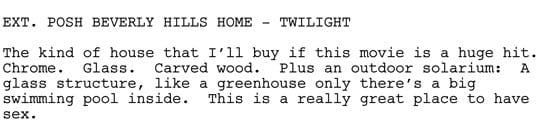
What this is about is breaking the 4th wall, using scene description to ‘talk’ directly to the script reader. Here are a few examples from the Vulture article. From the Shane Black spec script for Lethal Weapon:
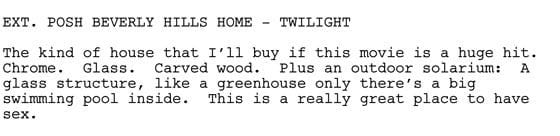
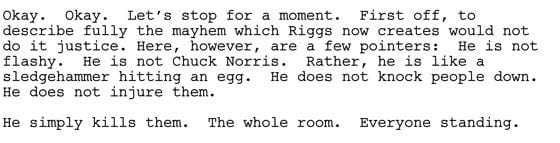
Another piece of scene description from Lethal Weapon:
Perhaps the single most famous piece of Shane Black scene description in which he broke the 4th wall is from The Last Boyscout:
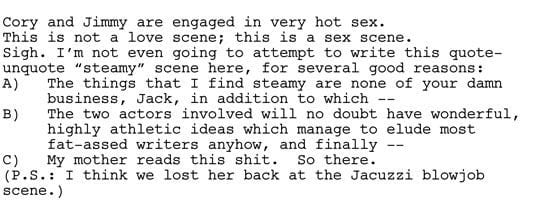
In a way, this approach was sheer genius. As the article notes, it’s a massive acknowledgement of the script reader and all the shit scripts they regularly have to read. And Black embraced a simple premise about his Narrative Voice as if to say: I am going to do everything I can to entertain you. You and me? We’re allies here. I want you on my side and we are going to have a good time for the next 100 plus pages.
The Last Boyscout spec script sold for a reporter $1.75M. I’m not going to say the main reason it sold for that much dough was this choice to break the 4th wall, but it certainly didn’t hurt.
The fact is there are very few screenwriters who have such a distinctive voice, you can recognize them from what’s written on the page. Shane Black is one of them. And it’s not just the whole breaking the 4th wall angle. He took inspiration from Walter Hill and his haiku style of writing scene description — I have written extensively about this over the years, a few posts here, here, here, and here — and made it his own. Black writes great dialogue. But his scene description is equally strong, even poetic in its brevity and heightened visuality and emotion. You actually want to read it, not skim over it like most scripts.
Here is the problem. After Shane Black sold The Last Boyscout for a head-turning amount of money, the inevitable happened: Hollywood was flooded with scripts by Shane Black wannabes. So within about a year of the Boyscout sale, script readers who had at one time been regaled by Black’s breaking the 4th wall became sick and tired of all the rotten imitators.
Over the years, we’ve seen an ebb and flow of this type of scene description. And if you track current spec scripts, there is a level of what we may call ‘editorializing,’ whereby the writer ‘comments’ on the action, the characters, the mood, and so forth that is considered fine, even desirable. But you have to be judicious and consistent when doing that.
As long as we’re here, let’s discuss breaking the 4th wall, editorializing, commenting, the whole thing.
In part, it’s a question about a writer’s voice and their decision about how to approach Narrative Voice which can vary from script to script, genre to genre.
Bottom line: What do you think about breaking the 4th wall in scene description?
For more of the Vulture article, go here.
Comment Archive