Classic 40s Movie: Les enfants du paradis
September was Classic 40s Movie month. Today a special guest post from Brendan Howley.
This is the film you wouldn’t ordinarily go to on a rainy January Friday but you do because a very beautiful young woman passing you by on the pavement outside the Paris cinema tells you confidingly ‘it’s France’s Gone with the Wind.’
I did. It was. It is.
The urban legend is that every evening in Paris, somewhere Les Enfants is playing; I’ve now seen the film more times than I’ve visited Paris, not least because it’s a film of Paris and about Paris the way The Godfather is a film of New York — but mostly because it’s a world that only Paris could leaven.
And a masterpiece of storytelling of a kind that’s out of the mind of an utterly unique sensibility obsessed with ambiguity: political, sexual, moral — that of director Marcel Carné, himself a study in ambiguity. (Sidebar: Walk, don’t run to read William Empson’s Seven Types of Ambiguity. You’ll learn more about writing than you ever thought possible. This is a former investigative journalist telling you this.)
What may well have been structured as a film acceptable to the Nazi/Vichy regime in occupied France and filmed under well-nigh impossible wartime conditions, rife with accusations of collaboration and even anti-semitism, Les Enfants has survived all that to become what’s generally accepted as the French film of the 20th Century.
It’s a Victor Hugo-scale piece of storytelling that’s not about the Anglo-Saxon tradition of allegory and linear storytelling but a “grasp in the dark” at the ancient Greek form of melodrama, in which the powerless seek glimpses of significance from the gods, essentially mysterious.
But why?
“What people really are (winking), really, at the bottom of their hearts, they keep quiet about, they hide carefully,” suggests Lacenaire, Garance’s lover and the criminal doomed to the guillotine. Les Enfants is the best investigation I’ve ever seen of ambiguity, those things we do to keep ourselves from ourselves.
Title: Les Enfants du Paradis
Year: 1945
Writer: Jacques Prévert
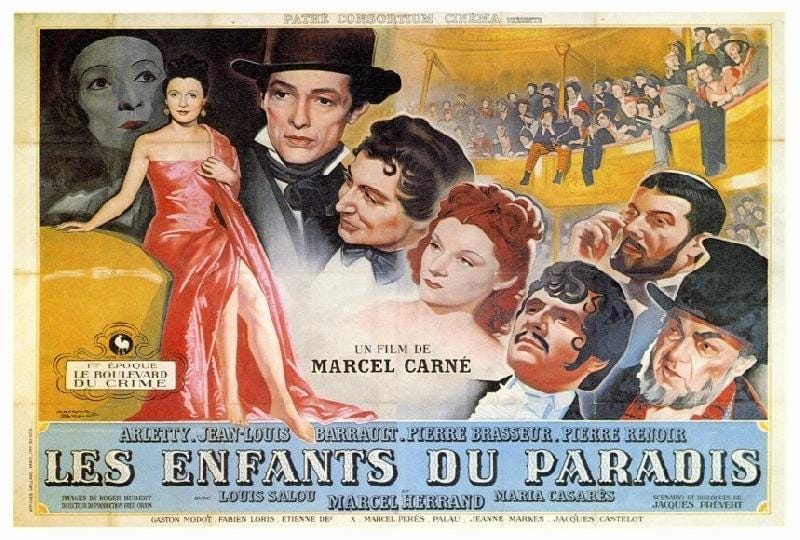
Lead Actors: Arletty, Jean-Louis Barrault, Pierre Brasseur, Marcel Herrand, Louis Salou
Director: Marcel Carné
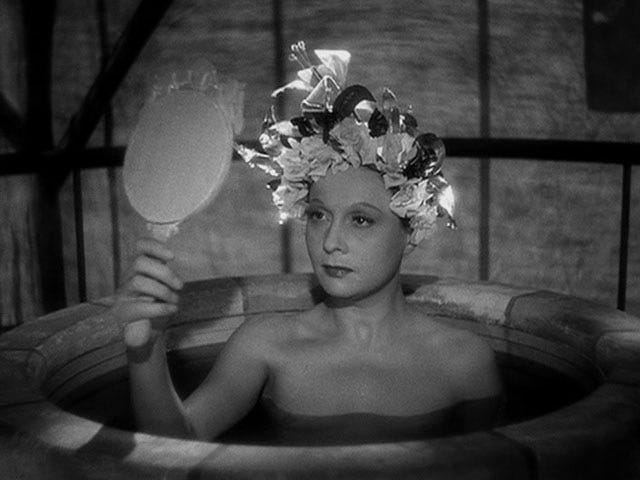
Plot Summary: A film in two parts, covering two distinct decades in Paris (c1827: ‘The Boulevard of Crime’ and c1835: ‘The Man in White’) Two theatres: one high, one low. One unreachable woman (Arletty as Garance, a carnival exhibitionist): four lovers — an artist (Barrault), an actor (Brasseur), a criminal (Herrand) and a nobleman (Salou).
Its beating heart? The doomed love affair between Garance and Baptiste.
Each of the four wants Garance for different reasons and the sum total of her connections to each of them is at once an ‘impossible dream’ — for no one mortal can ever wholly satisfy the longings of another — and an indictment of the danger of reading sexual ambiguity (Carné’s psychological stock-in-trade) for mystery, the prospect of discovering oneself in another.
The theatre’s architecture parses out the plot: in the orchestra, the aristocrats and the criminals. In the wings, the actors and, onstage, the solitary artist.
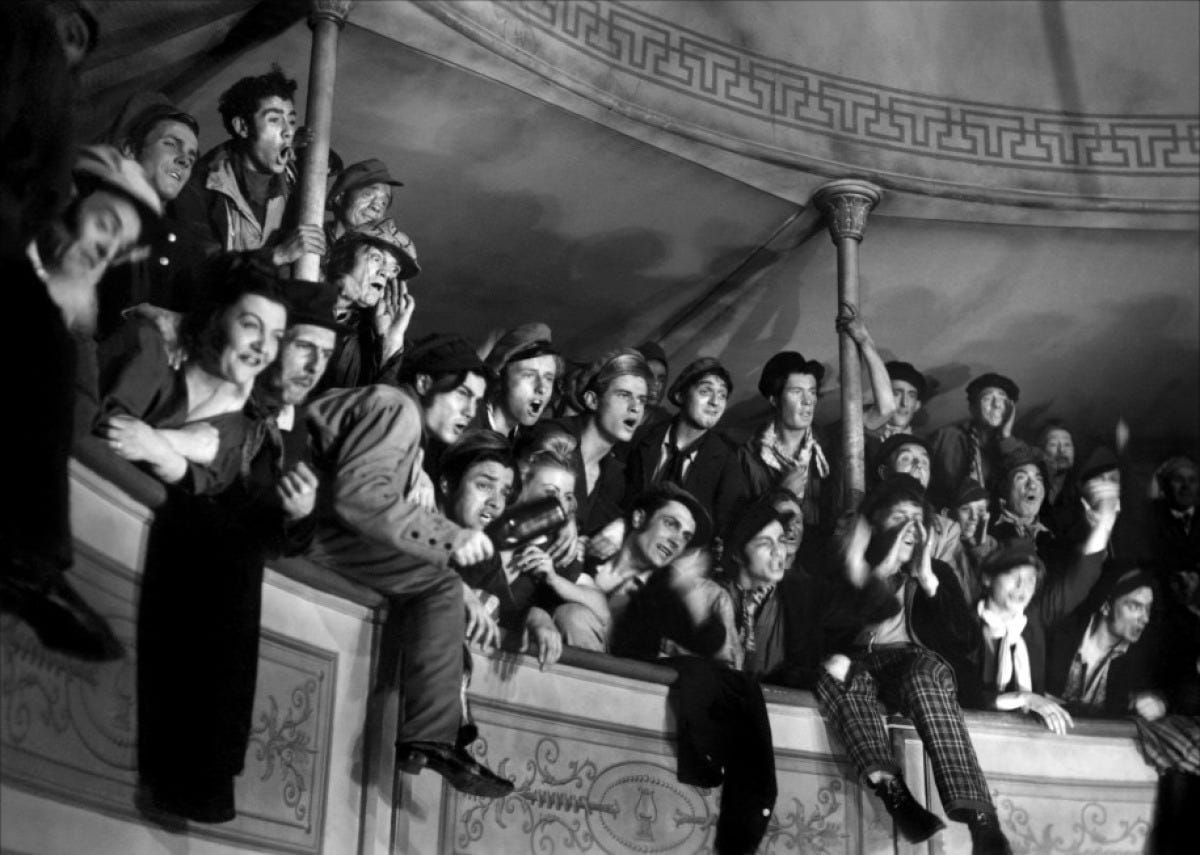
And, high above, in the most distant of the galleries — ‘the gods’ — ‘the children of the gods’: the penniless and the escapist and the would-be artists, those for whom the theatre itself is life.
In Carné’s plot, no one escapes their destiny, a formulation of the Greek tragedy of the mortals and the gods.
It’s a plot tailor-made to confront an entire country with its collaboration with the Germans, in a theatrical roman-à-clef…especially when the desirable woman has no conscience and, in the end, abandons the married artist for whom she was muse and lover.
Why I Think This Is A Classic 40s Movie
The overwhelming issue of the 1940s was the world war.
And no other film story takes as its core the wartime crisis of its home country in an utterly unique way: far more so than Casablanca or In Which We Serve, Les Enfants du Paradis teases apart the impossibility of lasting sexual love, the duplicity of those who angle for power, and the essence of high art — all at once, in an epic tragedy filmed under the noses of a police state. (And for the structuralists out there: there are very very few films which are constructed around a play (Othello) within a play (the love story) within a (screen)play. )
Carné’s trump card, at almost every turning point in his interlocking storylines, is crystal clear: ambiguity — and the moral ambiguity of Vichy France under Nazi rule is the ur-story, with a gay director’s lens focusing on the power of a woman to deceive, herself most of all.
But what drove Carné’s appetite for his story?
He was madly in love himself: with the world of vaudeville, of boulevard theatre, of the theatre that is Paris in the street, during a golden age of acrobats, sideshow eccentrics, geniuses of vaudeville, and the height — in the vacuum of Napoleon Bonaparte’s fall — of melodrama, no doubt in part because of the political minefield that was Paris under an illegitimate monarchy. And he clearly relished the dramatics of a culture in decline, for the French monarchy would vanish again in 1848, ‘the year of revolution’ all across Europe…just as the Vichy regime would vanish even as Carné completed his masterpiece.
That’s to my mind why this film has cast such a profound shadow over all other French films: Carné’s engineered a kind of ‘impossible dream’ that lives on two levels (duality again). The first is the tragicomedy of life in the half-world of theatre (a metaphor for France’s surrender and collaboration) and the second the poignant lesson that to know real love is to suffer, for an artist in love (Baptiste/Barrault), twice over.
Then there’s the story of the making of the film itself, a high-wire act that sounds utterly impossible today; the staggering Boulevard of Crime set alone, built in midst of wartime privations, is a miracle of design, costing millions of francs, plus coordinating shoots across two locations (Paris for the interiors and Nice for the boulevard exteriors)
But the personal stories — of hidden Jews (the composer and cinematographer!); project managers who were Resistance leaders one step ahead of the Gestapo; the vast crew surviving a freak Riviera hurricane which ripped the street sets apart; Carné’s own complicated love life; one of the five male leads, condemned by the Resistance for collaboration, simply vanishes mid-shoot — are almost unbelievable, even for cinema, whose ‘war stories’ are legion.
Arletty, the biggest star in France, partied her way through the war and was herself convicted of ‘horizontal collaboration’ with Nazi and Vichy officials, including one German with life-and-death power over imprisoned Resistance members. Her public shaming made headlines around the world.
Carné, accused of collaboration for a forced contract with the main Vichy film house, was politically suspect post-war and suffered accordingly; wiser observers saw lesser talents seeking revenge for Carné’s huge hit, for Les Enfants broke box office records, despite ticket prices twice normal.
Carné’s work went in and out of fashion until the early 1960s, when the likes of François Truffaut claimed Les Enfants was the one film he wished he had directed; despite this, out of favour with France’s cultural mandarins, Carné ended up eking out a living making small documentaries, often about the least of the least — the very people he captured in Les Enfants: the people of Paris to whom Baptiste, like Charlie Chaplinas the Tramp, gave a voice.
My Favorite Moment In The Movie
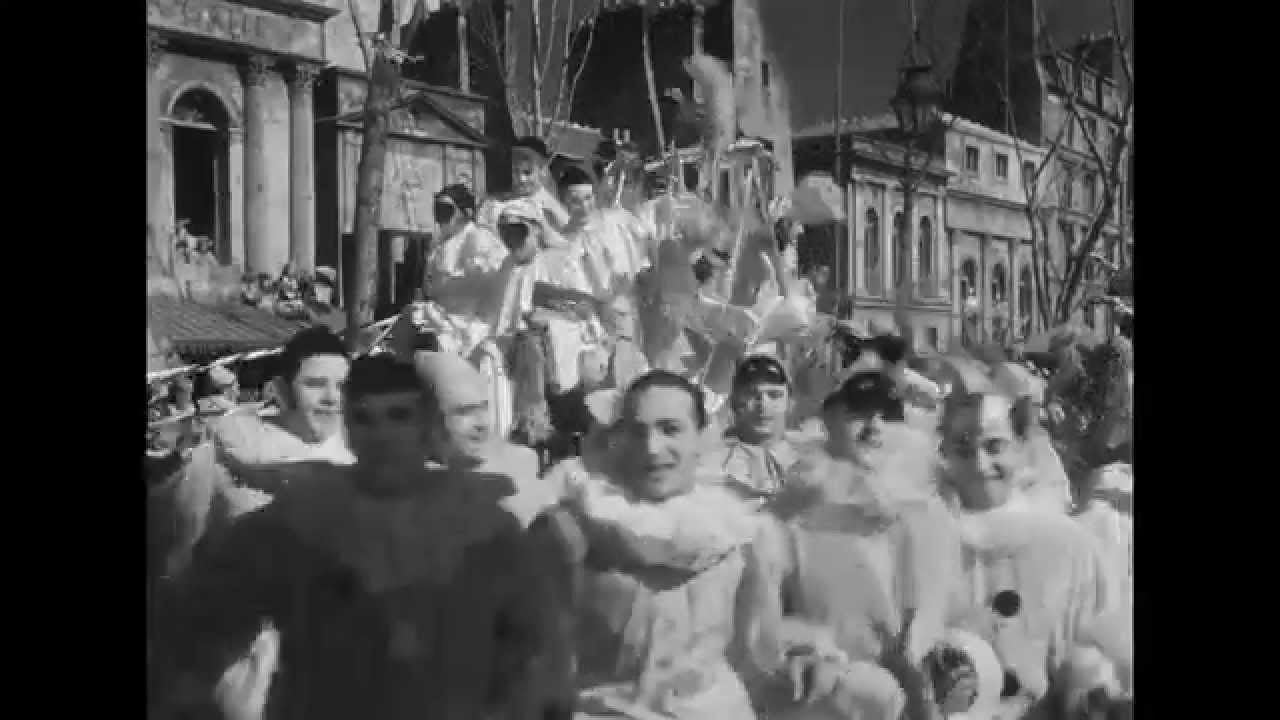
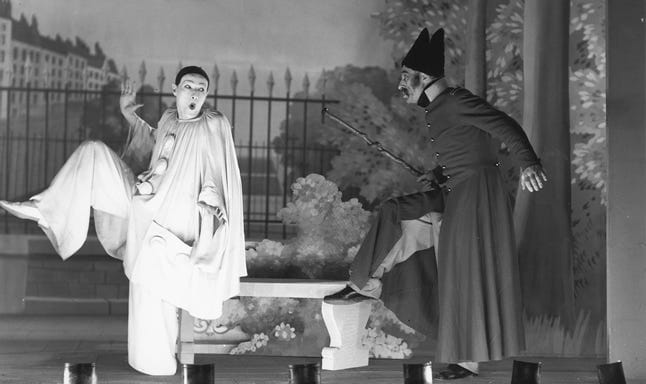
The denouement: in one of the most memorable crowd scenes ever filmed, Baptiste/Barrault vainly tries to reach the departing Garance/Arletty in a mob of white-faced streetpeople. As a visual metaphor for unrequited love — and as piece of pure theatre — the sequence, heartbreaking though it is, walks the line (perfectly, to my eye) of an artist-lover desperate to connect with his muse, framed against the sheer abandon of a Parisian ‘mardi gras’.
It’s Scarlett and Rhett and their final good-bye, stood on its head, set in Carné’s own take on the French genius for theatre, for life in the street — and the heartlessness of preoccupied onlookers, as time and place and the crowd drags the two ill-fated lovers apart.
It’s every good-bye on every street corner or airport or rail station: the world goes on as the lovers’ world falls apart — except the onlookers are all Pierrots. Typical of Carné, it’s heartbreaking and mysterious and joyous, all at once.
My Favorite Dialogue In the Movie
Carné’s thesis of the impossibility of love is embodied in an exchange perilously brief but, because it’s about power, hierarchy and control, not love itself, the two lines encompass the universe of the entire film.
Garance is dangerous because she doesn’t know what she wants — and because of her power over the dreams of men, she could have anything — or most anyone.
Here, the Comte (Salou) propositions her…and Garance reveals, for a heartbeat, who she really is: a lost soul, a victim of her own mystery.
THE COMTE: ‘A few words can change your life, madame’
GARANCE: ‘Is my life worth so little, then?’
When this truth is visited upon Baptiste at the film’s end, perfectly paced and superbly staged, the effect is devastating.
Key Things You Should Look For When Watching This Movie
If you don’t speak French, the subtitles for the Criterion edition are very good. That in mind, here are five thematic threads worth following across the two films
1/ The tension between the dreamed and the real, personified by Baptiste but lived by Garance, who cannot tell the difference
2/ The tension between the powerful and Les Enfants,for whom Baptiste is the voice, both onstage and off
3/ There are five performances onstage throughout the twin films — each cracks open when ‘real life’ intrudes, culminating in Baptiste’s flight from the stage when he hears Garance has returned to Paris
4/ The stage performances are full-frame; the love scenes, the peaks of audience involvement in the overlapping stories, are all filmed obliquely or off-camera.
5/ The crowd itself is a character — and sometimes, as when Garance or Baptiste are in the stalls or during the madness of Mardi Gras, the film turns inside out — and we can’t tell performer from audience.
Thanks, Brendan! To show our gratitude for your guest post, here’s a dash of creative juju for you. Whoosh!
We already have a set of classic 50s movies, 60s Movies, 70s movies, 80s Movies and 90s Movies. Now we add classic 40s movies.
Thanks to all of you for your participation in this project, creating a resource for writers, movies we should all watch to help learn the craft of screenwriting!