Classic 50s Movie: “12 Angry Men”
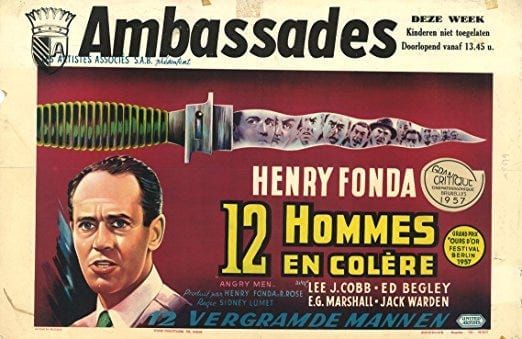
May is Classic 50s Movie month. Today’s guest post comes from Ipsita Barik.
Movie Title: 12 Angry Men
Year: 1957
Writer: Reginald Rose
Lead Actors: Henry Fonda, Lee J Cobb, E.G.Marshall
Director: Sidney Lumet
IMDb Plot Summary: A dissenting juror in a murder trial slowly manages to convince the others that the case is not as obviously clear as it seemed in court.
Why I Think This is a Classic 50s Movie: 12 Angry Men isn’t about anger. Rather the core underlining emotion through the film is that of attempting and struggling with the emotion of empathy and being compassionate towards a stranger. The idea of trying to empathise with someone charged with criminality, to “dig deeper” (Juror 11). In the “hottest day of the year” 12 Jurors debate a verdict that leaves then twisted and twirled as the conversation proceeds. “They smoke, they sweat, they swear, they sprawl, they stalk, and they get angry.” (Roger Ebert)
When Juror 8, the dissident, casts the first non-guilty vote, everyone in the room is stunned. With questions arising as to how to proceed thereon, Juror 8 offered,“I guess we talk!” At that moment, you can never imagine the crescendo into which the “talk” develops into. I love the way the movie explores the dark corners in our minds, underlined with prejudices and judgements about the “other”. The landscape is not complex, and yet in the simplicity of the conversations we find the most intricate of human emotions emerge. The conversation turns into heated arguments, wild rants, bullying, mocking and abusing, intertwined with placid moments of watching the rain pour down. 12 Angry Men could easily be a living room conversation between friends and in that lays the familiarity of the setting. In that is also embedded the idea that amongst a few men, a conversation can often lead to significant and valuable change. The jurors step into the room with the absolute conviction of the accused being guilty and yet when they exit the room, leaving behind the remnants — the doodles, the cigarettes stubs, strewn newspapers; of their long winded and heated conversations, they carry a strong conviction of the case involving a “reasonable doubt”.
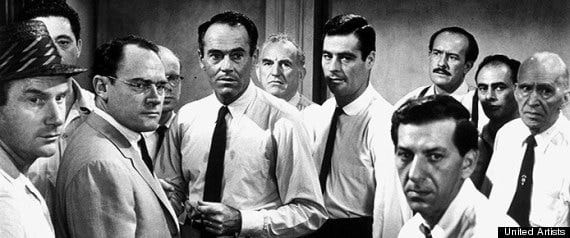
It’s amidst the conversations that the layered sense of human prejudices and biases emerge. In it also lay the sense of human strength and courage. Juror 8 is the dissenter not because he has hard facts to counter the alleged guilt of the accused, but he does have the courage to stand up to the 11 jurors all by himself, because his strength is born from empathy. The multiple questions raised through the length of the conversations are real and sharp. Is justice devoid of emotions? When Juror 8 argues, “he is a wild, angry kid..we owe him a few words”, Juror 10 counters, “do you know how much that trial costs? Let me tell you something, we owe him nothing” — the question that probes is whether justice is devoid of emotions? Or in the instance when Juror 4, states, “we know he comes from a broken family and filthy slum — but we can’t do anything about it,” one wonders whether hard facts overpower even a remote sense of inquisitiveness or dissent, both essential to human intelligence and society. When Juror 3 mocks, “Some underprivileged kid, who couldn’t help becoming a murderer,” as the second not-guilty vote is cast, you are led into thinking whether such scorn and abhorrence isn’t commonplace. The layers of doubt that emerge at every instance of detour, such as when Juror 6 says to Juror 8, “suppose you talk us out of it, and the kid really knifed his father!” Juror 11 is the second to begin thinking differently about the case and when accused of jumping ships, he asserts, “I don’t think I have to be loyal to one side or the other, am just asking questions,” which asserts that to think differently, you just need a slight nudge, The movie is a beautiful and intricate study of human emotions and the essential human characteristics that are both fallible and strong.
My Favorite Moment in the Movie: The underlying drama essentially lays in the rounds of vote calls and when the not guilty votes begin to swing its way up the ladder. From 11–1 vote in the beginning to the slow counts when the not-guilty votes rise alongside the temper and the heat, the movie is a classic drama and thriller.
Two occasions, are absolutely thrill driven in the movie. One when it is proven by the Jurors, that the empty L train passed by the apartment building when the murder happened, and hence, questioning whether in all that din and noise, it would have been possible for the old man (a witness) to hear the accused shout “I will kill you” alongside the thump of the body hitting the floor. The second is when the its is displayed convincingly by Juror 8 that the old man couldn’t have reached the front door of his apartment to see the accused run down the stairs in 15 seconds. It turned out that dragging a leg and walking slowly, it took Juror 8 almost 43 seconds, to reach the imaginary front gate.
My Favorite Dialogue in the Movie:
Juror 8: “I want to call for another vote; I want you 11 men to vote by secret written ballot, I will abstain. If there are 11 votes for guilty, I won’t stand alone, and will take in a guilty verdict to the judge right now. If anyone votes not guilty, we stay here and talk it out.”
Key Thing You Should Look for When Watching This Movie: The highlight of the movie is that it is shot almost uniformly in a single space, that of inside a jury room. One jury room, 12 jury members, the stifling heat and the process of trying to reach a uniform verdict. What is fascinating about the movie is that the anger seamlessly navigates through the movie and yet it doesn’t seem either contrived or misplaced. Its palpable, it’s real and somehow you feel the anger is indispensable.
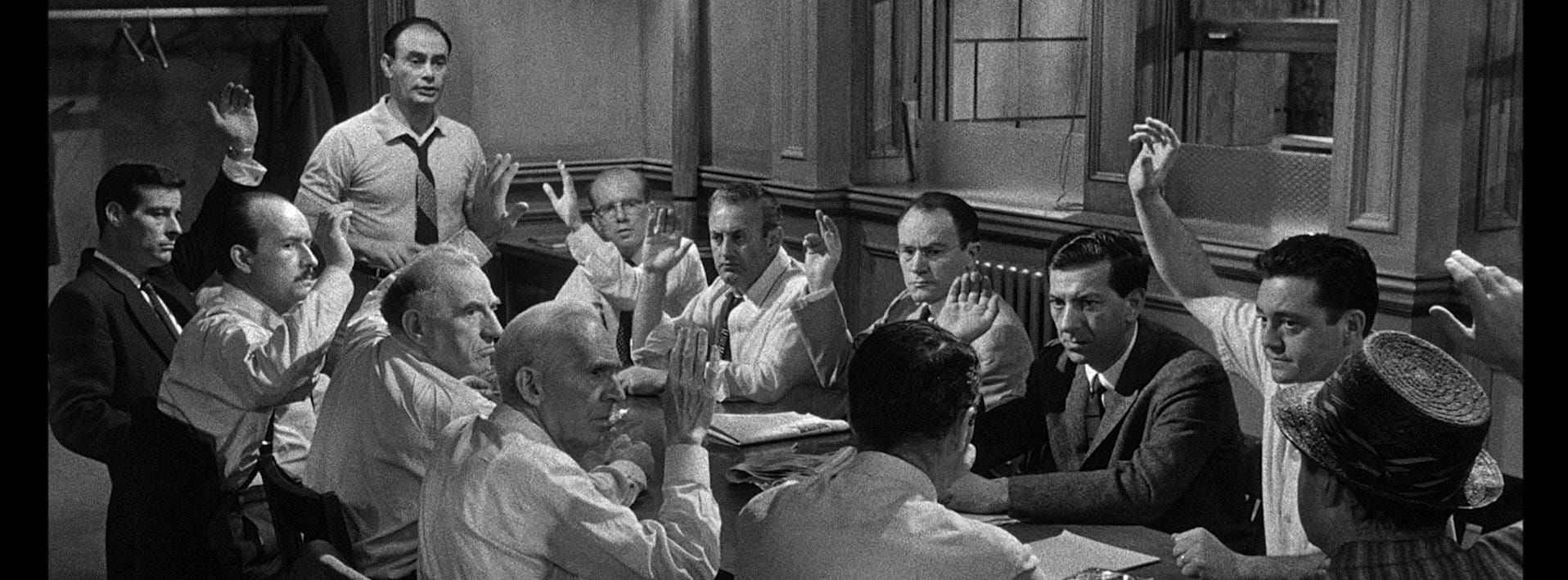
12 Angry Men is a case of personality study. The jury members aren’t identified by their names almost through the span of the film, and yet you don’t feel that the very key identification in human relations is missing! You naturally begin to identify with the array of disparate characters. Juror 1 is the assured moderator who gets angry at being called a controlling freak while juror 2 is nervous little man, who throughout the movie refuses to be cowed down. I think the movie beautifully weaves in the various characters, highlighting their distinctive traits. Juror 3 screams Bloody Mary at every instance, when the vote strays towards the “not-guilty” verdict. Juror 4 is the practical no nonsense man, whose focus refuses to stray from the facts. Juror 5 is the man who relates to the background of the accused and his empathy builds up in the process. Juror 6 keeps to his business and is courteous towards everyone, especially the elderly. Juror 7 is the flamboyant, off the hook guy, whose focus for a substantial part of the movie remains on the baseball tickets in his pocket. Juror 8 is the dissenter, not afraid to say and do different, even when bullied; he refuses to buckle under the pressure. Juror 9 is the old man, preacher, who is the first one to lend a sympathetic ear to the dissident Juror 8. Juror 10 is the bigot and the loudmouth and Juror 11 is the Irish immigrant who understands the position from the ‘margins’ very clearly. Juror 12 is the advertising guy, who doodles, sways and intermittently comes up with bright ideas. And yet brilliantly with the swinging lens shots, the characters struggle between detachment and apathy on one hand, and that niggling sense of “reasonable doubt” that arises as the story forwards.
“In form, 12 Angry Men is a courtroom drama. In purpose, it’s a crash course in those passages of the Constitution that promise defendants a fair trial and the presumption of innocence” — Roger Ebert.
Released in 1957, when Technicolor and lush production values were common, “12 Angry Men” was lean and mean. (Roger Ebert)
Lumet uses the “Lens Plot” in the movie. The room visually shrinks as the story progress, “he gradually changed to lenses of longer focal lengths, so that the backgrounds seemed to close in on the characters.” Lumet adds, “, “I shot the first third of the movie above eye level, shot the second third at eye level and the last third from below eye level. In that way, toward the end the ceiling began to appear. Not only were the walls closing in, the ceiling was as well. The sense of increasing claustrophobia did a lot to raise the tension of the last part of the movie.” In the film’s last shot, he observes, he used a wide-angle lens “to let us finally breathe.”
Thanks, Ipsita! To show our gratitude for your guest post, here’s a dash of creative juju for you. Whoosh!
We already have a set of classic 60s Movies, 70s movies, 80s Movies and 90s Movies. This month, we’re working on 50s movies. And thanks to the GITS community, we’ve got 31 movies in the works!
Those who I put in bold have already sent me their posts. If you haven’t sent yours to me, please do so as soon as you can!!!
12 Angry Men — Ipsita Barik
A Place in the Sun — Zach Jansen
A Star is Born — Melinda Mahaffey
A Touch of Evil — David Joyner
All About Eve — Ricardo Bravo
American in Paris — stefani1601
Bridge on the River Kwai — Tom Peterson
Cat on a Hot Tin Roof — uncgym44
Commando Cody: Sky Marshall of the Universe — J Nilsson-Acosta
File on Thelma Jordon, The — David Joyner
Harvey — Felicity Flesher
High Noon — Jeff Messerman
Invasion of the Body Snatchers — Rick Dyke
Kiss Me Deadly — John Henderson
Marty — jetwillie69
Night of the Demon — David Hutchison
Night of the Hunter — Mark Twain
On the Beach — Liz Warner
On the Waterfront — Bilbo Poynter
Pickpocket — Zach Jansen
Pick Up on South Street — Vincent Martini
Quiet Man, The — Traci Nell Peterson
Rear Window — Roy Gordon
Rebel Without a Cause — Jack McDonald
Searchers, The — mkm28
Seven Samurai, The — Paul Graunke
Seventh, Seal, The — Megaen Kelly
Singin’ in the Rain — Megaen Kelly
Some Like It Hot — Will King
Stalag 17 — James Schramm
Sunset Blvd. — Lisa Byrd
Tokyo Story — Jeff Messerman
Vertigo — Jason Pates
Thanks to everyone!
For the original post explaining the series, go here.
For all of the 50s movies featured in the series, go here.